Tide-Aware Anchor Watch for Superyacht Operations
Quick Summary
- ✓Consumer and chartplotter anchor alarms — Aqua Map, Navionics, Garmin, Raymarine, B&G, Furuno, Simrad — share a structural flaw: the geofence is a fixed circle that does not adjust as tide changes the swing-radius geometry.
- ✓Captains compensate by oversizing the radius (defeats drag detection) or accepting nuisance alarms (degrades alarm credibility, wakes guests, exhausts the watch stander).
- ✓The only commercial precedent for tide-aware monitoring is Maretron N2KView — correct design, but requires NMEA 2000 hardware integration most fleets will not retrofit for one feature.
- ✓YachtWyse runs the same Pythagorean geometry as a software layer on top of existing GPS and tide data — no new hardware, deployed identically across every vessel on the platform, with full session audit trail.
- ✓Requires a GPS or lat/lon feed to the YachtWyse helm. On professionally operated yachts this is rarely a constraint; without any feed, the system surfaces 'GPS required — connect a feed' rather than silently failing.
A Surface the Industry Has Tolerated
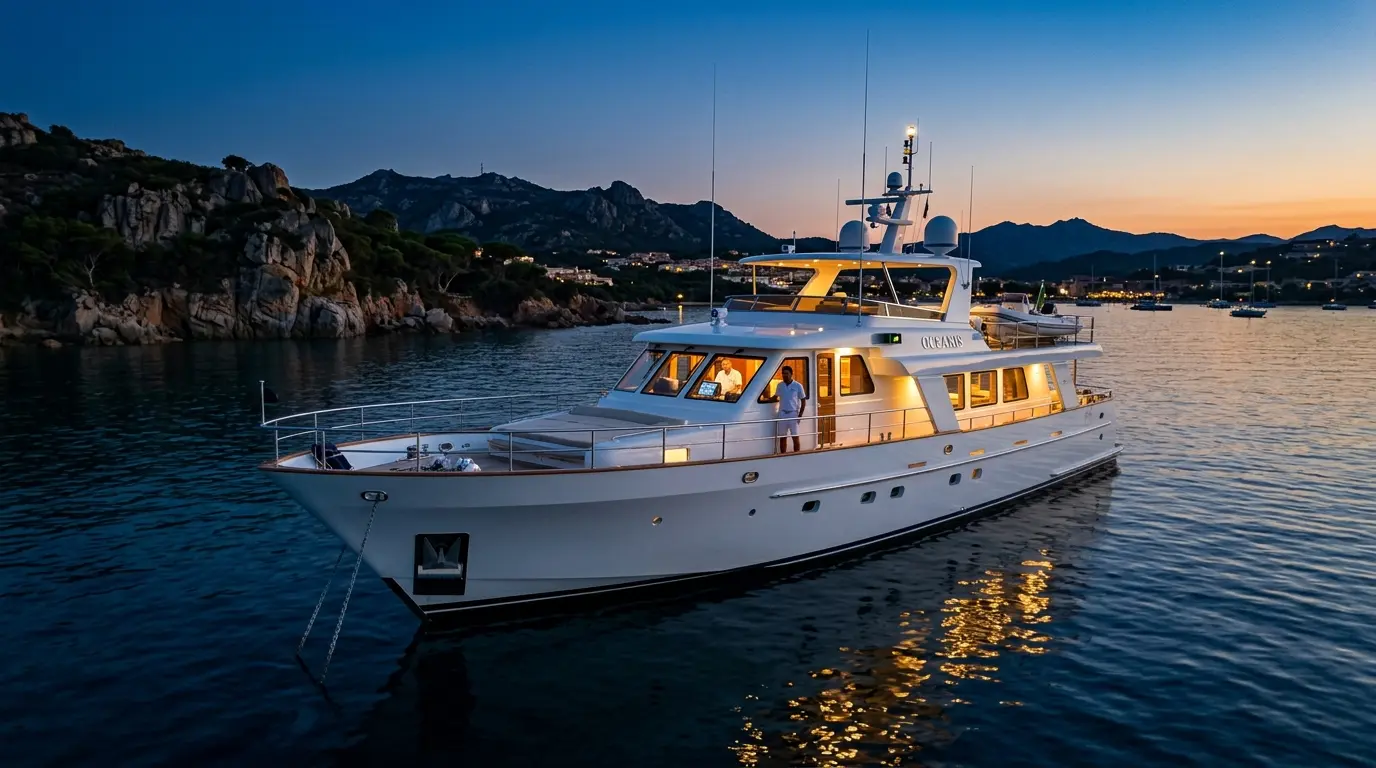
Off Porto Cervo at 02:30, a 48-metre motor yacht is at anchor in 22 metres of water with 110 metres of chain deployed. The owner and four guests are asleep in the on-deck master and VIP suites. The captain is in the wheelhouse, having relieved the chief officer twenty minutes ago. The chartplotter alarm has fired three times since midnight. Each event resolved the same way — the position trail shows a clean arc around the anchor, no drag, just the boat swinging through a slightly wider radius than it was earlier. Each time, the captain has widened the alarm circle by a couple of metres and reset.
By 04:00 the geofence is large enough that the boat would have to move most of the length of a tennis court before the next alarm fires. The captain knows this. He also knows the owner's standing instruction is to never call up to the master suite at night unless the vessel is on the rocks. He makes a quiet judgement: trust the snubber, watch the AIS for nearby movement, and accept that the alarm has become decorative until sunrise.
This scenario, in some form, is universal across the professional fleet. Every captain reading this has had a version of that night. The decision tree is the same: nuisance alerts that wake guests are the operational nightmare, and the workaround is to widen the radius until the alarm stops crying wolf. At which point the alarm has been converted from a real-time control into a documentation artifact.
It is worth saying plainly. The anchor watch as currently practiced on most professionally crewed yachts is not delivering what the title suggests. It is delivering a fixed-radius geofence around a drop point, configured at the moment of setting, with no mechanism to adapt as the underlying geometry changes through the tide. The math has been understood for centuries. The instrumentation has not caught up.
The Geometry, Briefly
Every captain reading this knows the relationship. The rode, the depth, and the swing radius form a right triangle. The rode is the hypotenuse, the depth from bow roller to anchor is the vertical leg, and the horizontal swing radius is the other leg:
R = √(L² − D²)
Where L is rode deployed (from bow roller to anchor), D is the vertical depth from bow roller to seabed, and R is the horizontal swing radius around the anchor.
When the tide falls, D decreases. With L held constant — because the rode is not adjusted through the night — R increases. The vessel naturally swings through a wider horizontal arc around an anchor that has not moved a centimetre.
The magnitude is not theoretical. In a 1.5 metre tide off the Côte d'Azur with 100 metres of chain in 25 metres of water, the swing radius grows by several metres between high and low water. In larger tides — Mediterranean spring tides, Caribbean shoulder-season fluctuations, the larger ranges encountered in the Channel Islands or the Bahamas Bank — the variation is correspondingly larger. None of this is news to the bridge team. What is rarely articulated is that the entire fleet of consumer and chartplotter anchor alarms — Aqua Map, Navionics, Garmin, Raymarine, B&G, Furuno, Simrad, and every successor — applies a fixed circle to a geometry that is not fixed.
This is the hidden door. The math is openly available. The chartplotter implementation quietly ignores it.
What Captains Actually Do About It
Four workarounds dominate the professional bridge. None of them is satisfactory and every captain reading this will recognize the pattern.
Maretron N2KView
The only commercial-grade marine system that has correctly addressed this geometry in production. N2KView's anchoring module corrects the GPS-offset problem (the alarm reference is the bow chock, not the GPS antenna), monitors the anchor through setting and weighing, and adjusts watch parameters dynamically through the tide cycle. The design is sound. The constraint is the deployment surface. N2KView requires a Maretron-compatible NMEA 2000 backbone, a dedicated black-box PC or client tablet, and a per-vessel integration scope.
For a new-build at a yard like Feadship, Lurssen, or Benetti where the bridge electronics package is specified upfront, N2KView is a defensible inclusion. For an existing yacht with a Furuno-dominant bridge, a Simrad helm, or a heterogeneous integrator history across several refits, the retrofit cost for a single anchor-watch capability is rarely funded. This is the principal reason a technically correct solution has existed for years without becoming a fleet standard.
Crew on visual watch
The maritime answer of last resort. A deck officer or qualified watch stander posted on the bridge or on deck with binoculars, transit bearings, and the radar. Effective. Expensive in crew hours, and on a vessel running an MLC-compliant rotation it cannibalizes rest hours that have downstream consequences for the following day's operation. On a yacht with guests aboard for a charter week, the chief officer who spent the night on anchor watch is the same chief officer expected to be present, alert, and gracious at breakfast service.
Oversized geofence radius
The most common configuration in practice. Set the alarm wide enough to absorb the worst-case tidal swing plus a comfortable margin. The alarm no longer cries wolf. It also no longer detects a genuine drag of moderate magnitude until the vessel is well beyond where any reasonable captain would have wanted notification. In a crowded Mediterranean anchorage during August, with vessels separated by two boat lengths and tenders running between yachts, the difference between a 30 metre drift and a 60 metre drift is the difference between recovering the situation and explaining it to a broker.
Dismissing nuisance alerts
The shrug response. Alarm fires, position trail looks clean, dismiss, return to the magazine. Each dismissal is a small erosion of the captain's instinct to take the next alarm seriously. The 11th alarm of the night, fired three minutes after a genuine drag, gets the same reflex dismissal as the 10th. This is the failure mode every senior captain has seen referenced in another captain's incident report and quietly resolved to never produce themselves.
What YachtWyse Does Differently
YachtWyse runs the same Pythagorean geometry described above as a continuous calculation against a live tide reference. The implementation is deliberately undramatic.
When the captain sets the anchor, the helm captures the GPS fix as the reference point, accepts the rode deployed and water depth at set, and identifies the nearest tide station — NOAA for US waters, WorldTides and harmonic constituent libraries for international anchorages. The system computes the expected swing radius across the next 24 hours of tidal change and writes the parameters to the session log.
While the watch is running, the geofence is not a static circle drawn at set time. It is a tide-adjusted envelope that expands and contracts silently in the background as the predicted depth changes. The recalculation runs roughly every five minutes. The captain on the bridge sees a single intuitive alarm circle on screen; the underlying envelope adjustment is invisible. The alarm fires only when the GPS position breaches the tide-corrected envelope — that is, when the anchor has actually moved.
A second design choice matters for professional operations. Every parameter, every recalculation, and every alarm event is written to the session log with timestamp and watch officer attribution. The session continues to log through the entire anchor cycle until the anchor is weighed. The record is contemporaneous and exportable.
What This Needs to Work
Professional candor on the dependencies, because the value of the capability is exactly zero without them.
The tide-aware anchor watch requires a continuous GPS or lat/lon feed reaching the YachtWyse helm in order to detect drift. Without a position fix, the system has no reference against which to evaluate the geofence. There is no workaround for this — drift detection is geometric.
On most professionally operated yachts, the feed is already there several times over. Common integration paths include:
- NMEA 2000 bridge: where the vessel's primary GPS, AIS, and depth instruments live on a 2000 network, YachtWyse ingests the position fix via a supported NMEA 2000 bridge.
- Victron VRM: where Victron monitoring is fitted (common on 40m+ vessels with significant battery and inverter infrastructure), the position telemetry surfaces through the VRM cloud integration.
- Paired bridge device: a dedicated tablet or single-board computer paired with the bridge as a YachtWyse helm endpoint, drawing position from the vessel's primary GPS.
- Onboard mobile device: the YachtWyse mobile application running on a wired tablet at the helm or on a phone held in the wheelhouse, using the device's own GPS receiver. Less accurate than an integrated bridge feed; entirely adequate for vessels without a wired feed available.
Where no GPS feed of any kind is reaching the helm, the anchor watch UI explicitly displays a "GPS required — connect a feed" state. The system does not silently run with degraded inputs and pretend to be monitoring an anchor it cannot see. This is the only honest UX for a safety-related feature, and it is how the screen presents itself the moment a feed becomes unavailable mid-session.
On a 30m+ vessel with an integrated NMEA 2000 bridge — that is, on essentially every professionally operated yacht in commission — the feed dependency is not a constraint. It is a configuration step on first deployment.
Why This Matters for Professional Operations
The case for tide-aware anchor monitoring on a single owner-operated boat is about sleep. The case on a professionally operated yacht is structural.
Owner and guest comfort
A genuine drag alarm at 03:00 is a necessary and welcome interruption. A nuisance alert at 03:00 because the tide fell is an erosion of trust in the bridge. Where the owner's suite is on the same deck as the wheelhouse — true on most contemporary motor yacht layouts — repeated false alerts produce a measurable degradation of the on-board experience for the people the operation exists to serve. A captain who can configure a tight, accurate alarm circle without producing nuisance alerts is delivering an operational capability the owner notices without ever discussing.
Watch stander efficiency
Anchor watch is one of the most fatiguing standing duties on a yacht because it is fundamentally a vigilance task. A watch officer who can trust the system to fire only on a true drag is freed to perform the rest of the watch responsibilities — logbook entry, weather monitoring, AIS scan, security round — without the cognitive overhead of disambiguating every alert. This is not a capability marketed in features lists. It is the kind of operational quality-of-life that determines whether an experienced chief officer renews their season or moves to another programme.
Standardization across rotations
On a yacht running a relief rotation — common across charter operations, multi-family office programmes, and any yacht where the captain works a 2:2 or 3:3 schedule — the anchor watch needs to be set the same way on Tuesday by the relief captain as it was on Monday by the principal. Variability in alarm configuration is variability in vessel safety practice. A platform that ships the same UI, the same defaults, and the same session log structure across every captain who holds the watch removes the alarm dimension of that variability. The hand-over briefing references the same data the off-going captain was working from.
Audit trail for management company and underwriter
The session log is the contemporaneous record. For a yacht managed by a management company answering to an ownership structure that requires periodic operational reporting, the anchor-session record provides a queryable history of where the vessel anchored, for how long, in what conditions, and with what alarm events. For a yacht insured under a policy that asks for documented anchor-watch procedures at renewal, the session log is the evidence the procedures were followed in practice rather than written and shelved. For a yacht subject to ISM SMS oversight, the session log feeds directly into the hazardous-occurrence investigation workflow when one is triggered.
Integration Posture
YachtWyse is designed to integrate with the vessel's existing bridge electronics rather than replace them. Supported integrations include NMEA 2000 position and depth feeds via a supported bridge, Victron VRM cloud telemetry for vessels with Victron monitoring infrastructure, AIS-derived position where it is the primary feed available, and paired bridge devices for vessels with mixed-vintage electronics. NMEA 2000 depth integration is on the roadmap for vessels that want the alarm to use measured depth at the bow rather than the predicted tide curve — the present implementation uses predicted tide as a defensible default that holds well in most professional cruising grounds.
The integration scope is closer to a configuration session than a refit. There is no requirement for new onboard hardware, no NMEA 2000 backbone to install, and no captain retraining specific to the anchor watch — the UI inherits the conventions of the rest of the YachtWyse helm, which captains and chief officers already use for logbook, maintenance, and crew certification tracking.
Closing
Tide-aware anchor monitoring is not the kind of capability that headlines a yacht software demo. It is small, technical, and almost invisible on the bridge once it is working as designed. The case for treating it seriously is not that it transforms the vessel's safety posture. The case is that the failure mode is measurable, the geometry has been understood for centuries, the commercial precedent (Maretron N2KView) confirms the design, and the deployment scope as a software layer on existing GPS infrastructure is undemanding enough that there is no defensible reason to defer it on a professionally operated yacht.
For captains and chief officers, the practical change is the alarm becomes a control rather than a decoration. For management companies, the change is a fleet-wide session log that supports audit, SMS investigation, and underwriter conversations. For owners, the change is one fewer category of nuisance alert that reaches the guest cabins at three in the morning.
The capability is part of the YachtWyse helm platform. For management companies, captains, and ownership representatives interested in evaluating deployment across a programme, the enterprise team handles fleet onboarding, integration scoping, and the standard set of vendor diligence requests.
Related Articles
- Enterprise Anchor Monitoring: Tide-Aware Risk Control — the procurement, insurance, and risk-control framing for commercial yacht operators
- Fleet-Wide Tide-Aware Anchor Watch for 2026 — shore-side fleet operations view, DPA workflow, multi-vessel dashboards
- Best Planned Maintenance Systems for Superyachts 2026 — the broader bridge platform context
- Flag State Survey Prep: Digital PMS Cuts Deficiencies — how documentation discipline changes audit outcomes
- Enterprise Yacht Operations Platform — YachtWyse for fleet and management company deployment
- Fleet Operations — multi-vessel platform overview
Sources
- Maretron N2KView product page (Raymarine)
- Anchoring with N2KView (PDF)
- NOAA Tides & Currents Web Services
- WorldTides API Documentation
- IMO ISM Code — International Safety Management Code
- Divergent Yachting — A Guide to the ISM Code for Yachts
- Yacht Management South Florida — Navigating ISM, ISPS, and MLC Yacht Regulations
- The Shipowners' Club — Yacht Liability Insurance Policy 2026
- Victron VRM Portal Documentation
- NMEA 2000 Standard Overview
- MLC 2006 — Maritime Labour Convention

Written by
YachtWyse Team
Maritime Technology Experts
The YachtWyse team brings decades of combined experience in maritime operations, marine engineering, and software development. We write from real-world experience managing vessels from 30ft cruisers to 100m+ superyachts.
Ready to Simplify Your Yacht Management?
YachtWyse helps owner-operators track maintenance, manage costs, and get AI-powered diagnostic assistance. Start your free trial today.
Request a DemoRelated Articles
Fleet-Wide Tide-Aware Anchor Watch for 2026
Fleet anchor watch finally goes shore-side. Tide-adjusted swing radius, fleet dashboards, captain-rotation handover, and audit-grade logs for multi-vessel ops.
Charter Yacht Anchor Alarm: Tide-Aware Watch for Guests
Tide-aware anchor watch for charter operations — silent guest cabins, audit-grade logs, fleet-wide protocols, plus the GPS dependency captains must plan for.
Tide-Aware Anchor Alarm: The Feature Loopers Need
Your anchor alarm goes off at 3 a.m. The boat hasn't moved — it's the tide. Here's why every app gets this wrong and how tide-aware alarms work.