Fleet-Wide Tide-Aware Anchor Watch for 2026
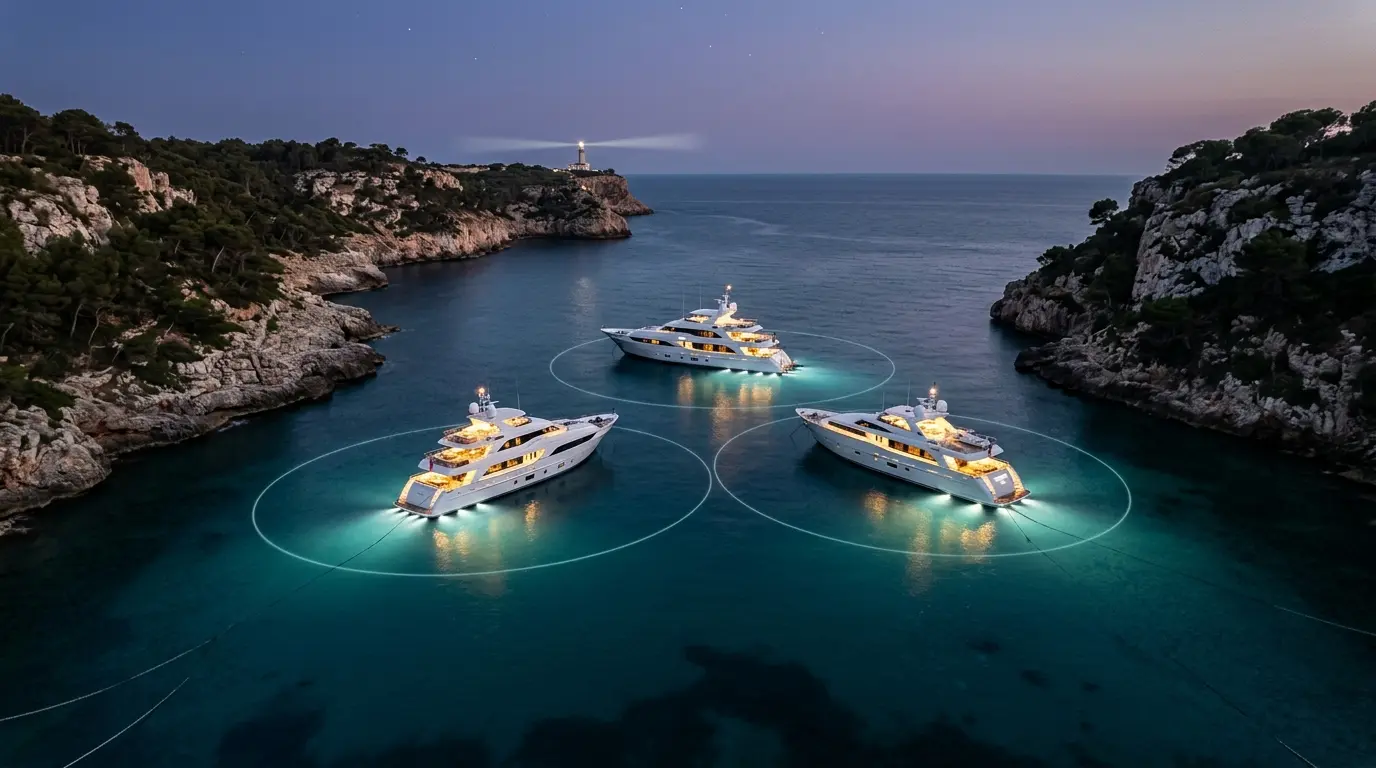
The 04:47 Phone Call Every Fleet Manager Knows
It is 04:47 in Palma de Mallorca, and the operations director of a mid-sized yacht management company is being woken by a phone call from a captain on a 38-metre motor yacht anchored off Cala Portals Vells. The captain is calm but tense. The boat has moved. He is not sure how far. The anchor alarm on the helm chartplotter went off twice earlier in the night and was widened both times after the position trail looked like a clean swing arc. The third event, ten minutes ago, did not look clean. The bow is now pointing somewhere the captain did not expect it to point.
The director pulls up the company's fleet dashboard on a phone, half-dressed, half-awake. There is a position fix from the vessel's AIS receiver from twenty-three minutes ago. There is no live anchor-watch telemetry. There is no swing-radius circle to compare the current position against. There is no record of what scope was set, what the predicted tide was, or what radius the captain had configured the alarm to. The dashboard knows the boat exists. It does not know whether the boat is dragging.
The director tells the captain to start the engines, recover the hook, and reposition. By the time the boat is back on a fresh set, dawn is breaking, the guests are asking what is happening, and the broker is composing a polite email to the owner. The vessel did not go on the rocks. Nothing was damaged. Nothing has to be claimed. But it was, by any honest reckoning, a near miss — and the fleet's safety management system has no usable record of what happened, why it happened, or whether it might happen again tonight on a sister vessel two hundred miles away in Porto Cervo.
This is the state of fleet anchor watch in 2026 on most managed yachts: every captain runs their own system, every system reports to nobody, and the shore-based fleet operations function finds out about anchor events when somebody picks up a phone.
Why Anchor Watch Is a Fleet-Level Problem, Not a Captain-Level Problem
Most discussions of anchor monitoring treat it as a single-vessel concern. A captain wants a reliable alarm, the manufacturer ships one, the captain configures it, end of story. For an owner-operator on a single hull, that framing is correct. For a fleet operator managing eight, twenty, or sixty vessels across multiple cruising grounds, it is dangerously incomplete.
Three structural realities make anchor watch a fleet-level concern.
The insurance perimeter is shared. Hull and Machinery and Protection and Indemnity policies on managed yachts are increasingly underwritten at the fleet level or with cross-vessel claims history scrutiny. A single significant anchor-drag claim — grounding, collision at anchor, or third-party property damage — drives premium renegotiation across every vessel the management company touches. Underwriters at Lloyd's syndicates and continental marine insurers now routinely ask for documented anchor-watch procedures and evidence those procedures are actually followed, not just written. A fleet that cannot produce that documentation prices its risk higher than a fleet that can.
The Designated Person Ashore is accountable. Under Section 4 of the ISM Code, every commercial vessel over 500GT — which captures most charter superyachts and a large share of privately-operated yachts of consequence — must have a Designated Person Ashore responsible for monitoring the safety and pollution-prevention aspects of each vessel's operation. The DPA does not get to delegate that responsibility back to the captain. When anchor watch lives only on the bridge and never reaches shore, the DPA is exposed during any post-incident review by the flag state or by the company's own auditors.
Operational continuity depends on it. A single dragging incident takes the affected vessel out of charter availability for the inspection, survey, and any required repair window. On a fleet of twenty managed yachts where utilization is the operational headline metric, that is a measurable revenue hit that propagates through the booking calendar.
The Current State of Fleet Anchor Watch
A frank look at how anchor monitoring is actually conducted across managed fleets today, drawn from conversations with operations directors at management companies in Fort Lauderdale, Palma, Antibes, and Viareggio, reveals a remarkably consistent picture.
Each captain runs the anchor-watch tool they personally trust. On smaller vessels in the fleet, this is most often a consumer app — Navionics, Aqua Map, Anchor Alarm, Savvy Navvy, or one of a dozen others — running on the captain's personal iPad. On larger vessels equipped with comprehensive monitoring, it is Maretron's N2KView running on the bridge PC, or in the most progressive cases, a hardware system like Swiss Ocean Tech's AnchorGuardian, which monitors the anchor module itself using sensor fusion and carries Lloyd's individual certification per unit.
What none of these tools have in common, in their default deployment, is shore-side visibility. The alarm fires on the bridge. The captain responds on the bridge. The event ends on the bridge. The management company learns about the event when a captain chooses to call, when an incident report is filed days later, or when an underwriter asks a question in the renewal cycle six months on.
Standardization across the fleet is essentially zero. A captain joining a vessel for the first time on a rotation rarely inherits the previous captain's anchor-watch defaults, anchorage notes, or alarm-event history. Each rotation starts approximately from scratch. Captain Whitfield's careful holding-ground notes for the south coast of Sardinia, accumulated over four seasons on the same vessel, are in Captain Whitfield's personal notebook — and they leave with him when his contract ends.
This is the gap fleet operators are quietly aware of and have not had a clean way to close.
The Tide-Induced False Alarm Problem
Before discussing the fleet layer, the underlying technical problem is worth stating precisely, because it is the reason most consumer anchor-watch tools are unreliable enough that captains learn to mute or widen them — and once muted or widened, they no longer protect against real drags.
When an anchor is set in depth D with rode length L, the horizontal swing radius R the boat can occupy around the anchor is given by:
R = sqrt(L² - D²)
This is straightforward trigonometry. The rode forms the hypotenuse of a right triangle whose vertical leg is depth and whose horizontal leg is swing radius. Plug in a typical Mediterranean overnight at 12 metres depth with 60 metres of chain at 5:1 scope and R works out to roughly 58.8 metres. The captain sets the alarm circle at, say, 75 metres to absorb wind and current swing.
Now the tide drops. In Palma the average range is modest, perhaps half a metre, and the effect is small. In Saint-Malo, where springs run over 13 metres, the effect is enormous. In Bahamian and Caribbean anchorages used by charter fleets, ranges of a metre or more are routine. As depth falls, R grows. With a 4-metre tide drop at 12 metres initial depth, R climbs from 58.8 to roughly 59.9 metres — small in absolute terms, but compound that with wind shifts and current rotation and the boat now sits very near the 75-metre alarm boundary on the geometry alone, before the anchor has moved a centimetre.
The alarm fires. The captain looks at the chartplotter, sees a clean swing arc, concludes false alarm, widens the radius. Now the alarm tolerance has been pushed out beyond the radius at which a real drag would be caught early. The next event, if it is a real drag, is detected late.
This is the failure mode every captain who has spent a season at anchor has encountered, and it is the reason commercial NMEA 2000 monitoring systems like Maretron's N2KView added comprehensive anchoring modules to their later releases. Until 2026, however, the tide-aware adjustment has been confined to expensive hardware-integrated bridge systems and to a small number of specialist anchor sensors. There has been no fleet-deployable, software-only equivalent.
What Fleet-Layer Tide-Aware Anchor Watch Actually Looks Like
YachtWyse has shipped tide-aware anchor watch as a native module across every tier of the platform, with first-class fleet operations support. Read end-to-end, this is what changes for a fleet operator.
Tide-Adjusted Swing Radius on Every Vessel
When a captain sets the anchor, the platform pulls predicted tide data from the nearest NOAA tide station in North American waters, or from regional equivalents — the UK Hydrographic Office, SHOM in France, the Spanish IHM — in European and Mediterranean waters. The alarm geofence is recomputed every few minutes through the full tide cycle. Captains stop seeing false 3 a.m. alarms, which means they stop widening the alarm radius to silence them, which means real drag events are caught early.
Fleet Dashboard With Live Anchor State
The fleet operations view displays every managed vessel currently at anchor in a single panel: vessel name, anchorage, time since set, current tide-adjusted swing radius, alarm status, and the captain on watch. A vessel in a normal state appears in standard colour. A vessel with an active alarm appears highlighted. A vessel that has lost telemetry — the case in the Palma opening scenario — appears flagged so the operations function knows to call the bridge proactively rather than waiting for the bridge to call them.
Multi-Channel Alarm Routing
When an alarm fires, the platform routes simultaneously to the on-watch captain, the relief captain, the master, the operations director, and — for vessels under management — the Designated Person Ashore. Routing rules are configured per vessel and per time-of-day. Insurers increasingly favour fleets that can demonstrate a documented escalation path; the platform provides it without the operations team building it themselves in WhatsApp.
Per-Session Audit Trail
Every anchor session generates a structured record: drop location, scope deployed, predicted tide envelope, configured alarm radius, every alarm event with timestamp and resolution, recovery location, and the captain on watch. The records are retained for the life of the vessel. When an underwriter asks during renewal what the fleet's anchor-watch protocol is and whether it is followed, the audit trail is the answer. When a flag-state inspector asks the DPA during an ISM audit how anchor watch is monitored from shore, the dashboard is the answer.
Anchorage Knowledge Base
Captains capture per-anchorage notes — holding ground (mud, sand, weed, rock), prevailing wind exposure, current patterns, hazards to avoid, recommended scope, contacts for local services — that are attached to the geographic anchorage record, not to the captain who wrote them. The next captain on any vessel arriving in that anchorage inherits the notes. Over a few seasons a managed fleet accumulates a proprietary anchorage atlas that none of its individual captains could produce alone and that no consumer app can match.
Captain-Rotation Handover
When a relief captain comes aboard, the vessel profile shows the full anchor-watch history for the hull — recent anchorages, recent alarm events, the standard scope and alarm defaults the fleet operates under, and any vessel-specific quirks the prior captain logged. The handover stops depending on whether the outgoing captain wrote a thorough night-order book.
Standardization Across the Fleet
The largest operational gain is not technical. It is that every captain on every vessel is using the same anchor-watch protocol, with the same interface, generating the same audit records, escalating to the same shore-based watchstanders. Operations does not have to learn eight different captain-specific systems. The DPA does not have to reconcile incompatible logs across the fleet for the annual safety management review. The audit trail produced for one vessel reads the same as the audit trail produced for every other vessel.
This is the kind of structural standardization that ISM-Code-certified operations have applied to maintenance, drills, and certification tracking for years, and that has been conspicuously absent from anchor watch.
Insurance, Compliance, and Risk
The risk environment in 2026 is not the risk environment of 2020. Underwriters have tightened, the Bayesian incident off Sicily has put yacht safety procedures under sustained press and regulatory scrutiny, and the cost of a poorly-documented incident is meaningfully higher than it was. Marine claims investigations now routinely collect data from onboard sensors and navigation systems as part of the reconstruction of events, and the absence of that data is itself adverse.
A fleet that ships standardized, tide-aware, shore-monitored anchor watch with per-session audit trails is materially easier to insure, materially easier to defend after an incident, and materially easier to certify under the ISM Code than a fleet that does not. None of those properties were possible at fleet scale until recently.
Part of the Broader Fleet Operations Platform
Anchor watch is one module within YachtWyse's fleet management platform. The same vessels that run tide-aware anchor watch also run the platform's planned maintenance, crew certification tracking, ISM document management, charter booking, expense reconciliation, and predictive maintenance modules. Fleet operations directors increasingly resist stitching together seven point-tools — a PMS here, a crew-management system there, an anchor-monitoring service somewhere else — and prefer a single platform with a single dashboard, a single audit boundary, and a single integration into accounting and CRM systems.
For management companies running mixed fleets — recreational, charter, and superyacht under one roof — the same platform serves owner-operators with simpler needs and full superyacht operations with enterprise-grade requirements. The anchor-watch module behaves the same on a 14-metre charter catamaran in the BVI as on a 60-metre Benetti in the Mediterranean. The fleet view aggregates both.
Closing
Anchor watch has been treated as a captain's tool for as long as anchor alarms have existed. The Bayesian-era regulatory environment, the tightening insurance market, and the maturation of fleet management software have made that framing untenable for any operator with more than a handful of vessels under management. Anchor watch is fleet infrastructure now, and it should be deployed, monitored, and audited at the fleet layer.
YachtWyse ships it that way. Tide-aware on every vessel, visible from shore across the whole fleet, audit-grade by default, integrated with the rest of the fleet operations platform, and consistent across every captain in every rotation. The 04:47 phone call from Cala Portals Vells does not have to be the way fleet operators learn that one of their hulls is drifting.
Operators evaluating the platform can explore the fleet operations and enterprise modules, or read the companion piece on the underlying tide-aware anchor alarm written for owner-operators on the Great Loop.
Related Articles
- Tide-Aware Anchor Alarm: The Feature Loopers Need
- Fleet Yacht Management Software: Ditch the Spreadsheets
- B2B Yacht Management Platforms for 2026
- Best Superyacht PMS Software in 2026
- ISM Compliance Software for Superyacht Captains
- Fleet Operations
- Enterprise
Sources
- Designated Person Ashore (DPA) — Bluewater Yachting
- The Evolving Role of the Designated Person Ashore — IIMS White Paper
- AnchorGuardian — Superyacht Anchor Monitoring
- AnchorGuardian: The Ultimate Tool for Superyacht Crew — ACREW
- Swiss Ocean Tech's AnchorGuardian Marks a New Era in Anchor Safety — Yachting Ventures
- Maretron N2KView User Manual 6.4.0
- 2021 NMEA Awards: Remote Monitoring — Maretron N2KView
- Italian Prosecutors Blame Bayesian Crew, Not Weather, for Sinking — Megayacht News
- Bayesian Superyacht 'Did Not Sink Due to Storm' — Marine Industry News
- Commercial Hull and Machinery Claim Assessments — Sedgwick
- Marine Hull Insurance Guide — Axon Risk Advisory
- WATCHOUT: Dragging Anchor During Strong Winds Leads to Collision — Nautical Institute
- SuperyachtNews — Is the Anchor Dragging?
- Standard Operating Procedures for Yard Periods — Seahub
- Superyacht Engineering Handover: Good, Bad or Essential? — Seahub

Written by
YachtWyse Team
Maritime Technology Experts
The YachtWyse team brings decades of combined experience in maritime operations, marine engineering, and software development. We write from real-world experience managing vessels from 30ft cruisers to 100m+ superyachts.
Ready to Simplify Your Yacht Management?
YachtWyse helps owner-operators track maintenance, manage costs, and get AI-powered diagnostic assistance. Start your free trial today.
Request a DemoRelated Articles
Yacht Crew Management Software Guide (2026)
Compare the best yacht crew management software for superyachts in 2026. Certification tracking, MLC compliance, role-based permissions, and fleet oversight.
Best Boat Logbook Apps in 2026
A professional comparison of the best boat logbook apps for superyachts in 2026. Covers compliance, auto-logging, ISM integration, and fleet-ready platforms.
Boat Fuel Tracking Software Guide (2026)
How boat fuel tracking software cuts superyacht operating costs, improves compliance, and delivers real-time consumption analytics for fleet operations.