Digital Safety Sign-Off: What Every Charter Operator Needs to Know
Quick Summary
- ✓The Bayesian sinking in August 2024 — which resulted in criminal manslaughter investigations of the captain and crew — has driven the charter industry to demand verifiable proof that safety briefings actually happened.
- ✓Traditional verbal briefings with no documentation create a liability gap. If a guest is injured and you cannot prove you briefed them, courts and insurers treat it as if you never did.
- ✓Digital safety sign-off tools create timestamped, per-guest acknowledgments covering muster stations, life jackets, fire equipment, MOB procedures, and tender rules — producing a legally defensible audit trail.
- ✓P&I clubs, flag state authorities, and maritime insurers are shifting expectations toward documented proof of guest safety briefings, not just crew assertions that they happened.
- ✓Platforms like YachtWyse allow guests to complete safety acknowledgments pre-boarding through a guest portal or at boarding via phone or tablet, eliminating paper checklists and verbal-only briefings.
The captain of the Bayesian is facing manslaughter charges in Italy. The captain of the Conception was sentenced to four years in federal prison. In both cases, prosecutors and investigators zeroed in on the same question: did the crew adequately inform the people on board about safety procedures, and can they prove it?
That question should keep every charter operator awake at night. Not because you are running an unsafe operation. Most charter captains are professionals who take safety seriously. But because the gap between conducting a safety briefing and proving you conducted one has become the most dangerous liability exposure in the charter business.
The Bayesian sinking in August 2024 did not create this problem. It exposed it. And the industry's response has been swift, measurable, and heading in one direction: verifiable, digital, per-guest safety acknowledgment.
Here is what changed, why it matters for your operation, and what you need to do about it.
What the Bayesian Changed
On August 19, 2024, the 56-meter Perini Navi sailing yacht Bayesian sank off Porticello, Sicily, during a severe weather event. Seven of the 22 people on board died, including tech billionaire Mike Lynch. The yacht went down in approximately 16 minutes.
The Italian Maritime Accident Investigation Board's interim report revealed that the vessel's angle of vanishing stability had dropped to just 70.6 degrees with the centreboard raised and sails furled — a capsize-prone configuration that neither the owners nor the crew knew about, because the Stability Information Book made no mention of it.
Italian prosecutors opened criminal investigations against Captain James Cutfield, chief engineer Timothy Parker Eaton, and deckhand Matthew Griffiths on charges of multiple manslaughter and culpable shipwreck. The Superyacht Builders Association (SYBAss) has called for re-evaluation of stability calculations under the large yacht code. The MAIB pointed to design and certification gaps that failed to foresee the vulnerability.
But for charter operators, the immediate fallout was not about stability books or keel configurations. It was about a much simpler reality: when things go wrong on a yacht, everyone asks what the guests were told, when they were told it, and whether there is any proof.
The Liability Pattern
The Bayesian case follows a pattern that maritime lawyers have seen repeatedly. The Conception dive boat fire in September 2019 killed 34 people off the California coast. Captain Jerry Boylan was convicted of seaman's manslaughter and sentenced to four years in federal prison in May 2024 — a conviction the Ninth Circuit upheld in March 2026. Prosecutors cited three specific failures: no night watch, insufficient crew training, and insufficient fire drills.
In the charter fishing vessel Erik, which sank in the Sea of Cortez in July 2011 killing eight passengers, the investigation report specifically cited the captain and crew for not issuing safety instructions to passengers.
The common thread is not mechanical failure. It is documentation failure. Captains who did brief their passengers but cannot prove it are in nearly the same legal position as captains who did not brief them at all.
The Documentation Gap Nobody Talks About
If you run charter operations, you almost certainly conduct safety briefings. Your captain walks guests through life jacket locations, muster stations, fire extinguisher positions, MOB procedures, and tender rules. Maybe there is a laminated card in each cabin. Maybe the crew does a walk-through before departure.
But ask yourself this: if a guest was injured tomorrow and their lawyer asked you to produce evidence that the guest personally received and acknowledged your safety briefing, what would you hand over?
For most charter operations, the honest answer is nothing. No documentation. No signatures. No timestamps. No proof that Guest A received the briefing on Tuesday, April 1st at 14:30, reviewed the specific procedures for your vessel, and confirmed they understood.
You have a verbal briefing that happened in front of witnesses who are also your employees. In a courtroom, that is not evidence. That is an assertion.
What Courts and Insurers Actually Want
Maritime negligence law examines whether the operator took reasonable steps to inform passengers of safety procedures. The standard is not perfection — it is reasonable care. But "reasonable care" has shifted dramatically in the past two years.
Under SOLAS Chapter III, vessels carrying passengers must provide safety briefings before departure or immediately after sailing. The ISM Code requires documented safety procedures for qualifying vessels. The REG Yacht Code (which superseded LY3 for Red Ensign Group-flagged vessels in 2017, with the latest edition published January 2024) sets safety and operational standards for commercial yachts carrying up to 12 passengers.
None of these regulations explicitly require a per-guest digital sign-off. But all of them require that safety procedures be documented and verifiable. And when an incident occurs, the operator who can produce timestamped, per-guest acknowledgments is in a fundamentally different position than the operator who says "we always do a verbal briefing."
P&I clubs are noticing. Maritime insurers evaluate risk based on documented procedures, not stated intentions. An operator with verifiable safety sign-offs is a demonstrably lower risk than one without — and that distinction will increasingly show up in premiums, coverage terms, and claims handling.
What a Digital Safety Sign-Off Actually Looks Like
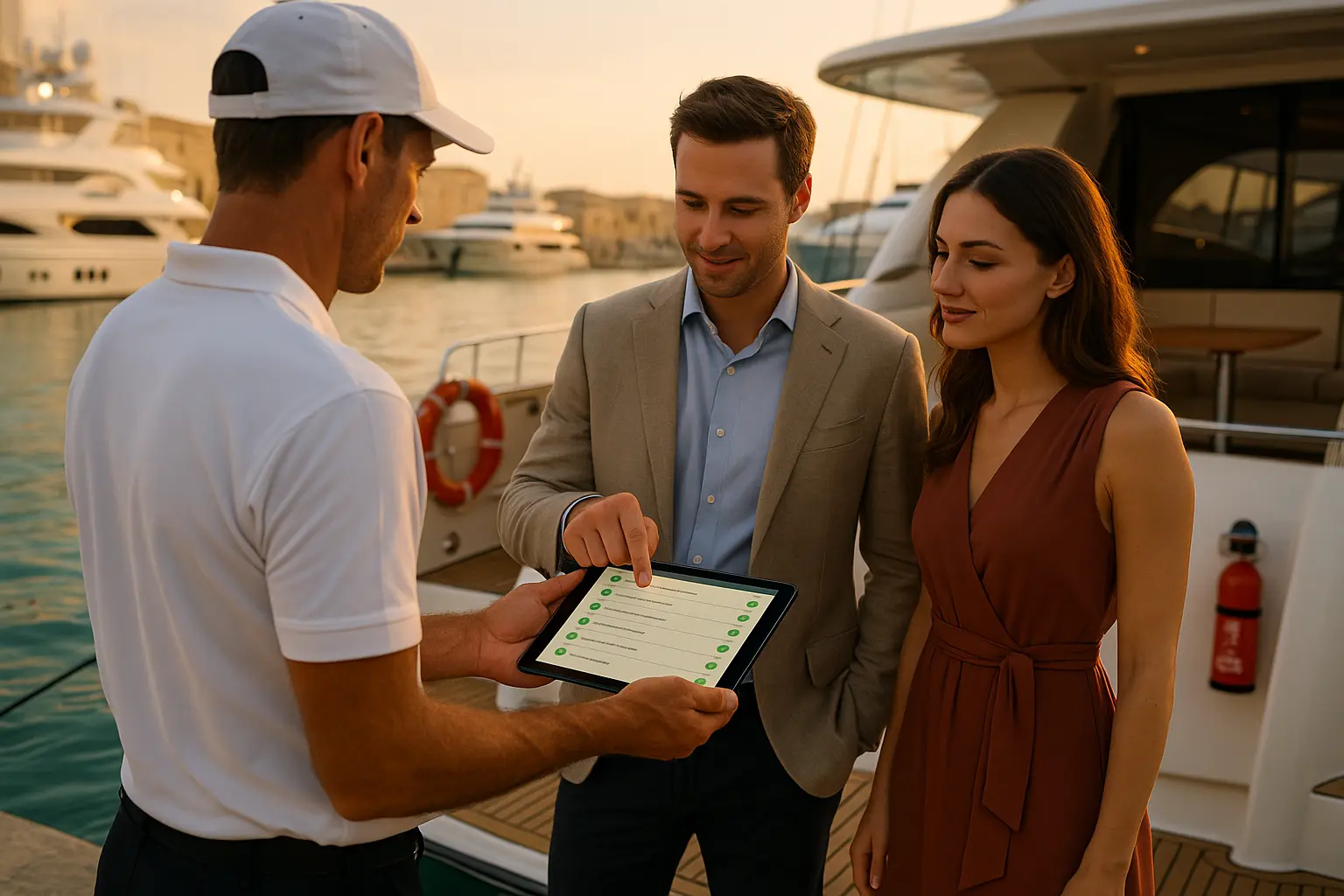
The concept is straightforward. Before boarding or at boarding, each guest reviews the vessel's emergency procedures and digitally confirms they have done so. The system records who acknowledged what, when, and on which device.
A proper digital safety sign-off should cover:
Emergency Orientation
- Muster station locations for the specific vessel
- Life jacket storage locations and donning instructions
- Life raft positions and basic deployment awareness
- Fire extinguisher locations and operation
- Emergency exits and escape routes
Operational Safety
- Man-overboard procedures and what guests should do (not try to rescue — alert crew immediately)
- Tender boarding rules, capacity limits, and boarding/disembarking procedures
- Marine head operation (this sounds minor until a guest creates a $15,000 plumbing failure)
- Swimming platform rules and re-boarding procedures
- Water toy safety protocols
Acknowledgment
- Per-guest digital signature or confirmation
- Timestamp and date
- Device identification
- Association with the specific charter booking
Pre-Boarding vs. At-Boarding
The strongest approach is a two-stage process. Guests receive the safety information through a digital guest portal before they arrive. They can review it at their own pace, on their own device, without the time pressure of a dock-side briefing. Then at boarding, the captain or crew conducts the live walk-through, confirms understanding, and the guest completes the formal digital sign-off.
This matters because a dock-side verbal briefing is fighting for attention against the excitement of boarding a yacht. Guests are distracted, taking photos, settling in. A pre-boarding review gives the safety content a better chance of actually being absorbed.
The SOS Charter Guest app — developed by the Superyacht Operating Systems team founded by yacht captain David Clarke, led by Jodie and Keira Clarke — launched their Guest Emergency Procedure Sign-off feature at METSTRADE 2025 in Amsterdam. As Keira Clarke noted, this was "the number one feature requested by captains" following the Bayesian incident.
YachtWyse takes a similar approach through its guest portal. Guests receive a unique link to a branded portal containing vessel orientation, safety information, and area guides — no login required. Safety acknowledgment can be completed before boarding or at the dock via phone or tablet.
The Real-World Cost of Not Having This
Let me put some numbers to this.
Legal defense costs in maritime personal injury cases typically start at $50,000 and escalate quickly into six figures. If your only defense for the safety briefing is "the captain says he did it," your legal team is working with significantly less ammunition.
P&I club deductibles for yacht charter operations typically range from $5,000 to $25,000 per incident. But if your insurer determines you failed to adequately document safety procedures, they may contest coverage entirely. A $250,000 guest injury claim with contested coverage is a business-ending event for most charter operators.
Regulatory fines and operational restrictions from port state control or flag state authorities can include vessel detention. If an investigation reveals no documented safety briefing process, that finding compounds every other deficiency.
Reputation damage from a safety incident where you cannot demonstrate due diligence is permanent. Charter brokers and repeat clients will find out. In an industry where trust and word-of-mouth drive bookings, one incident with a documentation gap can erase years of operational excellence.
Compare that to the cost of implementing digital safety sign-offs: a few hundred dollars per year through an integrated platform, or nothing additional if your charter management software already includes guest portal and checklist functionality.
What Good Implementation Looks Like
If you are going to implement digital safety sign-offs — and you should, this year — here is how to do it properly.
1. Build Vessel-Specific Content
Generic safety briefings are better than nothing, but vessel-specific content is what holds up under scrutiny. Your safety sign-off should reference actual locations on your vessel. "Life jackets are stored in the forward cabin port-side locker and under each salon settee" is documentation. "Life jackets are available on board" is not.
Include photos or simple diagrams showing equipment locations. Mark muster stations on a deck plan. Show where the fire extinguishers are, not just state that they exist.
2. Make It Per-Guest, Not Per-Booking
Every individual adult on the charter should complete their own sign-off. A single signature from the lead charterer does not demonstrate that Guest #4 in the aft cabin knows where the life jackets are. This matters in litigation. It matters to insurers. And it matters for actual safety.
3. Keep It Readable
You are writing for vacation guests, not maritime professionals. Short sentences. Plain language. No jargon. "If someone falls in the water, shout 'Man overboard!' as loud as you can, point at the person, and do not jump in after them" works. Regulatory language does not.
4. Timestamp Everything
The sign-off record should capture the exact date and time of acknowledgment, associated with the specific charter booking and the specific guest profile. This creates the audit trail that makes the entire system defensible.
5. Store It Independently
The sign-off record should exist outside the guest's device and outside any single crew member's phone. A cloud-based system tied to your charter management platform ensures the record survives crew changes, device failures, and operational transitions. If your proof of briefing lives only on the captain's personal iPad, it is not reliable evidence.
6. Review and Update Seasonally
Safety procedures change. Equipment moves. New crew members join. Review your digital safety content at the start of each charter season and after any significant vessel modification. Version the content so you can demonstrate which version each guest acknowledged.
Flag State and Insurance Implications
The regulatory environment is tightening, and the direction is clear.
The MCA (UK Maritime and Coastguard Agency) has been progressively strengthening documentation requirements through the REG Yacht Code. Port State Control inspections in the Mediterranean — particularly in France, Italy, and Spain — have increased in frequency and rigor since 2024. Flag states including the Cayman Islands, Marshall Islands, and Malta are placing greater emphasis on operational documentation during annual surveys.
For charter operators, the practical implication is this: within the next two to three years, documented guest safety briefings will likely move from "best practice" to "expected standard." Operators who implement digital sign-offs now are ahead of the curve. Operators who wait for a regulation to force the change will be scrambling to implement while their competitors already have years of documented compliance history.
Maritime insurers are already factoring operational documentation quality into risk assessments. When you renew your P&I coverage, your underwriter is evaluating your safety management practices. An operator who can demonstrate a systematic, documented approach to guest safety briefings presents a materially different risk profile than one who relies on verbal briefings with no records.
How YachtWyse Handles This
YachtWyse includes digital safety acknowledgment as part of its charter guest portal. Here is how it works in practice.
When you set up a charter booking, you create a guest portal that includes vessel orientation, safety information, emergency procedures, and area guides. Each guest receives a unique link — no app download, no login, no friction.
The safety section presents vessel-specific emergency procedures with clear language and visual references. Guests review the content and confirm their acknowledgment digitally. The system records who acknowledged, when, and ties it to the specific charter booking.
Captains and crew can see which guests have completed the sign-off before boarding, allowing them to follow up with anyone who has not. At boarding, the captain conducts the live walk-through as always — the digital sign-off supplements the human briefing, it does not replace it.
The result is a documented, timestamped, per-guest safety briefing record for every charter. It lives in the platform alongside your booking records, APA tracking, crew management, and vessel documentation. If an insurer, lawyer, or flag state authority ever asks for proof that Guest A received your safety briefing, you produce the record in seconds.
No binders. No paper sign-off sheets that get lost or damaged. No relying on crew memory to testify about what was said three months ago.
What You Should Do This Week
If you are running charter operations without documented safety sign-offs, you have an unacceptable gap in your liability protection. Here is a practical action plan.
Immediately: Audit your current safety briefing process. Write down exactly what your crew tells guests, when they tell them, and what documentation exists afterward. If the answer to "what documentation" is "none," you know the problem.
This month: Select a digital platform that includes guest safety acknowledgment. If you are already using charter management software, check whether your current platform offers this feature. If not, evaluate alternatives. The cost of switching platforms is trivial compared to the cost of a single undefended liability claim.
Before your next charter: Build vessel-specific safety content. Photograph life jacket locations, fire extinguisher positions, and muster stations. Write plain-language procedures for MOB response, tender boarding, and marine head operation. Load this into your digital sign-off system.
Every charter going forward: Make the digital safety sign-off a non-negotiable part of your boarding process. No guest boards without completing the acknowledgment. No exceptions. Build it into your crew's pre-charter checklist and verify completion before departure.
The Bayesian changed the conversation about guest safety in the charter industry. The question is no longer whether you conduct safety briefings. It is whether you can prove it.
YachtWyse provides digital guest portals with built-in safety acknowledgment for charter operators. See how it works or start a free trial.
Written by
YachtWyse Team
Maritime Technology Experts
The YachtWyse team brings decades of combined experience in maritime operations, marine engineering, and software development. We write from real-world experience managing vessels from 30ft cruisers to 100m+ superyachts.
Ready to Simplify Your Yacht Management?
YachtWyse helps owner-operators track maintenance, manage costs, and get AI-powered diagnostic assistance. Start your free trial today.
Request a DemoRelated Articles
Yacht Compliance Tracking Software (2026)
How yacht compliance tracking software centralizes certificates, crew credentials, and regulatory deadlines. A 2026 guide for captains and fleet managers.
ISM Compliance Software for Superyachts
A captain's guide to ISM Code compliance software for superyachts. Cover the 13 ISM elements, common audit failures, and how digital SMS tools replace paper binders.
Dive Charter Compliance: Managing Certifications, Medical Forms, and Liability in 2026
Dive charters carry the toughest certification gate in the charter industry. Here's how to manage PADI/SSI verification, RSTC medical screening, equipment sizing, nitrox certs, and DAN insurance requirements — without drowning in paper.