Why Your Yacht Documents Still Live in a Filing Cabinet (And What It's Costing You)
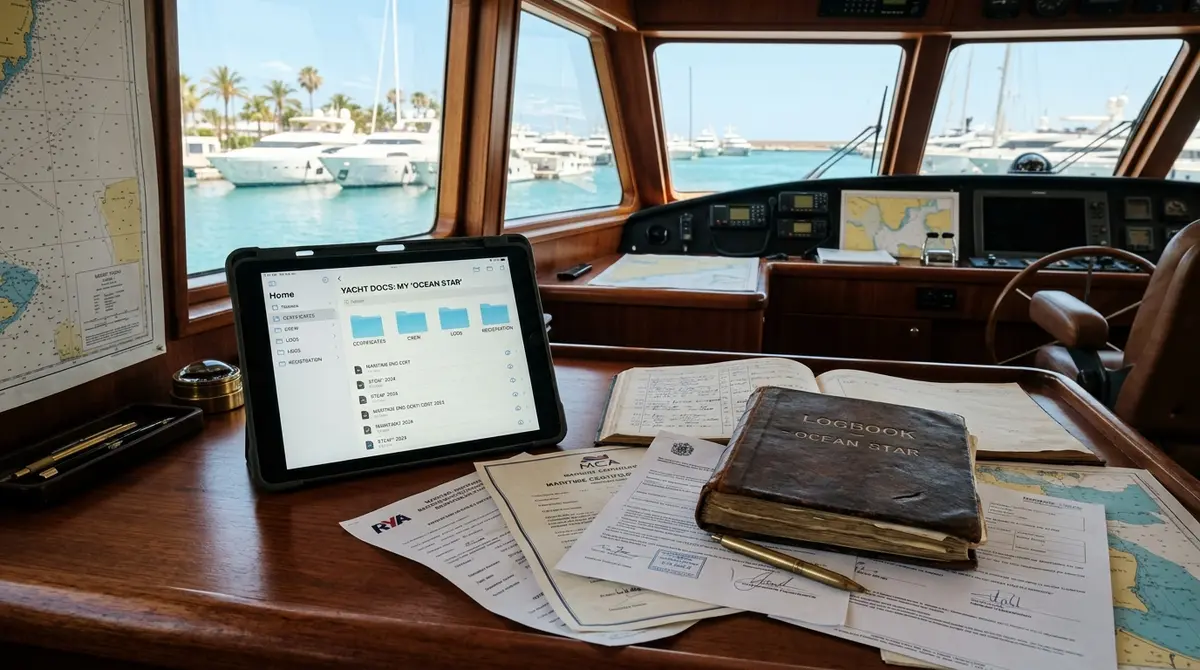
Quick Summary
- ✓A single expired registration can get your yacht turned away from a foreign port — and an expired class certificate can void your insurance entirely.
- ✓Port state control inspectors flag document deficiencies more than almost any other category, and yachts with recent deficiencies get flagged for more detailed inspections on every subsequent visit.
- ✓OCR-powered document search means finding a specific clause in a 50-page warranty takes seconds, not an hour of flipping through folders.
- ✓Automated expiry alerts for registrations, insurance policies, crew certifications, and survey deadlines prevent the kind of lapses that cost owners thousands.
Three months ago, I watched a 52-foot Hatteras get turned away from customs in the Bahamas. The owner had crossed from Fort Lauderdale for a long weekend — fuel topped off, provisions loaded, guests aboard. Everything was perfect except one thing: his vessel registration had expired eleven days earlier.
He didn't know. The renewal notice was sitting in a stack of mail at his house in Tampa. The document itself was in a binder somewhere on the boat, but the expiration date wasn't something he checked regularly. Why would he? It's just paperwork.
Except it wasn't just paperwork. It was the difference between a weekend in the Abacos and a $2,400 emergency turnaround, including fuel, lost provisions, and the cost of expedited registration renewal from overseas. His guests flew home. The trip was over before it started.
I've heard variations of this story from yacht owners across Tampa Bay more times than I can count. The details change — sometimes it's insurance, sometimes it's a survey certificate, sometimes it's crew documentation — but the plot is always the same. Someone trusted a filing cabinet, a binder, or their memory to keep track of documents that have hard expiration dates and real consequences.
The Filing Cabinet Is Not a System
Let me be honest about something: most yacht owners I know are organized people. You don't buy and maintain a 40-foot-plus vessel without some capacity for planning. The problem isn't laziness. The problem is that a filing cabinet doesn't do anything.
It doesn't remind you that your insurance renews in 30 days. It doesn't tell you that your captain's STCW certificate expires next month. It doesn't flag that the survey you scheduled for Q3 has a hard deadline tied to your class certificate, and missing it triggers automatic suspension.
A filing cabinet stores paper. That's it. And for documents that have expiration dates, compliance requirements, and sharing needs, storage alone is not management.
Here's what I've seen go wrong with paper-based and binder-based document systems among yacht owners I know personally:
Mark lost his insurance claim. After a lightning strike damaged electronics on his 45-footer, he filed a claim. The insurer asked for his most recent survey report and the original equipment warranties. Mark knew he had them — somewhere. It took him three weeks to locate the survey report (it was in a box at his house, not on the boat) and he never found two of the warranties. The claim was reduced by $8,600 because he couldn't document the age and condition of the damaged equipment.
Jennifer got detained during a port state control inspection. She operates a 60-foot charter yacht in the Keys. An inspector asked for her SOLAS safety equipment certificate. She had it, but it took her twenty minutes of searching through three different binders to produce it. That delay triggered a more detailed inspection, which found that her fire extinguisher service records were out of date. The detention cost her two days of charter revenue — roughly $6,000 — plus the cost of expedited re-certification.
Carlos missed his class survey window. His 55-foot motor yacht was classed with a five-year survey cycle. He knew the survey was coming up but didn't realize the three-month completion window had already opened. By the time he scheduled the survey, the certificate had expired by six days. His class was automatically suspended. His insurance company was notified. His P&I coverage was temporarily voided. The re-classification process took five weeks and cost over $12,000 — for a survey that would have cost $3,500 if completed on time.
These aren't hypothetical scenarios. These are real consequences of treating document management as a filing problem instead of a compliance problem.
What Document Disorganization Actually Costs
The financial exposure from poor yacht document management breaks down into three categories, and most owners only think about the first one.
Direct Costs: Fines and Fees
Operating with expired registration can result in denial of port entry in foreign countries and potential fines. In the U.S., violations related to documentation and certification can exceed $5,000 per incident. For charter operators, carrying passengers without valid certificates of insurance can result in fines approaching $6,000 per violation.
These are the costs you can see on a statement. They hurt, but they're usually recoverable.
Indirect Costs: The Ones That Compound
This is where the real damage happens.
Voided insurance claims. If your insurance policy lapsed — even briefly — and damage occurred during that gap, you have no coverage. On a yacht valued at $300,000 or more, a single uninsured incident can be catastrophic.
Loss of class consequences. When a yacht falls out of class due to a missed survey, the cascade is brutal. Insurance is suspended. P&I clubs require valid class certification. Charterers won't book an unclassed vessel. Port state control officers will detain you. Getting back into class requires a full condition survey, which is significantly more expensive than the routine survey you missed.
Charter revenue loss. For charter operators, every day your vessel is detained, undergoing emergency re-certification, or waiting for replacement documents is a day of lost revenue. At $3,000 to $10,000 per day depending on vessel size and season, the math gets painful fast.
Opportunity Costs: Time You'll Never Get Back
How many hours have you spent looking for a specific document? Not just once — across a full year of ownership. Digging through a binder for an insurance declaration page. Searching your email for a PDF your broker sent eight months ago. Calling the marina to ask if they have a copy of your haul-out report.
I tracked my own document-hunting time for six months before I switched to digital storage. It averaged about 90 minutes per month. That's 18 hours per year spent looking for pieces of paper that should have been findable in seconds.
For a captain managing a fleet of three or four vessels, multiply that by the number of boats and the number of document types. I've talked to fleet managers who estimate they spend 8 to 10 hours per week on document-related tasks — finding, copying, scanning, emailing, and verifying expiration dates across their fleet.
Why Port State Control Makes This Urgent
If you've never been through a port state control inspection, here's what you need to know: inspectors are specifically trained to check documents first. Registration. Insurance. Safety certificates. Crew certifications. Classification certificates. MARPOL records. If your documents are in order and readily available, the inspection is usually quick and uneventful.
If they're not? That's when things escalate.
According to DNV's Q2 2025 port state control report, 73 vessels were detained in a single quarter, with 252 detainable deficiencies recorded. The most common deficiency categories include ISM documentation failures at 16% of all findings, and fire safety documentation issues at 18%. These aren't obscure technical violations — they're paperwork problems.
Here's the part that makes this a compounding issue: port state control systems have long memories. A vessel with recent deficiencies on its record gets selected for more detailed inspections in every subsequent port visit. One bad inspection doesn't just cost you that day — it flags your vessel for enhanced scrutiny at every port for years.
For yacht owners who cross international borders regularly — Florida to Bahamas, U.S. to Caribbean, Mediterranean cruising — this inspection history follows you across jurisdictions. The Paris MoU, Tokyo MoU, and U.S. Coast Guard databases all track inspection outcomes. A clean record keeps inspections fast and routine. A deficiency record makes every port entry slower, more stressful, and more expensive.
The Shift: From Storage to Management
The difference between storing documents and managing them comes down to four capabilities that paper simply cannot provide.
1. Search That Actually Works
When I scanned my yacht documents into a digital vault with OCR (Optical Character Recognition), the first thing I did was test it. I searched for a specific clause in a 50-page engine warranty — a coverage exclusion I remembered reading but couldn't locate. Found it in four seconds.
OCR extracts text from scanned PDFs, photographs of documents, even hand-filled forms with printed text. Once processed, every word in every document becomes searchable. Need to find every reference to "Caterpillar" across all your documents? One search. Need the specific liability limit in your insurance policy? Type it, find it.
For anyone who's ever flipped through a thick binder looking for one paragraph, this alone justifies the switch.
2. Expiry Alerts That Prevent Expensive Mistakes
This is the feature that would have saved the Hatteras owner his Bahamas trip. Automated expiry tracking monitors every document with a date-sensitive requirement: registration renewals, insurance policy terms, crew certification expirations, survey deadlines, safety equipment service intervals.
You set the alert window — 90 days, 60 days, 30 days, whatever makes sense for each document type. The system notifies you with enough lead time to schedule renewals, book surveys, or update certifications before they lapse.
No more relying on mail-in renewal notices. No more trying to remember which month your captain's STCW expires. No more discovering that your class survey window opened three months ago and you're already behind.
3. Controlled Sharing Without Giving Away the Keys
One of the persistent annoyances of paper-based document management is sharing. Your surveyor needs your last haul-out report. Your insurance broker needs your registration and class certificate. Port authorities need your crew list and safety certificates. Your charter manager needs everything.
With paper, you photocopy or scan and email. Every recipient gets a static copy that may become outdated. You lose track of who has what version.
A digital vault lets you share specific documents with specific people, without exposing everything else. The surveyor sees the haul-out report and nothing more. The insurance broker gets the registration and class certificate. Port authorities get exactly what they need for clearance. You maintain a single source of truth, and you control access.
4. Version History That Protects You
Documents get updated. Insurance policies renew with different terms. Survey reports supersede previous ones. Registration numbers change when you re-flag.
Paper systems make version control nearly impossible. Which binder has the current policy? Is this the 2024 survey or the 2025 one? Did we replace the old registration or just add the new one on top?
A digital vault maintains version history automatically. The current document is always on top. Previous versions are archived and accessible if you need them. You can see when each version was uploaded and what it replaced.
This matters most during insurance claims, where you may need to demonstrate the history of a document — when coverage started, what the terms were at the time of an incident, how conditions changed over time.
The Documents That Matter Most
If you're thinking about moving from paper to digital, here's the priority order I'd recommend based on consequence severity — what costs you the most if it expires, goes missing, or can't be produced on demand:
Tier 1 — Failure means you can't operate:
- Vessel registration (flag state)
- Insurance policies (hull, P&I, liability)
- Class certificates
- Safety equipment certificates (SOLAS)
- Crew certifications (STCW, medical)
Tier 2 — Failure means fines, delays, or inspection escalation:
- MARPOL records
- Fire safety inspection reports
- Navigation equipment certificates
- Radio station license
- Survey reports (annual, intermediate, special)
Tier 3 — Failure means lost money or lost time:
- Equipment warranties
- Maintenance service records
- Parts invoices and receipts
- Haul-out reports
- Bottom paint records
Tier 4 — Nice to have digitized:
- Builder documentation
- Original specifications
- Refit documentation
- Charter agreements (for charter operators)
- Guest documentation and waivers
Start with Tier 1. If those documents are secure, searchable, tracked for expiry, and shareable on demand, you've eliminated the highest-risk scenarios. Then work down from there.
What Changed for Me
I switched from binders to YachtWyse's Digital Ship's Vault about a year ago. The immediate difference was speed — finding any document in seconds instead of minutes. But the real value showed up over time.
The expiry alerts caught my insurance renewal 45 days before the policy ended. I'd been so focused on planning a summer cruise that I completely forgot the renewal date was approaching. Without the alert, I would have sailed with a lapsed policy and not known it until renewal day, or worse, until I needed to file a claim.
The OCR search saved me during a warranty dispute with an electronics installer. I needed to find the specific warranty language covering installation defects. The warranty was a 30-page document I'd scanned when the work was completed two years earlier. I found the relevant clause in under ten seconds. The installer's face when I read it back to him verbatim was worth the entire cost of the software.
The document sharing simplified my annual survey. Instead of photocopying six different documents for my surveyor, I shared them directly from the vault. He had everything he needed before he arrived at the boat. The survey took half a day instead of a full day because we didn't waste time tracking down paperwork.
These aren't dramatic stories. They're the kind of small, steady wins that add up over a year of boat ownership. Less time searching. Fewer missed deadlines. Better organized for inspections. Faster insurance claims. And the peace of mind that comes from knowing every document is where it should be, when you need it.
The Bottom Line
Your filing cabinet isn't going to remind you that your registration expires next month. It won't help you find that one paragraph in a 50-page warranty. It can't share a document with your surveyor without you scanning, emailing, and hoping they got the right version. And it definitely won't keep you from getting turned away at customs in the Bahamas because of something you could have renewed last week.
The question isn't whether to go digital with your yacht documents. The question is how much the paper system has already cost you — in fines you've paid, claims you've lost, time you've wasted, and close calls you may not even know about.
The Hatteras owner I mentioned at the start? He digitized everything the week after that Bahamas trip fell apart. "I'll never let a piece of paper ruin another weekend," he told me. He's had zero document-related issues since.
That's not a technology story. It's a common sense one.

Written by
YachtWyse Team
Maritime Technology Experts
The YachtWyse team brings decades of combined experience in maritime operations, marine engineering, and software development. We write from real-world experience managing vessels from 30ft cruisers to 100m+ superyachts.
Ready to Simplify Your Yacht Management?
YachtWyse helps owner-operators track maintenance, manage costs, and get AI-powered diagnostic assistance. Start your free trial today.
Request a DemoRelated Articles
Dive Charter Compliance: Managing Certifications, Medical Forms, and Liability in 2026
Dive charters carry the toughest certification gate in the charter industry. Here's how to manage PADI/SSI verification, RSTC medical screening, equipment sizing, nitrox certs, and DAN insurance requirements — without drowning in paper.
Digital Safety Sign-Off: What Every Charter Operator Needs to Know
The Bayesian sinking changed how the industry thinks about guest safety briefings. Here's why digital safety sign-offs are becoming the new standard for charter operators — and what happens when you can't prove a briefing took place.
Yacht Compliance Tracking Software (2026)
How yacht compliance tracking software centralizes certificates, crew credentials, and regulatory deadlines. A 2026 guide for captains and fleet managers.