Dive Charter Compliance: Managing Certifications, Medical Forms, and Liability in 2026
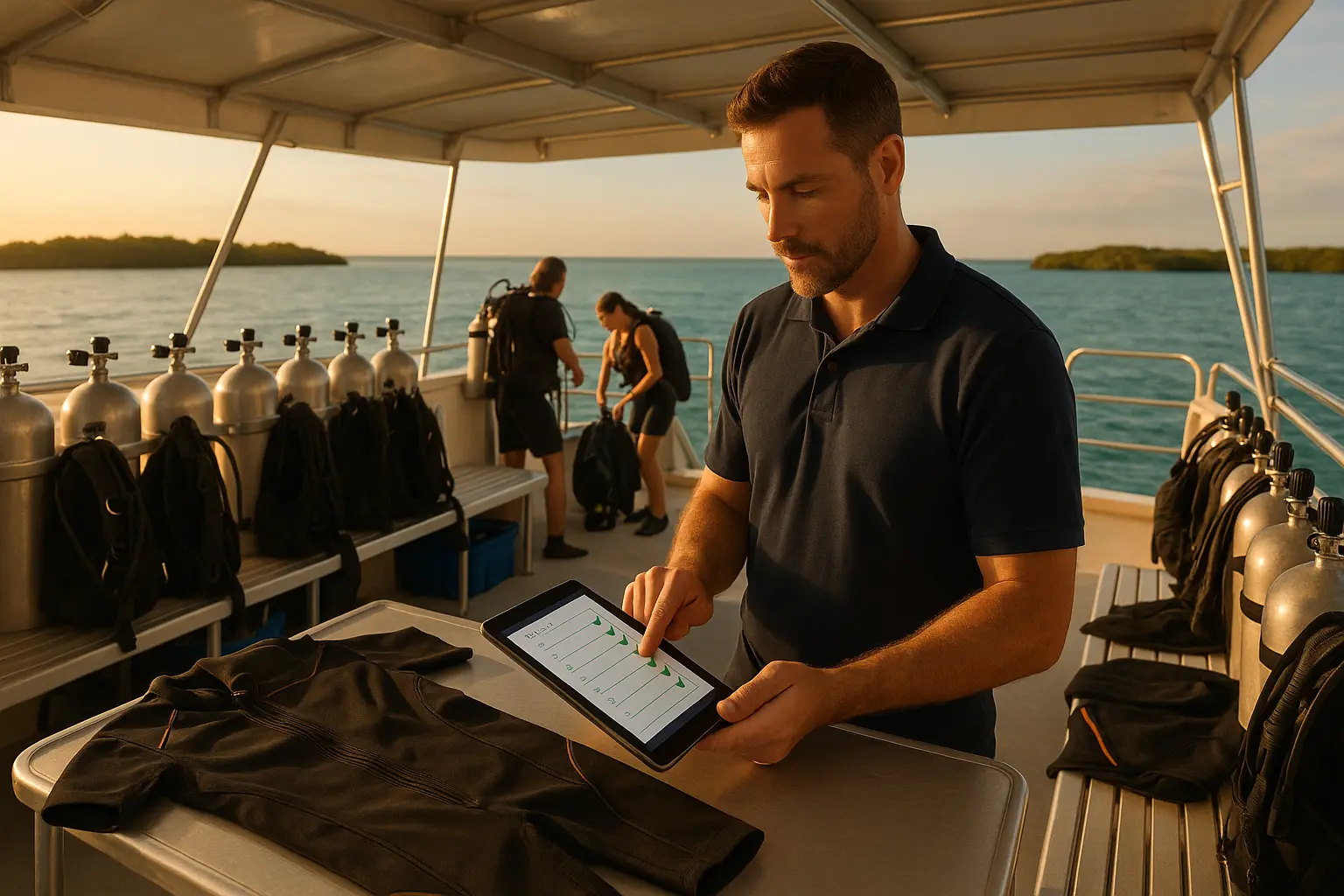
Quick Summary
- ✓Dive charters face the most complex guest compliance gate in the charter industry — PADI/SSI certification verification, conditional RSTC medical screening, equipment sizing per diver, nitrox certification for enriched air, and DAN/medevac insurance requirements all must be confirmed before a guest enters the water.
- ✓The RSTC medical questionnaire is your first line of legal defense. Courts consistently rule in favor of operators who properly administered medical screening and maintained signed, timestamped records — and against those who treated it as a formality.
- ✓Equipment sizing is a compliance and safety issue, not just a convenience. Recording BCD size, wetsuit measurements, fin size, and weight requirements per guest creates an audit trail that demonstrates duty of care.
- ✓Medevac insurance is becoming a booking requirement for remote dive destinations, where medical evacuation costs can exceed $100,000 and hyperbaric chamber access may require an airlift.
- ✓Digital guest onboarding systems that collect certification scans, medical forms, equipment preferences, and safety sign-offs before the guest boards eliminate the chaotic dock-side paper shuffle and create a legally defensible compliance record.
Last February, a liveaboard operator I know in the Florida Keys got a phone call that still keeps him up at night. A guest had surfaced from a 90-foot wall dive, complained of chest tightness, and collapsed on the swim platform. The crew started CPR. The Coast Guard dispatched a helicopter. The guest survived — barely — and the investigation that followed revealed he'd had a cardiac stent placed eight months earlier. He'd checked "no" on every line of the medical questionnaire.
The operator had done everything right. He had the signed form. He had the certification card on file. He had the dive briefing documented. And because of that paper trail, when the guest's family hired a lawyer three weeks later, the case went nowhere.
But here's what haunts him: if he'd done what he used to do — glance at the cert card, ask "any medical issues?" and take a head nod as an answer — he'd have been fighting a lawsuit with nothing but his word against a grieving family's attorney.
Dive charters carry the hardest compliance gate in the entire charter industry. No other charter type requires you to verify professional certifications, administer conditional medical screening, size safety-critical equipment to each individual guest, confirm specialty credentials for specific gas mixes, and collect proof of third-party insurance — all before anyone gets wet. And the consequences of getting it wrong aren't a bad review. They're a body bag and a deposition.
I've spent the last three years building guest onboarding workflows for charter operators, and dive operations consistently take three to four times longer to set up than standard crewed charters. Every shortcut I've seen an operator try to take has eventually cost them — in liability exposure, insurance premium hikes, or worse.
Here's what the compliance stack actually looks like in 2026, and how to manage it without losing your mind.
The Certification Gate: More Than Checking a Card
The baseline requirement is straightforward: every guest who enters the water on scuba must hold a valid certification from a recognized training agency — PADI, SSI, NAUI, CMAS, SDI/TDI, or an equivalent organization. But "valid certification" is doing a lot of heavy lifting in that sentence.
What you actually need to verify per diver:
-
Agency and certification level. An Open Water card is not an Advanced card. A diver with Open Water certification is trained to 18 meters (60 feet). If your dive plan includes a 30-meter wall or a wreck at 25 meters, that diver is not qualified to participate — and if you let them, the liability falls on you.
-
Certification number. Record it. If a dispute arises, you need to prove the card was real, not a laminated printout from someone's home printer. Most agencies offer online verification — PADI's system lets you confirm certification status in seconds.
-
Last dive date. A diver who earned their Open Water card in 2019 and hasn't been underwater since is not the same risk profile as someone who dives every month. Training agencies recommend a refresher (often called a ReActivate or Scuba Skills Update) after 12 months of inactivity. You're not required to enforce this in most jurisdictions, but your insurance carrier will ask about it if something goes wrong.
-
Nitrox certification. If you're offering enriched air fills — and most serious dive charters do — every diver breathing nitrox must hold a separate Enriched Air or Nitrox specialty certification. This is non-negotiable. Nitrox introduces oxygen toxicity risk at depth, and a diver without the training to analyze their mix and calculate their maximum operating depth has no business breathing anything other than air. Record the nitrox cert number alongside the primary certification.
-
Specialty certifications for site-specific dives. Night dives, deep dives beyond 30 meters, wreck penetration, drift dives in strong current — each of these has a corresponding specialty certification. Whether you require the card or simply document the diver's experience level is a judgment call, but documenting that you assessed the diver's qualifications for the planned dive profile is the standard of care.
I photograph or scan every certification card that comes aboard. Physical cards get lost, digital cards require app access that may not work offshore, and memory is unreliable. A scanned image linked to the guest's profile in your management system is the only record that holds up when it matters.
The RSTC Medical Questionnaire: Your Most Valuable Legal Document
If certification verification is the gate, the medical questionnaire is the moat. The RSTC (Recreational Scuba Training Council) Diver Medical Participant Questionnaire — endorsed by WRSTC, DAN, PADI, SSI, NAUI, and virtually every training agency worldwide — is the single most important document in your compliance file.
The questionnaire is a conditional screening tool. It asks a series of yes/no questions about medical conditions that are contraindicated for diving: heart disease, lung disease, seizure disorders, diabetes, ear/sinus conditions, pregnancy, medications affecting consciousness, and more. The logic is binary:
- All "no" responses: The diver self-certifies fitness to dive. You file the signed form.
- Any "yes" response: The diver must obtain a physician's evaluation and written clearance before diving. You file the physician clearance alongside the questionnaire.
This sounds simple, but the execution is where operators trip up. Here are the failure modes I see most often:
Failure 1: Administering the form verbally. "Do you have any medical conditions?" followed by a head shake is not a medical screening. It's a conversation. If a diver dies and you're holding nothing but your memory of a head shake, you're exposed.
Failure 2: Collecting the form but not reading it. I've talked to operators who collect stacks of paper forms, stuff them in a folder, and never look at them until something goes wrong. If a guest checked "yes" to a cardiac condition and you let them dive without physician clearance, the form actually works against you — it proves you had the information and ignored it.
Failure 3: Using the form once for a multi-day trip. Medical conditions can change during a week-long liveaboard. A guest who was healthy on day one might develop a sinus infection by day three that makes diving dangerous. The RSTC form covers the initial screening, but smart operators build in a daily dive fitness check — even if it's a simple "Has anything changed since you filled out your medical form?" with a documented response.
Failure 4: Not retaining forms after the charter. How long should you keep medical questionnaires? There's no universal answer, but the statute of limitations for maritime personal injury claims in the United States is three years under general maritime law. I keep mine for five. Digital storage makes this trivial — paper storage makes it a fire hazard and a privacy liability.
The WRSTC-endorsed medical screening system was updated in 2020 after a three-year review by the Diver Medical Screen Committee, with input from DAN, UHMS, and dive medicine professionals. The current version includes the Diver Medical Participant Questionnaire, the Diver Medical Physician's Evaluation Form, and the Diving Medical Guidance to the Physician document — all three components work together as a system.
Equipment Sizing: The Compliance Layer Nobody Talks About
Most charter operators think of equipment sizing as a logistics problem: does the BCD fit, are the fins the right size, is there enough weight. And it is a logistics problem. But it's also a compliance and safety documentation issue that gets overlooked until someone gets hurt.
What you should be recording per diver:
- BCD (buoyancy compensator) size — S, M, L, XL, and which model if you carry multiple types
- Wetsuit measurements — height, weight, chest, waist, and suit thickness preference
- Fin size — often correlated to shoe size, but not always with different foot pocket designs
- Weight requirements — in pounds or kilograms, noting saltwater versus freshwater and suit thickness
- Regulator preference — if you offer multiple options, note which was assigned
- Mask fit notes — guests with facial hair, narrow faces, or prescription needs
Why does this matter for compliance? Two reasons.
First, improperly sized equipment contributes to dive accidents. A BCD that's too large can shift during ascent, a weight system that's wrong leads to buoyancy problems, and fins that don't fit cause fatigue and cramping. If a guest has an incident and you can't demonstrate that you properly sized their equipment, you've handed the plaintiff's attorney a narrative.
Second, equipment sizing data creates a profile that makes returning guests faster to onboard. A diver who chartered with you last year and comes back doesn't need to go through the full sizing process again — you pull up their profile, confirm nothing has changed, and they're ready. That's not just compliance efficiency. That's the kind of personalization that drives rebooking.
DAN Membership and Medevac Insurance: The New Booking Requirement
Three years ago, asking guests for proof of dive insurance was unusual. Today, it's becoming standard — and for remote dive destinations, it's non-negotiable.
DAN (Divers Alert Network) membership provides two things that matter to you as an operator: access to the DAN Emergency Hotline (a 24/7 dive medicine consultation service) and dive accident insurance that covers medical evacuation, hyperbaric chamber treatment, and emergency medical care.
Here's why this has shifted from "nice to have" to "required":
The cost of medevac from remote dive destinations is staggering. A helicopter evacuation from the Exumas to a hyperbaric facility in Miami can run $40,000 to $80,000. An air ambulance from Raja Ampat or the Red Sea to the nearest recompression chamber can exceed $150,000. If the diver doesn't carry insurance, guess who the family calls first? You.
DAN's annual report data consistently shows that cardiovascular disease is the leading contributing factor in dive fatalities, with over half of fatalities involving divers over 50. The average age of dive fatality victims is 54. Your guest demographic on a premium dive charter skews older and wealthier — exactly the population with the highest cardiac risk profile.
Your own professional liability insurance may require it. DAN's professional liability program covers dive professionals and operators, but the terms increasingly reference guest insurance coverage as a factor in claims assessment. If your guest carried no insurance and you didn't require it, that becomes part of the narrative.
At minimum, I require proof of DAN membership or equivalent dive accident insurance at the time of booking confirmation — not at the dock, not on boarding day, but during the booking process. This gives guests time to purchase coverage (DAN membership starts at around $40/year for basic coverage) and gives you time to follow up with guests who haven't provided proof.
For remote itineraries — anything more than two hours from a hyperbaric chamber — I also require medevac/evacuation insurance. DAN's higher-tier plans include this, as do standalone travel medical policies from companies like Global Rescue, Medjet, and World Nomads.
The Liability Equation: What Protects You and What Doesn't
Let's talk about what actually protects a dive charter operator when something goes wrong.
What protects you:
-
A properly administered RSTC medical questionnaire, signed and dated by the guest. Courts and juries consistently side with operators who can demonstrate they followed the standard screening process. In the DeWolf v. Kohler case — where a diver died from an undisclosed heart condition on a wreck dive charter — the jury found the diver solely responsible because he assumed the risk by concealing his medical history.
-
Documented certification verification. A record showing you confirmed the diver's certification level, number, and agency — and that it was appropriate for the planned dive profile.
-
A signed assumption of risk and release of liability. While waivers are not absolute protection (they generally don't cover gross negligence or actions outside the ordinary scope of diving, like leaving a diver adrift at sea), a properly drafted release requires the plaintiff to meet a much higher legal standard. Under general maritime law, waiver enforceability varies by jurisdiction, but having one is always better than not having one.
-
A documented dive briefing. This should cover site conditions, planned depth and time, emergency procedures, buddy assignments, and recall signals. A digital safety sign-off where each guest acknowledges receiving the briefing creates a timestamped record that's far stronger than a verbal "everyone got that?"
What doesn't protect you:
-
Verbal confirmations with no documentation. "I asked and they said they were fine" is not evidence. It's a memory competing against a bereaved family's attorney.
-
Stale medical forms. A questionnaire signed three charters ago doesn't cover today's dive. Administer new screening for each charter.
-
Ignoring positive responses. If a guest checks "yes" to any medical condition and you don't require physician clearance before allowing them to dive, the questionnaire becomes evidence against you — it proves you knew about the condition.
-
Skipping certification verification for "experienced" divers. A guest telling you they've been diving for twenty years is not the same as a guest showing you a certification card. Verify every time.
Building a Digital Compliance Workflow
Paper forms work until they don't. They get wet. They get lost. They're illegible. They sit in a folder on the boat and nobody ever transfers them to permanent storage. And when you need them two years later for a legal proceeding, good luck finding the right folder.
Here's what a digital guest onboarding workflow looks like for a dive charter:
Pre-booking (at reservation confirmation):
- Guest receives link to online onboarding portal
- Certification upload — photo or scan of all dive certification cards
- RSTC medical questionnaire — completed digitally, signed electronically, timestamped
- Insurance verification — DAN membership number or policy upload
- Equipment sizing form — measurements and preferences collected
Pre-departure (72 hours before):
- Dive plan review — site descriptions, depth profiles, conditions expected
- Conditional forms triggered — if medical questionnaire had positive responses, physician clearance upload required
- Assumption of risk and liability release — signed electronically
- Emergency contact information and allergies confirmed
At boarding:
- Physical certification card verified against uploaded copy
- Equipment sizing confirmed and gear assigned
- Safety briefing sign-off — dive-specific briefing covering buddy procedures, emergency ascent, DAN hotline number, nearest hyperbaric chamber location
- Daily dive fitness confirmation for multi-day trips
Post-charter:
- All documents archived digitally with charter date, guest name, and vessel
- Dive logs synced if integration is available
- Guest profile retained for future charters — certifications, sizing, preferences
This is not theoretical. This is the workflow I've built in YachtWyse for dive charter operators. The guest portal collects certification scans, medical questionnaires, equipment preferences, and safety acknowledgments before the guest ever sets foot on the dock. The captain sees a compliance dashboard showing which guests are cleared and which have outstanding items. No paper. No dock-side scrambling. No "I forgot to bring my cert card."
Every document is timestamped, linked to the specific guest and charter, and stored digitally for as long as you need it. If a lawyer calls three years from now, you pull up the charter, pull up the guest, and every form is right there.
The Returning Diver Advantage
One thing that consistently surprises dive charter operators when they switch to digital onboarding: returning guests become dramatically easier to manage.
A guest who dove with you last season already has their certification cards on file, their medical history documented (with an annual refresh), their equipment sizing saved, and their insurance information recorded. When they book again, the system pre-fills everything and asks only for updates: "Has your medical status changed since your last charter? Have you earned any new certifications? Same equipment preferences?"
What took 45 minutes of dock-side paperwork on the first visit takes three minutes on the return booking. And that efficiency isn't just about convenience — it's about the guest experience. A diver who books a week on your liveaboard doesn't want to spend the first afternoon filling out forms. They want to be in the water.
This is the same principle that drives rebooking in standard crewed charter operations — personalized service built on retained guest data. The dive version just has more compliance layers.
What I'd Do This Week
If you're running a dive charter operation and your compliance workflow still involves a clipboard and a stack of paper forms, here's where I'd start:
-
Digitize the RSTC medical questionnaire. Move it out of paper and into a system that timestamps the signature, flags positive responses, and stores the form permanently. This single change addresses your biggest liability exposure.
-
Build a certification verification checklist. Certification agency, level, number, last dive date, nitrox cert if applicable. Record it per guest, per charter. Don't rely on memory or verbal confirmation.
-
Require DAN membership or equivalent at booking. Add it to your booking terms. Give guests the link to sign up. Follow up if they haven't provided proof 30 days before departure.
-
Create an equipment sizing form. BCD, wetsuit, fins, weight, mask. Collect it digitally before departure. Save it to the guest profile for return visits.
-
Document every dive briefing. A digital safety sign-off that each guest taps "acknowledged" on is worth more than any verbal briefing you'll ever give.
-
Set a retention policy. Keep all compliance documents for a minimum of five years. Digital storage costs nothing. The cost of not having a document when you need it is unlimited.
The dive charter industry has the highest compliance burden in the charter world. But it also has the most to gain from getting compliance right — because the operators who make onboarding seamless are the ones whose guests come back. Nobody wants to spend their vacation filling out forms. Give them a system that handles compliance before they arrive, and they'll remember the diving, not the paperwork.
Managing dive charter compliance in YachtWyse? The guest onboarding portal handles certification uploads, medical screening, equipment sizing, insurance verification, and safety sign-offs — all before your guests board. See how it works.

Written by
YachtWyse Team
Maritime Technology Experts
The YachtWyse team brings decades of combined experience in maritime operations, marine engineering, and software development. We write from real-world experience managing vessels from 30ft cruisers to 100m+ superyachts.
Ready to Simplify Your Yacht Management?
YachtWyse helps owner-operators track maintenance, manage costs, and get AI-powered diagnostic assistance. Start your free trial today.
Request a DemoRelated Articles
Digital Safety Sign-Off: What Every Charter Operator Needs to Know
The Bayesian sinking changed how the industry thinks about guest safety briefings. Here's why digital safety sign-offs are becoming the new standard for charter operators — and what happens when you can't prove a briefing took place.
Why Your Yacht Documents Still Live in a Filing Cabinet (And What It's Costing You)
Expired registrations, lapsed insurance, missed surveys — paper-based yacht document management creates real financial risk. Here's what disorganized documents actually cost owners and how a digital ship's vault eliminates the problem.
Yacht Compliance Tracking Software (2026)
How yacht compliance tracking software centralizes certificates, crew credentials, and regulatory deadlines. A 2026 guide for captains and fleet managers.