The Complete Guide to Marine Parts Management: From Barcode to Bolt
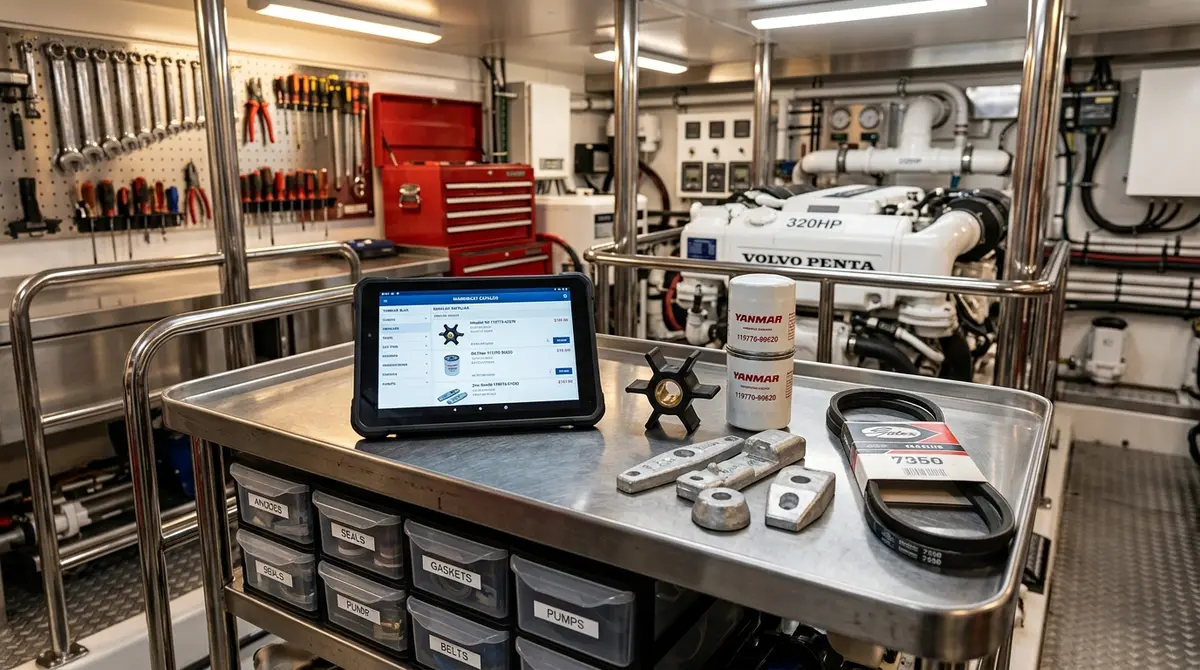
Quick Summary
- ✓The average 40-60ft yacht carries 200-400 trackable parts, and most owners can only account for half of them when something breaks.
- ✓Barcode scanning eliminates manual data entry errors and instantly links parts to manufacturer specs, Sierra cross-references, and retailer pricing.
- ✓Bulk spreadsheet import with smart column mapping lets you digitize years of accumulated parts records in a single sitting.
- ✓AI-powered part lookup identifies unknown components from photos or partial descriptions, pulling manufacturer data and compatible replacements.
- ✓Shopping lists tied to maintenance tasks turn reactive emergency orders into planned purchases at better prices from preferred retailers.
Last October, I was halfway through an impeller change on my port engine when I realized the replacement I'd pulled from the spares locker was for a Yanmar 4JH4-TE, not the 4JH5E that actually powers my boat. Same brand. Similar part number. Wrong engine. The packaging had been separated from the part months ago during a locker reorganization, and whoever put it back on the shelf — probably me — grabbed the wrong bag.
That mistake cost me a $38 overnight shipping charge from Defender, a lost Saturday of cruising, and the particular frustration of knowing I had the right impeller aboard the whole time. It was sitting in a different compartment, in a box labeled "misc engine spares," because my parts organization system at that point consisted of ziplock bags, a Sharpie, and optimism.
If you've owned a boat for more than a season, you've lived some version of this story. Maybe it was the wrong oil filter. Maybe it was spending $65 on zinc anodes you already had twelve of. Maybe it was standing in the West Marine aisle, squinting at your phone trying to read a blurry photo of a nameplate, hoping you grabbed the right size raw water strainer basket.
The parts management problem on recreational yachts isn't dramatic. Nobody writes articles about it the way they do about hull blisters or engine failures. But it's constant, it's expensive in aggregate, and it's one of those friction points that turns a relaxing ownership experience into a low-grade headache.
Here's what I've learned about solving it.
The Scale of the Problem Most Owners Underestimate
When I finally sat down and cataloged every replaceable part on my 46-footer, the number surprised me: 287 discrete items. That includes engine parts for two diesels, genset consumables, raw water pump components, fuel system filters, electrical fuses and breakers, navigation light bulbs, helm station electronics, plumbing fittings, head rebuild kits, windlass components, thruster parts, zincs for three different applications, and dozens of fasteners and hardware pieces that seem trivial until one corrodes and you need an exact replacement.
A 30-foot weekender might carry 80-120 trackable parts. A 60-foot sportfish or motor yacht can easily exceed 400. And that's before you start counting the non-mechanical items like canvas snaps, teak plugs, and the specific grade of sealant your hull-deck joint requires.
The problem isn't that any single part is hard to manage. The problem is the cumulative weight of all of them, each with its own manufacturer, part number, cross-reference, supplier preference, and replacement interval. Your brain can hold maybe 30 or 40 of these in working memory. The rest lives in shoeboxes, email inboxes, and that one note on your phone from 2023 that just says "Racor 500FG 2 micron — NOT 10."
Why the Old Methods Stop Working
Most yacht owners progress through the same stages of parts management:
Stage 1: The Memory Method. You remember what you need. This works great for the first year, when you only have a handful of replacement parts and the boat is new enough that nothing breaks.
Stage 2: The Notebook. You start writing things down. Part numbers go in a spiral notebook that lives in the nav station. This works until the notebook gets wet, or you need the information while you're at the chandlery and the notebook is on the boat.
Stage 3: The Spreadsheet. You graduate to Excel or Google Sheets. Columns for part name, manufacturer, OEM number, quantity on hand, supplier. This feels organized and professional. It works until you realize that nobody updates the spreadsheet after using a part, the quantities are always wrong, and you spend 45 minutes before every maintenance day cross-referencing the spreadsheet against what's actually in the locker.
Stage 4: The Photos. You start photographing every nameplate, every part number, every receipt. Your camera roll becomes an unsearchable archive of 600 blurry close-ups of filter housings and impeller packaging. You know the information is in there somewhere.
Each of these methods solves one problem while creating another. The underlying issue is that parts management is a database problem, and none of these tools are databases.
What a Real Parts Catalog Looks Like
When I switched to using actual parts management software, the difference wasn't just organizational — it changed how I plan maintenance. Here's what a proper digital parts catalog handles that notebooks and spreadsheets cannot:
OEM Numbers and Cross-References
Every part in your catalog carries its original manufacturer part number. But the real value is in cross-references. That Racor fuel filter element? It has an OEM number from Racor, a Sierra cross-reference number, and compatible aftermarket numbers from other suppliers. When you search for any one of those numbers, the software finds the part.
This matters because marine parts are sold through a fragmented ecosystem. The same filter might be listed under three different part numbers at three different retailers. Without cross-references, you either overpay for the OEM version every time, or you waste time manually looking up equivalents on Sierra's website and hoping you matched the right application.
Sierra Marine has built the most extensive cross-reference database in the industry, covering Mercury, Yamaha, Volvo Penta, Cummins, and dozens of other manufacturers. A good parts catalog integrates that cross-reference data so you see OEM and aftermarket options side by side.
Barcode Scanning That Actually Works
The fastest way to add a part to your catalog is to scan its barcode. Most marine parts ship with standard UPC barcodes on the packaging. Point your phone camera at the barcode, and the software looks up the manufacturer, part number, description, and specifications from its database.
This sounds like a small convenience until you're doing it 50 times during an initial catalog setup. Typing "Sierra 18-7848 fuel filter element, replaces Mercury 35-802893Q01, Racor S3213" by hand — with the hyphens in the right places — is the kind of tedious data entry that guarantees errors. Scanning the barcode takes three seconds and gets it right every time.
The scanning approach also works in reverse. When you're standing in West Marine holding a filter that might be the right one, you can scan its barcode and check it against your catalog. If it matches a part already in your system, you know it's compatible. If it doesn't, you just saved yourself a trip back to the store.
Bulk Import for Existing Records
If you've accumulated parts records in spreadsheets — even messy, inconsistent ones — a smart import tool can absorb them. The key is column mapping: you tell the system which of your columns corresponds to part name, OEM number, manufacturer, quantity, and location. The software handles the rest, including detecting duplicates and normalizing formatting differences.
I had a three-year-old spreadsheet with 140 entries when I made the switch. Some entries had full manufacturer details, others just had a cryptic shorthand like "impeller — spare." The import pulled in everything and flagged the incomplete records for me to clean up over time, rather than demanding perfection upfront.
This matters because the biggest barrier to adopting any management system is the initial data entry. If you have to manually re-enter everything you've already tracked, you won't do it. Good import tools meet you where you are.
AI Part Lookup
Sometimes you have a part in your hand and no idea what it is. The label faded. The packaging is gone. You know it came off the starboard engine, but you can't remember when or why you pulled it.
AI-powered part lookup lets you describe what you're looking at — or in some cases, photograph it — and the system identifies it. "Brass fitting, 90-degree elbow, 3/4 inch NPT to hose barb" returns matching parts with their full specifications. More sophisticated systems can identify engine components by visual recognition and suggest the correct OEM part number.
This is genuinely useful for the collection of mystery parts that every yacht accumulates. That bin of fittings and fasteners under the helm seat? You can finally figure out what half of them are for.
The Retail Link Problem (and How to Solve It)
Here's something that frustrated me for years: I'd identify the exact part I needed, write down the part number, and then spend 20 minutes checking prices across West Marine, Defender, Amazon, Fisheries Supply, and Jamestown Distributors. Each retailer has a different URL structure, different search behavior, and different inventory availability. The comparison shopping alone could eat an hour for a routine maintenance order.
Smart retail links solve this. When you look at a part in your catalog, the software generates direct links to that part on each major retailer's website. Not a generic search link that dumps you on a results page — a link that takes you to the specific product listing using the retailer's URL template and the part's UPC or OEM number.
The retailers worth having configured:
- West Marine — largest physical retail presence, good for same-day pickup
- Defender — competitive pricing, strong filter and hardware selection
- Amazon — fast shipping, sometimes the cheapest, but verify you're getting genuine parts
- Fisheries Supply — Seattle-based, excellent for Pacific Northwest boaters, quality catalog
- Jamestown Distributors — strong on marine coatings, hardware, and specialty fasteners
Having all five pre-configured means you can price-compare in under a minute instead of 20. Over a season, this saves real money — marine parts pricing varies 15-40% across retailers for the same item.
Source Tracking: Knowing Where Your Parts Came From
Not all parts in your catalog arrive the same way. Some come from the manufacturer's recommended parts list. Some you added yourself after discovering a better aftermarket alternative. Some were bulk-imported from your old spreadsheet. Knowing the source matters because it tells you about data quality.
A part that came from the manufacturer's catalog has verified specifications. A part you added manually might have a typo in the OEM number. An imported part might be missing its cross-reference data. Source tracking lets you prioritize which records to verify first and gives you confidence in the data you're relying on for purchasing decisions.
This might seem like an unnecessary detail until you order the wrong fuel filter because someone fat-fingered a digit during manual entry. Then it becomes the detail you wish you'd paid attention to.
Shopping Lists: Where Parts Management Meets Maintenance Planning
The real payoff of a well-organized parts catalog isn't knowing what you have — it's knowing what you need before you need it.
When you plan a maintenance event, a good system shows you the parts required for each task. Annual engine service? Here are the oil filters, fuel filters, impeller, zinc anodes, and belts you'll need, with quantities and current inventory status. If you have the parts aboard, you're good. If you don't, they go on a shopping list.
Shopping lists aggregate parts across multiple maintenance tasks. Instead of ordering filters for the engine service, then placing a separate order for the zinc anodes due next month, then another for the raw water strainer baskets — you combine everything into one order. Fewer shipments. Lower shipping costs. Less time spent at the checkout counter.
The lists also serve as a purchasing record. Six months from now, when you're trying to remember whether you bought those impellers, you can check the shopping list history instead of digging through email receipts and credit card statements.
Planning Around Seasonal Maintenance
In Florida, the pre-hurricane-season maintenance push starts in May. By June, every marine supply store on the Gulf Coast is backordered on bottom paint, zinc anodes, and emergency supplies. Smart boat owners place their seasonal orders in March.
Shopping lists make this planning natural. You build the list from your maintenance schedule, check quantities against your current inventory, and place the order with enough lead time that you're not competing with everyone else for the last case of Interlux bottom paint in Tampa Bay.
The same principle applies to winter layup in northern climates, pre-cruise provisioning for extended passages, and mid-season restocking after a busy charter period. Planning beats reacting, and planning requires knowing what you have and what you need.
The Catalog-to-Inventory Connection
A parts catalog tells you what exists. An inventory tells you what's aboard. The connection between them is where the real efficiency lives.
Your catalog might list 287 parts. Your inventory — the parts you actually have in stock right now — might be 60 or 70 of those. The gap between the catalog and the inventory is your exposure: parts you might need but don't have readily available.
Good parts management software lets you see both views. The catalog is the master reference. The inventory is the current state. When you use a part during maintenance, you update the inventory count. When the count drops below a threshold you set, the part appears on a reorder suggestion list.
This feedback loop eliminates the two most common parts management failures: running out of something you should have stocked, and buying duplicates of something you already have six of.
Getting Started Without Losing Your Mind
The biggest mistake people make with parts management is trying to catalog everything at once. You sit down with the intention of creating a complete inventory, make it through the engine room, get overwhelmed by the electrical panel, and abandon the project. Six months later, you try again and repeat the cycle.
Here's a better approach:
Start with what you service. Your first 30 catalog entries should be the parts you actually replace on a regular basis: oil filters, fuel filters, impellers, zincs, belts, raw water strainer baskets. These are the parts where tracking saves immediate money and prevents the most common "wrong part" mistakes.
Add parts as you buy them. Every time you order a part, scan it or enter it before putting it in the locker. This builds your catalog incrementally, with zero dedicated "data entry sessions." In six months, you'll have a solid catalog without ever having sat down specifically to create one.
Import your existing records. If you have a spreadsheet with 50 or 200 entries, use the bulk import. Don't worry about cleaning the data first — import it as-is and fix the gaps over time.
Use barcode scanning for physical inventory. Walk through the boat with your phone, scanning every part you can find. This is oddly satisfying, and it captures the parts that never made it into your spreadsheet because you bought them at a boat show and threw them in a locker.
Tag the unknown parts. For the mystery items — the ones with no label, no packaging, no memory of when they arrived — take a photo and set them aside for AI lookup. Don't let unknowns block you from cataloging everything else.
Within two or three months of this incremental approach, you'll have a catalog that covers 80-90% of your serviceable parts. That remaining 10-20% will fill itself in as you encounter those parts during maintenance.
What Changes When You Get This Right
I've been running a proper parts catalog for about eight months now. Here's what's different:
Maintenance prep takes minutes, not hours. Before a service day, I pull up the task list, check parts availability, and confirm everything is aboard or on order. No more rummaging through lockers with a flashlight and a notepad.
I stopped buying duplicates. I had accumulated four identical Racor filter elements because I could never remember whether I had spares aboard. Now I check the app, see the count, and order only what I need.
Emergency orders dropped to near zero. The combination of shopping lists and reorder alerts means I almost always have common replacement parts in stock. The last three maintenance surprises — a broken belt, a leaking raw water pump seal, and a corroded zinc — all had replacement parts already aboard.
I actually comparison shop. With retail links built into the catalog, I check prices across multiple suppliers for every order. The savings add up. I tracked it for one quarter: $340 less than I would have spent buying everything from the nearest chandlery out of convenience.
Crew handoffs got simpler. When my mate takes the boat out, the parts catalog is on his phone too. If something fails, he can look up the part, check if there's a spare aboard, and know exactly where it's stored. No phone calls to me while I'm trying to enjoy a Saturday off the boat.
None of this is glamorous. Parts management will never be the exciting part of yacht ownership. But getting it right removes a persistent source of friction, wasted money, and that nagging feeling that you're always one broken part away from a ruined weekend.
The impeller that started this whole exercise? It's in the catalog now. Yanmar 129470-42530, Sierra 18-3200, stored in the starboard engine room spares cabinet, shelf 2. I even know that I have one spare aboard and that I'm due to order another before the August service.
Some problems don't need dramatic solutions. They just need a system.

Written by
YachtWyse Team
Maritime Technology Experts
The YachtWyse team brings decades of combined experience in maritime operations, marine engineering, and software development. We write from real-world experience managing vessels from 30ft cruisers to 100m+ superyachts.
Ready to Simplify Your Yacht Management?
YachtWyse helps owner-operators track maintenance, manage costs, and get AI-powered diagnostic assistance. Start your free trial today.
Request a DemoRelated Articles
Marine Equipment Tracking Software (2026)
How marine equipment tracking software helps superyacht engineers manage inventories, meet class society requirements, and prevent costly failures in 2026.
Best Superyacht PMS Software in 2026
A chief engineer's honest comparison of the best planned maintenance systems for superyachts in 2026, from Seahub to YachtWyse and beyond.
Paper Logbooks to AI: Modernize Yacht Records
How superyacht captains and engineers are replacing paper logbooks and spreadsheets with AI-powered digital maintenance records that prevent failures.