Paper Logbooks to AI: Modernize Yacht Records
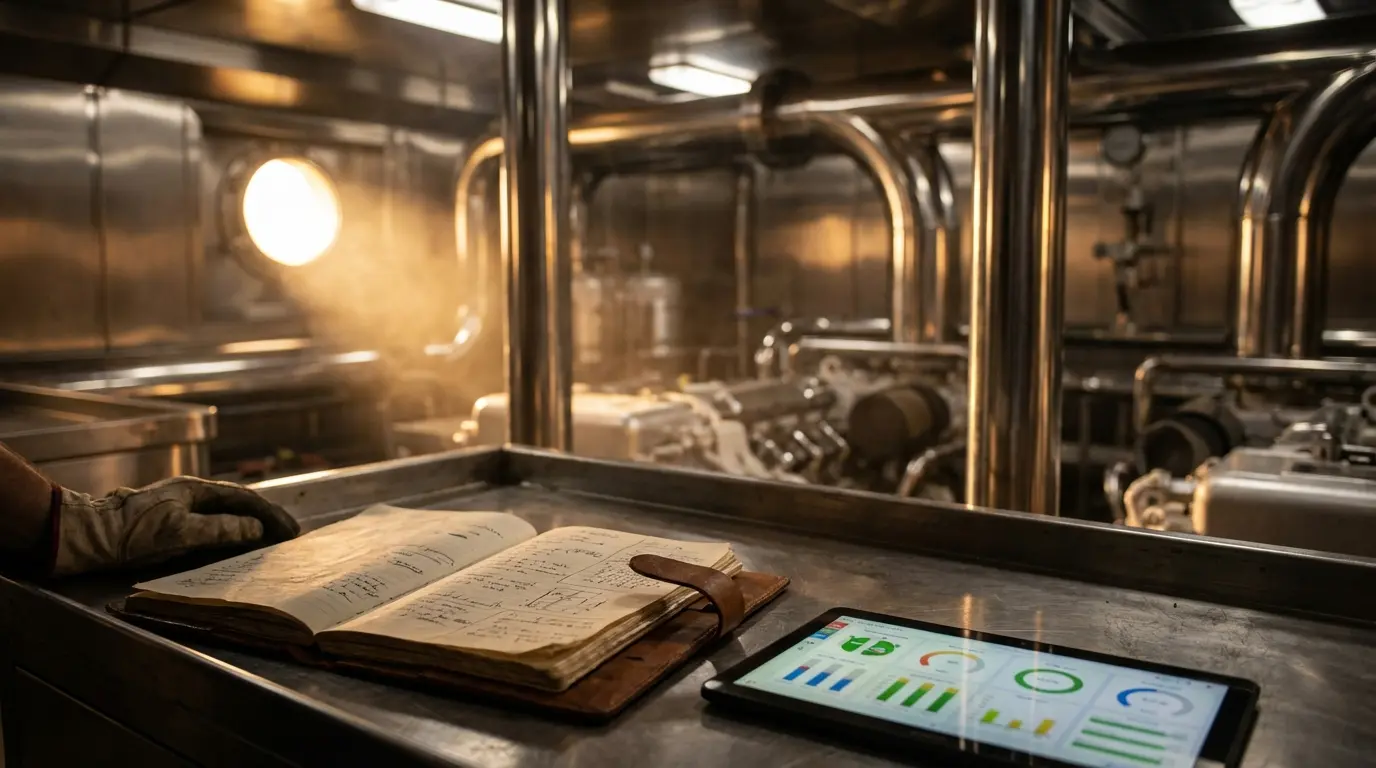
Quick Summary
- ✓Paper logbooks lose institutional knowledge with every crew rotation and cannot be searched or analyzed
- ✓AI-powered platforms analyze maintenance patterns across time to predict equipment failures weeks in advance
- ✓Digital transition takes 2-4 weeks for equipment inventory and active schedules; no need to backfill history
- ✓Mobile-first design and offline access ensure crew actually use the system in engine rooms and at docks
- ✓A single prevented failure worth $5K-$20K covers years of software subscriptions and justifies the switch
The chief engineer handed me a ring binder. It was thick, maybe four inches, with a cracked spine and tabs that had long since lost their labels. We were sitting in the crew mess of a 62-meter Lurssen in La Ciotat, and I had asked to see the maintenance history for the port generator.
"It is in there somewhere," he said, with the tone of a man who had been through this particular exercise before. "The last chief had a different system. And the one before him had a different system from that."
I spent forty-five minutes looking for the record of a coolant pump replacement that we knew had happened eight months earlier. When I finally found it, the entry was a single line in handwriting I could not decipher, with no date, no parts reference, and no mention of whether the impeller had been replaced at the same time.
This was a yacht with an annual operating budget north of two million euros. A vessel with a full-time crew of sixteen, a dedicated technical manager ashore, and a captain who ran a tight operation by every other measure. And yet the maintenance records, the single most important technical document aboard, were essentially unreliable.
That was not an unusual situation. It was a completely typical one.
The Paper Problem Nobody Talks About
Here is the uncomfortable truth about superyacht maintenance records in 2026. A significant number of vessels, including yachts valued at thirty million euros and above, still rely on paper logbooks, ring binders, and spreadsheets as their primary maintenance documentation.
I am not talking about small sailing yachts or weekend pleasure boats. I am talking about professionally crewed superyachts with complex machinery plants, ISM compliance requirements, and class survey schedules that demand meticulous record-keeping.
Paper persists for reasons that are understandable. The chief engineer who learned his trade filling in logbooks by hand trusts what he can see and touch. The captain who has been through a total electronics failure mid-Atlantic knows that paper does not crash. The management company that has been running the same system for fifteen years does not want to disrupt operations during the charter season.
These are not irrational concerns. They come from real experience, and anyone selling digital solutions to this industry needs to respect that. But understanding why paper persists does not change the fact that it is costing yacht owners, operators, and crew far more than they realize.
Knowledge Walks Off the Yacht
Crew turnover in the superyacht industry is among the highest in any maritime sector. Engineers rotate, chiefs move to new builds, second engineers get promoted to chief on another vessel. Every time a key crew member leaves, their understanding of the machinery, the quirks of specific equipment, the context behind maintenance decisions, walks off the gangway with them.
With paper records, the incoming engineer inherits a collection of binders that may or may not contain the information they need. They cannot search those binders. They cannot see trends. They cannot quickly answer the question: when was the last time we serviced the hydraulic power pack, and what did we find?
I have watched new chief engineers spend their first two weeks aboard essentially performing an archaeological dig through filing cabinets, trying to reconstruct a maintenance timeline from fragments of previous crews' documentation. That is two weeks of a senior technical professional's time spent on administrative detective work instead of engineering.
The Audit Problem
Every captain who has prepared for a flag state inspection or a class survey knows the feeling. The surveyor asks for the maintenance history of a specific piece of safety equipment. You know the work was done. You are confident the records exist. But finding them means pulling binders, cross-referencing dates, and hoping the relevant entry is legible and complete.
I have seen surveys that should take a single day stretch into two because the documentation took longer to assemble than the physical inspection. That is not just an inconvenience. It is a cost measured in surveyor fees, port days, and crew overtime. It also creates a terrible impression with the surveyor, who starts wondering what else might be incomplete.
Paper Cannot Think
Perhaps the most significant limitation of paper records is what they cannot do. Paper cannot analyze. Paper cannot correlate the rising oil consumption on the starboard main engine with the vibration readings logged three months ago and the operating profile data from last summer's Mediterranean season.
Paper records are static. They capture a moment in time and then sit there. The patterns that predict equipment failures, the trends that reveal degrading performance, the correlations that could prevent a catastrophic breakdown during an owner's trip, are all invisible in a paper system because no human has the time or capacity to read through thousands of entries and identify those connections.
This is not a criticism of the engineers maintaining these records. It is a recognition that paper is fundamentally the wrong medium for a task that demands dynamic analysis of interconnected data points across long time horizons.
The Evolution: Paper to Spreadsheets to PMS to AI
The superyacht industry has not been standing still. The transition from paper to digital has been happening in stages, and understanding that progression helps clarify where we are now and where we are heading.
Stage One: Paper Logbooks
The original system. Handwritten entries in bound logbooks, maintenance records in ring binders, parts inventories on clipboards, and defect lists on whiteboards. It worked when yachts were simpler, crews stayed longer, and regulatory requirements were less demanding.
The strengths were tangible. No batteries required, no software updates, no login credentials. The weaknesses were equally tangible. No searchability, no backup (lose the binder, lose the history), no way to share information between vessel and shore office in real time, and absolutely no analytical capability.
Stage Two: Spreadsheets
Excel arrived on yachts and felt like a revolution. Suddenly you could sort, filter, and calculate. You could create maintenance schedules with formulas that flagged overdue tasks. You could email a spreadsheet to the management company instead of faxing photocopies of logbook pages.
But spreadsheets are, at their core, digital paper. They share most of paper's fundamental problems. Version control is nonexistent. The chief sends an updated spreadsheet ashore; the technical manager makes changes to a different version; within a week, nobody knows which file is current. Spreadsheets do not enforce data consistency. One engineer logs hours as "1,250" and another logs them as "1250 hrs" and a third logs them as "twelve fifty," and suddenly your data is unreliable for any analytical purpose.
I have seen Excel maintenance trackers on superyachts that would make a data scientist weep. Merged cells, color-coded rows with no legend, multiple tabs with conflicting information, and formulas that broke six crew rotations ago and nobody noticed because the numbers looked plausible.
Stage Three: Digital Planned Maintenance Systems
Purpose-built planned maintenance systems represented a genuine step forward. They centralized records, enforced data structures, scheduled tasks based on calendar intervals or running hours, and generated the reports that management companies and surveyors needed.
First-generation PMS platforms got centralization right. For the first time, everyone from the second engineer to the shore-based technical manager could access the same set of records. They also brought structure, requiring users to fill in specific fields rather than writing free-text entries that might or might not contain the relevant information.
But early PMS platforms also introduced new problems. Many were designed for commercial shipping and adapted for yachts, which meant interfaces built for desktop computers that crew were expected to use on a shared PC in the captain's office. The user experience was often poor. Data entry felt like a chore rather than a natural part of the workflow. And critically, these systems were still fundamentally reactive. They told you what maintenance was scheduled and whether it was overdue. They did not tell you what maintenance was actually needed based on the real condition of your equipment.
Stage Four: AI-Powered Platforms
This is where the industry stands today, at the threshold of a fourth stage that fundamentally changes what maintenance records can do. AI-powered platforms do not just store and organize data. They analyze it, learn from it, and generate insights that were impossible in any previous system.
The difference is not incremental. It is categorical. Moving from paper to spreadsheets improved convenience. Moving from spreadsheets to a PMS improved organization. Moving to an AI-powered platform improves understanding. And in maintenance management, understanding is what prevents failures, reduces costs, and keeps yachts operating safely.
What AI Adds That Paper Never Could
I want to be specific here, because the yacht industry has been promised technological revolutions before and experienced captains and engineers are rightly skeptical of vague claims about AI transforming everything.
Pattern Recognition Across Maintenance Histories
An AI-powered diagnostic system can analyze your complete maintenance history and identify patterns that no human would catch. It connects the fact that your watermaker membrane replacements have been trending more frequent over the past eighteen months with the sea water temperature data and the pre-filter inspection logs to determine that your pre-filtration system is underperforming, causing accelerated membrane wear.
That kind of multi-variable correlation across hundreds of data points and months of history is simply impossible with paper records, even for the most diligent chief engineer. The data is there in the logbooks. The connections are invisible because a human cannot hold all those variables in working memory simultaneously.
Predictive Alerts Based on Real Equipment Data
Traditional maintenance scheduling says: replace the raw water pump impeller every 2,000 hours. AI-powered predictive maintenance says: based on this specific pump's performance data, operating conditions, and historical wear patterns on similar equipment, this impeller is showing early signs of degradation and should be inspected within the next 200 hours.
The difference is the difference between a calendar reminder and a medical diagnosis. One follows a generic schedule. The other responds to actual conditions.
Conversational Troubleshooting
When a second engineer encounters an unfamiliar alarm at two in the morning during an Atlantic crossing, paper records are nearly useless. The relevant information might be in a binder, but finding it under pressure, in a rolling engine room, while the alarm is sounding, is not realistic.
An AI assistant like Wyse-I can be asked a plain-language question: "The low-pressure alarm on the hydraulic stabilizer system keeps triggering after startup. What should I check?" The system draws on the vessel's specific equipment data, maintenance history, and known failure modes to provide targeted troubleshooting steps. Not a generic manual excerpt, but guidance informed by what has actually happened on this yacht with this equipment.
Automatic Trend Analysis
Every time a crew member logs a maintenance task, records an equipment reading, or completes a checklist, the AI platform is building a more complete picture of the vessel's technical health. Over time, it identifies trends that would take a human analyst weeks of dedicated review to spot.
Oil consumption trending upward by 3 percent per month. Bilge pump run cycles increasing in frequency. Generator load imbalance developing between the port and starboard units. These are the early warning signals that prevent expensive failures, and they are only visible when your records are digital, structured, and analyzed by systems designed to find them.
Smart Checklists That Adapt
Paper checklists are static. The same list gets completed the same way regardless of what is actually happening on the vessel. AI-powered checklists can adapt based on conditions. If the vessel has been stationary in a marina for three weeks, the checklists emphasize systems that degrade during inactivity: air conditioning condensation, generator exercise, hull fouling checks. If the yacht has just completed a long passage, the checklists shift to post-voyage inspection items.
This is not complexity for its own sake. It is the system being intelligent enough to direct crew attention where it matters most at any given time.
The Transition Roadmap: Paper to Digital in Four Phases
I have helped enough vessels make this transition to know that the biggest mistake is trying to do everything at once. The captains and engineers who succeed approach it in phases, building confidence and competence at each stage before moving to the next.
Phase One: Digitize Your Equipment Inventory and Active Schedules
Start with the foundation. Get every piece of significant equipment into the digital system with its specifications, serial numbers, manufacturer details, and current maintenance schedules. This is the work that pays for itself immediately because it creates a searchable, shareable equipment database that every crew member and shore-based manager can access.
Do not try to be exhaustive on day one. Start with the critical systems: main engines, generators, navigation equipment, safety systems, and the equipment that class and flag state care about during surveys. You can add secondary systems over the following weeks.
Most vessels can complete this phase in one to two weeks with a focused effort from the chief engineer and one or two crew members.
Phase Two: Start Logging New Maintenance Digitally
This is the phase where I see the most unnecessary stress, because crews feel they need to backfill years of paper history before they can start using the digital system. They do not.
Start logging new maintenance activities in the digital platform from a defined date forward. Every task completed, every inspection performed, every parts replacement, goes into the digital system from that point on. The paper binders become historical archives. They do not need to be digitized in their entirety.
The critical mindset shift here is accepting that the digital record will be incomplete for a while, and that is perfectly fine. A partial digital record that is accurate, searchable, and growing every day is infinitely more valuable than a complete paper record that nobody can effectively use.
Phase Three: Train Crew on Mobile-First Workflows
This is where platform choice matters enormously. If the digital system requires crew to find a laptop, log in to a desktop application, navigate through multiple menus, and type detailed entries using a keyboard, adoption will fail. Engineers do not work at desks. They work in engine rooms, in lazarettes, on deck, and in spaces where a laptop is impractical.
A mobile-first platform that lets crew log a completed task with a few taps on their phone, snap a photo of the work performed, and move on to the next job, that is a system crews will actually use. Add offline capability so the system works during ocean crossings without satellite connectivity, and you have removed the last practical barrier to adoption.
Training should take hours, not days. If your crew needs a week of training to use the maintenance system, the system is too complicated. The best platforms are intuitive enough that a technically competent engineer can start logging tasks within thirty minutes of first opening the app.
Phase Four: Leverage AI Insights
Once you have three to six months of consistent digital data, the AI layer starts delivering genuine value. The system has enough history to establish baselines, identify trends, and generate predictions that are specific to your vessel and your equipment.
This is the phase where captains and chief engineers have the realization that changes their perspective on digital records permanently. They see a prediction they would never have caught from paper logs. They receive an alert about a developing issue weeks before it would have become an emergency. They pull a comprehensive maintenance report for a survey in thirty seconds instead of thirty hours.
At this point, nobody on board wants to go back to paper.
Getting Your Crew on Board
Technology adoption on a superyacht is fundamentally a people challenge, not a technology challenge. The best platform in the world fails if the crew does not use it consistently.
Start With Pain Points, Not Features
Do not introduce the digital system by listing its features. Introduce it by solving a problem the crew already has. If the second engineer spends twenty minutes every morning filling in paper checklists, show them how the digital checklist takes three minutes on their phone. If the chief hates preparing survey documentation, show them the one-click report generation.
Crew adopt tools that make their lives easier. They resist tools that feel like additional administrative burden. Lead with the reduction in paperwork, not the addition of technology.
Respect the Generational Dynamic
The superyacht industry has a genuine generational divide when it comes to technology. Junior crew in their twenties expect digital tools and find paper logbooks baffling. Senior engineers in their fifties may have decades of experience with paper systems and legitimate skepticism about digital alternatives.
The solution is not to dismiss either perspective. Pair junior and senior crew during the transition. Let the junior crew handle the technical interface while the senior crew contribute their irreplaceable knowledge of the machinery. Often, the most effective approach is having a younger second engineer champion the system while the chief provides the engineering expertise that makes the data meaningful.
Make It the Path of Least Resistance
The moment digital logging becomes harder than paper logging, you have lost. The system needs to be the easiest way to record what happened. If taking a photo of a completed repair and adding a two-line note on a phone is faster than writing in a logbook, crews will choose the phone every time.
This is why mobile-first design is not a nice-to-have feature. It is the single most important factor in crew adoption. If the system was designed for a desktop and the mobile app is an afterthought, the crew in the engine room will default to paper and the data will be incomplete.
Celebrate Early Wins
When the digital system catches something that paper would have missed, make sure the whole crew knows. The first time an AI alert prevents an unplanned repair, or the survey documentation comes together in an afternoon instead of a week, those are the moments that convert skeptics into advocates.
Recognition matters. When the bosun completes a perfect set of tender maintenance records with photos and notes, acknowledge it. When the second engineer uses the system to identify a parts reorder need before the item runs out, highlight it. Positive reinforcement drives adoption far more effectively than mandates.
The Real Cost of Waiting
I understand the temptation to wait. The current system works, more or less. The charter season is coming. There is always a reason to postpone the transition.
But consider what the paper system is actually costing you. The hours of crew time spent on administrative tasks that a digital system handles in seconds. The risks of incomplete records during insurance claims or warranty disputes. The inability to see equipment trends that could prevent a six-figure emergency repair. The knowledge lost every time an experienced crew member departs.
The superyacht industry is moving toward digital operations not because it is fashionable, but because the operational advantages are too significant to ignore. Regulatory bodies are increasingly expecting digital documentation. ISM compliance is easier to demonstrate and maintain with structured digital records. Class societies are moving toward continuous survey methodologies that depend on accessible, analyzable maintenance data.
Vessels that make the transition now will have years of structured data when AI capabilities mature further. Vessels that wait will be starting from scratch while their peers are already benefiting from predictive insights and automated trend analysis.
Why YachtWyse Makes the Transition Painless
I have been deliberately platform-agnostic throughout this post because the principles of paper-to-digital transition apply regardless of which system you choose. But I want to be transparent about why we built YachtWyse the way we did, because every design decision was informed by watching crews struggle with exactly the problems described above.
YachtWyse was built mobile-first because we watched engineers give up on desktop PMS platforms that could not be used in the engine room. Offline access works seamlessly because we know that mid-ocean is exactly when you need your maintenance records most. Photo documentation is built into every task because a picture of a corroded impeller tells the shore-based technical manager more than any written description.
The AI layer, powered by our Wyse-I diagnostic assistant, starts delivering value from day one with conversational troubleshooting and grows more powerful as your maintenance data accumulates. Within a few months of consistent use, the system is identifying trends, generating predictions, and providing the kind of equipment intelligence that transforms how you manage your vessel.
The transition from paper to digital does not need to be disruptive. It does not need to consume an entire refit period. With the right platform, it can happen alongside normal operations, with minimal training, and start paying for itself almost immediately.
Frequently Asked Questions
How long does it take to transition from paper logbooks to a digital maintenance system?
Most vessels can be operationally digital within two to four weeks. The first phase involves digitizing your equipment inventory and active maintenance schedules, which typically takes one to two weeks depending on vessel complexity. New maintenance logging can start immediately after that. You do not need to backfill years of paper records to begin getting value from a digital system.
Will a digital maintenance system work offshore without internet?
Yes, if you choose a platform built for marine operations. YachtWyse and other marine-focused platforms offer offline functionality that lets crew log maintenance, take photos, and complete checklists without connectivity. Data syncs automatically when the vessel reconnects. This is a critical requirement that generic maintenance software cannot meet.
How do I get resistant crew members to adopt digital maintenance tools?
Start with the tasks that cause the most friction on paper, such as daily checklists and equipment hour logging. Choose a mobile-first platform that crew can use on a phone or tablet in the engine room. Pair experienced crew with the system gradually rather than mandating a full switch overnight. Most resistance fades within the first two weeks once crew experience how much faster digital logging is.
What happens to our existing paper records during the transition?
Keep your paper records as archived reference material. There is no need to digitize every historical entry. Focus on getting current equipment inventories, active maintenance schedules, and recent service histories into the digital system. Over time, the digital records will become your primary source of truth and the paper binders will become historical archives.
Can AI-powered maintenance records help with insurance and warranty claims?
Absolutely. Digital records with timestamps, photos, and complete service histories create a documented chain of evidence that paper logbooks cannot match. When filing an insurance claim or warranty request, you can produce a comprehensive, verifiable maintenance history in minutes rather than spending hours searching through binders for the relevant entries.
The Bottom Line
The journey from paper logbooks to AI-powered maintenance records is not a technology upgrade. It is an operational transformation that makes your vessel safer, your crew more effective, your compliance more robust, and your maintenance spending more intelligent.
The paper logbook served the industry well for decades. But the demands placed on modern superyacht operations, the complexity of the machinery, the regulatory requirements, the expectation of data-driven decision-making, have outgrown what paper can deliver.
The transition does not require a leap of faith. It requires a first step. Digitize your equipment inventory. Start logging maintenance digitally. Give your crew a tool they actually want to use. And let the AI do what paper never could: turn your maintenance records from a static archive into a living intelligence system that actively protects your vessel.
If you are ready to explore what that looks like for your yacht, start with YachtWyse and see how quickly the transition from paper to digital pays for itself.
Related Articles
- How AI Is Transforming Superyacht Engineering - Predictive maintenance and AI diagnostics
- Best Superyacht PMS Software in 2026 - Comparing the top maintenance platforms
- ISM Compliance Software for Superyachts - Digital tools for ISM Code compliance
- YachtWyse for Enterprise - White-label platform for management companies
Sources
Research for this article included:
Written by
YachtWyse Team
Maritime Technology Experts
The YachtWyse team brings decades of combined experience in maritime operations, marine engineering, and software development. We write from real-world experience managing vessels from 30ft cruisers to 100m+ superyachts.
Ready to Simplify Your Yacht Management?
YachtWyse helps owner-operators track maintenance, manage costs, and get AI-powered diagnostic assistance. Start your free trial today.
Request a DemoRelated Articles
Marine Equipment Tracking Software (2026)
How marine equipment tracking software helps superyacht engineers manage inventories, meet class society requirements, and prevent costly failures in 2026.
Best Superyacht PMS Software in 2026
A chief engineer's honest comparison of the best planned maintenance systems for superyachts in 2026, from Seahub to YachtWyse and beyond.
Predictive Yacht Maintenance: Stop Fixing, Start Preventing
How predictive maintenance saved me $43,000 annually on my 52-foot yacht. Learn the difference between reactive, preventive, and predictive approaches.