Trusted Systems for Boat Tour Operators 2026
Quick Summary
- ✓Tour boat operations require two systems: booking platforms for guests and operational platforms for vessels
- ✓FareHarbor, Peek Pro, and Rezdy handle bookings well but don't track maintenance or compliance
- ✓YachtWyse fills the operational gap with engine-hour tracking, USCG compliance, and cost-per-trip analytics
- ✓Digital compliance records let you pass USCG inspections in minutes instead of scrambling through binders
- ✓Smart operators run both systems together: booking platforms keep boats full, operational platforms keep them running
Quick Take: The Most Trusted Systems for Boat Tour Operators in 2026
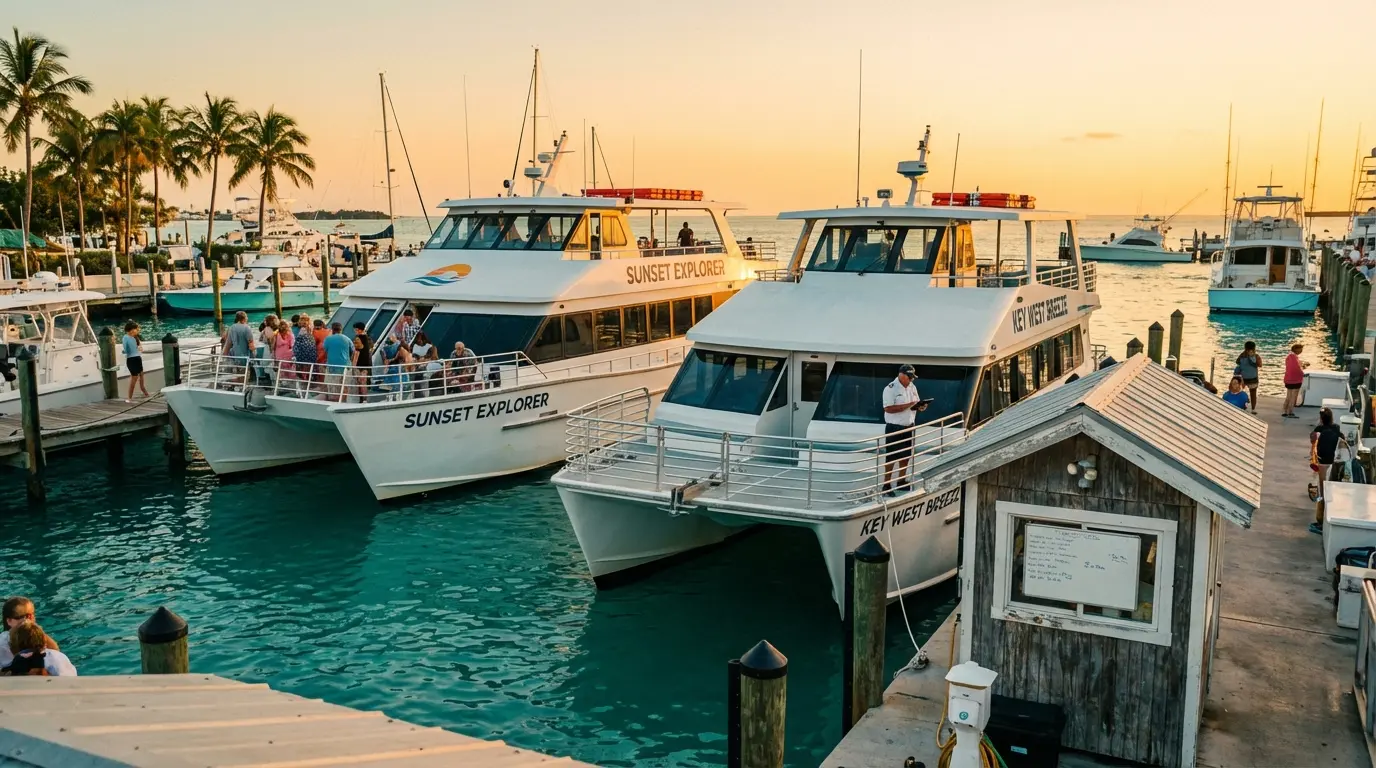
Last July, I was standing on a dock in Key West watching a USCG inspector walk toward my 45-foot catamaran. He had a clipboard. I had a knot in my stomach.
He asked for my fire extinguisher service records. Then my life jacket inventory log. Then proof that my captain's license was current. Then my safety drill documentation from the last 90 days.
Two years ago, that interaction would have taken me 45 minutes of rifling through a binder in the wheelhouse, hoping I had filed everything correctly. This time, I pulled up every record on my phone in under a minute. The inspector raised an eyebrow, nodded, and moved on.
That moment crystallized something I had been learning the hard way: running a successful tour boat operation in 2026 requires two completely different systems working together. One for filling your boats with guests. One for keeping those boats running safely, legally, and profitably.
If you are searching for the most trusted systems for boat tour operators in 2026, this guide covers what I have learned running snorkel tours and sunset cruises across three boats in the Florida Keys. I am going to be honest about what works, what doesn't, and where the real gaps are.
The Two Sides of Every Tour Boat Operation
Here is the thing nobody talks about at marine trade shows: every tour boat business is actually two businesses running simultaneously.
The guest-facing side is the one everyone focuses on. Bookings, availability calendars, payment processing, marketing, TripAdvisor reviews, OTA distribution, waivers, and upsells. This is the visible business, the one your guests interact with.
The operational side is the one that keeps you in business. Engine maintenance schedules, safety equipment inspections, hull cleaning intervals, crew certifications, fuel costs, parts inventory, USCG compliance documentation, and the ten thousand small things that prevent a $47,000 engine rebuild from blindsiding you in peak season.
Most tour operators I talk to have the booking side figured out. They picked a platform a few years ago, customized their listings, and bookings flow in. But ask them how they track when their port engine hits its next service interval, or when their CO2 system needs recertification, and you will get one of three answers: a spreadsheet, a whiteboard in the shop, or an honest "I try to remember."
That gap between a polished booking experience and a chaotic back-end operation is where tour boat businesses get hurt. Not because they are careless, but because until recently, there was nothing built for them to manage it.
The Booking Platforms: What They Do Well
I am not going to pretend that booking platforms are the enemy. They are genuinely good at what they do. Here is an honest breakdown of the three most common ones I see tour operators using.
FareHarbor
FareHarbor dominates the tour and activity space for good reason. Their booking flow is clean, their distribution network connects you to major OTAs, and their dashboard makes managing availability across multiple trips per day straightforward. They also offer website design services, which is a nice touch if you do not want to mess with your own site.
The pricing model passes booking fees to the customer rather than charging you a monthly subscription, which keeps your fixed costs low. For a sunset cruise operator running tight margins, that matters.
What it does not do: Anything related to your boats. No maintenance tracking, no compliance documentation, no crew certification management, no cost-per-trip analysis. FareHarbor knows when your 6 PM sunset cruise is sold out. It has no idea that the starboard engine on Boat 2 is 50 hours past its oil change interval.
Peek Pro
Peek Pro has carved out a strong position with outdoor adventure operators, including boat tours. Their platform handles bookings, payments, waivers, and marketing retargeting. They have a unique feature called Peek Capital that offers business loans, which can be a lifeline during the slow season.
The calendar and availability management works well for high-volume operations running multiple departure times. Their channel management connects to major distribution platforms.
What it does not do: Same story as FareHarbor. Peek Pro is built for the guest experience, not for what happens to the boat between trips. No engine hour tracking, no safety equipment logs, no maintenance scheduling.
Rezdy
Rezdy focuses on booking and distribution, connecting operators to a global network of resellers and OTAs. If you are in a tourist-heavy market and want maximum exposure across booking channels, Rezdy's distribution strength is compelling.
Their pricing starts at a monthly subscription plus a per-booking fee, which adds up differently than FareHarbor's model. Worth running the numbers based on your volume.
What it does not do: You already know where this is going. Rezdy manages bookings. Your boats are on their own.
The Pattern
These are all solid platforms. I am not suggesting you replace them. But they all share the same blind spot: they see your operation through the lens of reservations and revenue. They do not see the boats.
And the boats are where things go wrong.
What Tour Operators Actually Need on the Operational Side
After three seasons of running tours, losing sleep over inspections, and learning expensive lessons about deferred maintenance, here is what I think every tour boat operation with more than one vessel needs from an operational management system.
Maintenance Tracking That Understands High Utilization
Tour boats are not weekend pleasure craft. My three boats each run 3-4 trips a day during peak season. That is 800-1,200 engine hours per season, per boat. Service intervals come fast.
A good system tracks maintenance by both calendar and engine hours, sends alerts before you hit intervals, and logs completed work with photos and costs. When your mechanic replaces the raw water pump impeller on Boat 1, that record needs to exist somewhere more permanent than a grease-stained notepad.
The difference between preventive maintenance and emergency repairs is often a $200 impeller swap versus a $15,000 overheating incident that takes a boat offline for two weeks during your busiest month.
Safety Compliance That Is Always Ready
If you carry more than six paying passengers in the US, USCG inspections are a fact of life. Your Certificate of Inspection is your license to operate, and inspectors can show up unannounced.
They want to see documentation for fire extinguisher servicing, life raft inspections, EPIRB registrations, flare expiration dates, life jacket counts and condition, safety drill logs, and crew licensing. All current. All organized.
A system that stores these records digitally, alerts you before certifications expire, and lets you pull them up on a phone or tablet in the wheelhouse is not a luxury. It is the difference between passing an inspection in five minutes and sweating through an hour of searching while your next tour group waits on the dock.
Crew Management for Seasonal Operations
Tour boat crews turn over. You hire captains and mates for the season, some come back, some don't. Each one has licenses, certifications, medical certificates, and drug testing records that need to be current.
A good system tracks all of it per crew member: USCG license expiration, first aid and CPR certification, TWIC card renewal, drug test scheduling, and whatever else your COI requires. When your seasonal captain's medical certificate expires in August and you are running full capacity, you need to know about it in July, not when the inspector asks.
Cost-Per-Trip Tracking
This is the one that changed how I run my business. For two seasons, I assumed my whale watching trips were my most profitable product because they had the highest ticket price. I was wrong.
When I finally broke down costs per trip, the whale watching runs burned significantly more fuel due to longer distances, required more maintenance due to rougher offshore conditions, and needed a larger crew. My harbor tours, which I had almost dropped from the schedule, turned out to have the best margins because they were short, fuel-efficient, and required minimal crew.
You cannot make smart pricing or scheduling decisions without knowing what each trip actually costs. A system that tracks fuel consumption, allocates maintenance costs per vessel, and factors in crew expenses per trip gives you the numbers you need.
Equipment and Inventory Management
Tour boats carry a lot of gear that needs tracking. Life jackets in multiple sizes. Snorkel sets. Fishing rods. First aid kits. Dive tanks. Sunscreen. All of it has quantities, conditions, and replacement cycles.
When you are turning a boat between a morning snorkel trip and an afternoon sunset cruise, you need to know that all the snorkel gear came back, that the life jackets are accounted for, and that the first aid kit is fully stocked. A checklist system that your crew can run through on a tablet or phone between trips keeps the operation tight.
The Most Trusted Systems for Boat Tour Operators in 2026
Now for the actual landscape. Here is what I see tour operators using for the operational side, with honest assessments.
Enterprise Maritime: Helm CONNECT
Helm CONNECT is the heavy hitter in commercial vessel management. If you run a ferry company or a fleet of workboats, it is the industry standard. Maintenance, compliance, personnel, logistics, purchasing — it covers everything.
For a 3-boat tour operation? It is like using a commercial trucking fleet management system for a food truck. The capabilities are there, but the complexity and cost are calibrated for operators with 20+ vessels, dedicated shore-side management teams, and procurement departments. I talked to two tour operators who tried it. Both switched within a year because the overhead of running the system was almost as much work as the manual processes it replaced.
If you are running 15+ vessels and have a dedicated operations manager, Helm CONNECT makes sense. For most tour boat operators reading this, it is overkill.
The Operational Gap Filler: YachtWyse
This is where I landed after trying spreadsheets, a whiteboard system that fell apart when I added the third boat, and a brief flirtation with enterprise software.
YachtWyse is built for the operational side of vessel management. Maintenance tracking with engine-hour-based alerts. Digital checklists your crew can run between trips on their phones. Compliance document storage with expiration alerts. Cost tracking per vessel. Crew certification management. Equipment registries.
The AI diagnostics feature has saved me more than a few mechanic calls. When my captain reported an unusual vibration on Boat 2, instead of immediately scheduling a haul-out, I ran it through the diagnostic tool. It suggested checking the prop for fishing line wrap based on the symptoms, which turned out to be exactly the problem. A 20-minute fix instead of a $1,500 haul-out.
It is mobile-first, which matters when your captains are logging maintenance notes on the dock between trips, not sitting at a desk. And the cost tracking gives me the per-trip profitability data that changed my scheduling decisions.
What it does not do: bookings, guest management, marketing, or payment processing. It is not trying to replace FareHarbor or Peek Pro. It is meant to work alongside them, covering the operational side they do not touch.
The DIY Approach: Spreadsheets and Paper
I will be honest. A surprising number of tour operators are still running maintenance on spreadsheets and compliance on paper. For a single-boat operation, it can work. I know a captain in St. Augustine who runs one 30-foot center console for fishing charters and tracks everything in a spiral notebook. He has been doing it for 15 years. It works for him.
But it breaks down the moment you add a second boat, hire seasonal crew, or face an unexpected inspection. Spreadsheets do not send alerts. Paper logs get lost. And when you are running 4 trips a day across 3 boats during tourist season, the mental bandwidth to manually track everything is bandwidth you do not have.
The Smart Operator's Tech Stack
The tour operators I see running the tightest operations in 2026 are using a two-platform approach.
For the guest-facing side: A booking platform like FareHarbor, Peek Pro, or Rezdy handles reservations, payments, waivers, marketing, and distribution. Pick the one that fits your market and pricing model.
For the operational side: A vessel management platform like YachtWyse handles maintenance, compliance, crew, costs, and equipment. Pick the one that matches your fleet size and operational complexity.
The two sides do not need to talk to each other. Your booking platform tells you that Tuesday's 10 AM snorkel trip has 24 guests. Your operational platform tells you that the boat assigned to that trip has current safety certs, a crew with valid licenses, engines within service intervals, and enough snorkel sets on board.
Together, they cover the full picture. Separate, each one only gives you half.
Real Scenarios You Will Recognize
If you have been running tour boats for more than a season, these will sound familiar.
The Surprise Inspection
Your USCG inspector shows up on a Thursday morning. Your best captain is out today, and the mate running the boat has only been with you for three weeks. The inspector wants fire extinguisher service dates, life jacket inventory, safety drill logs, and crew documentation.
Without a system: You are pulling binders from the wheelhouse, calling your captain to ask where the drill logs are, and trying to remember if the fire extinguishers were serviced in January or February. The inspection takes an hour and you miss your 10 AM departure.
With a system: The mate pulls up the vessel's compliance dashboard on a tablet. Every document is there, organized, current. The inspector verifies everything in 15 minutes. You make your 10 AM departure.
The Engine Hour Surprise
Your second boat's port engine hits 500 hours. The manufacturer recommends a full service at 500 hours, including impeller, belts, zincs, and fluid changes. Nobody scheduled it because nobody was tracking hours.
Without a system: The engine runs another 100 hours before someone notices. By then, the impeller has deteriorated and rubber fragments have partially blocked the heat exchanger. What should have been a $400 service becomes a $3,500 repair, and the boat is offline for a week.
With a system: You got an alert at 475 hours. The service was scheduled for next Monday, parts were already ordered. The captain ran the pre-departure checklist this morning, confirmed the engine hours, and everything is on track.
The Profitability Question
You are planning next season's schedule. You run sunset cruises, snorkel trips, and whale watching tours. Which trips should you add more of? Which should you cut?
Without a system: You look at revenue per trip and assume whale watching wins because tickets are $95 versus $65 for snorkel trips. But you have not factored in that whale watching burns three times the fuel, requires a longer boat with higher maintenance costs, and needs an extra crew member.
With a system: Your cost-per-trip report shows that snorkel trips net $38 per guest after all costs, sunset cruises net $31, and whale watching nets $22. You add two more snorkel departures and drop the Tuesday whale watching run. Your season profit goes up 18%.
What to Look for When Choosing Your Operational System
Not every vessel management platform is built for tour boat operations. Here is what to prioritize.
Mobile-first design. Your captains and crew are not sitting at desks. They are on docks, in wheelhouses, and between trips. If the system requires a laptop to be useful, it will not get used.
Engine-hour-based maintenance tracking. Calendar reminders are not enough for tour boats running 4 trips a day. You need alerts based on actual engine hours, because a boat running 8 hours a day hits service intervals four times faster than a weekend cruiser.
Pre-departure checklists. Digitized safety checklists your crew can complete on a phone before every trip. This creates a compliance record and ensures nothing gets skipped during a fast turnaround.
Cost tracking per vessel. Fuel, maintenance, crew costs, and equipment expenses broken down by boat and ideally by trip type. Without this, you are guessing at profitability.
Compliance document management. A place to store and track expiration dates for every certificate, license, and inspection record your operation requires. With automatic alerts before things expire.
Crew certification tracking. Especially important for seasonal operations where crew members change and each person's licensing, medical certificates, and training records need to stay current.
The Bottom Line
Running a tour boat operation in 2026 means running two businesses at once. The guest-facing side gets all the attention because it is where the revenue comes from. But the operational side is where your margin lives or dies.
The most successful operators I know have stopped trying to do both jobs with one tool. They use a booking platform that excels at filling boats and an operational platform that excels at keeping those boats safe, legal, and profitable.
If your booking system is humming but your maintenance tracking is still on a whiteboard, or your compliance records are stuffed in a binder, or you have no idea what your actual cost per trip is, that is the gap to close.
Your booking platform keeps the boats full. Your operational platform keeps them running. You need both.
Ready to bring your operational side into 2026? See how YachtWyse works for tour and charter operators, or explore the owner-operator features built for hands-on boat owners who run their own operations.
Written by
YachtWyse Team
Maritime Technology Experts
The YachtWyse team brings decades of combined experience in maritime operations, marine engineering, and software development. We write from real-world experience managing vessels from 30ft cruisers to 100m+ superyachts.
Ready to Simplify Your Yacht Management?
YachtWyse helps owner-operators track maintenance, manage costs, and get AI-powered diagnostic assistance. Start your free trial today.
Request a DemoRelated Articles
What is Yacht Management Software? Complete Guide for 2026
Learn what yacht management software is, who uses it, key features to look for, and how to choose the right platform for your vessel. Updated for 2026.
Why Superyacht Charter Companies Are Ditching Paper Preference Sheets in 2026
Charter managers and chief stewardesses are replacing 12-page PDF preference sheets with mobile-friendly digital alternatives. Here's what's driving the shift and what it means for guest onboarding.
How to Track Yacht Maintenance Like a Pro
Learn how to track yacht maintenance effectively with proven systems, schedules, and tools. Discover why spreadsheets fail and how smart software saves owner-operators 10+ hours monthly.