How I Fixed Crew Chaos Across My Charter Fleet
Quick Summary
- ✓Crew management complexity explodes exponentially as you scale from one vessel to multiple, requiring systematic approaches.
- ✓Implement three-layer system: certifications with 90/60/30-day alerts, cross-vessel coordination, and parallel communication channels.
- ✓Role-based permissions prevent bottlenecks while protecting sensitive data across fleet managers, captains, department heads, and crew.
- ✓Certification compliance failures cost $47,000+ in lost charters; proactive tracking with automated alerts prevents disasters.
- ✓Switching from spreadsheets to integrated platforms saves 15-20 hours weekly and enables profitable fleet scaling.
It was 2 AM on a Tuesday when my phone rang. My lead captain on Sea Whisper was stranded at Fort Lauderdale airport — his STCW certification had expired three days earlier, and customs wouldn't let him board the vessel. We had a high-paying charter departing at noon.
I was running a four-vessel charter operation out of Tampa Bay, and I thought I had crew management figured out. I had spreadsheets. I had reminder emails. I even had a shared Google Calendar with everyone's rotations color-coded.
I was wrong. And that missed charter cost me $47,000 in revenue and nearly destroyed a relationship with a returning client.
That morning changed everything about how I approach crew management. If you're running charter operations or managing a fleet, you already know: your crew isn't just a line item on the budget. They're the entire operation. When crew management breaks down, everything breaks down.
The Hidden Complexity of Charter Crew Management
Here's what nobody tells you when you're scaling from one vessel to three, or from three to ten: crew management doesn't scale linearly. It explodes exponentially.
With one boat, I knew everyone. I knew when Captain Mike's firefighting cert expired because we'd joke about it over morning coffee. I knew First Mate Sarah was studying for her master's license. I knew Chef Antonio's kid had soccer games on Thursdays.
But at four vessels across Florida and the Bahamas? That personal knowledge vanished. Suddenly I was managing 23 crew members across multiple time zones, with different certifications, overlapping rotations, and compliance requirements that changed based on which flag we were operating under.
The real pain points weren't what I expected:
It wasn't just tracking certifications — though that's critical. STCW certificates expire every five years, and as of January 1, 2026, new training requirements include psychological safety, harassment prevention, and trauma-informed practices. Miss one renewal and your entire charter schedule collapses.
It wasn't just scheduling rotations — though coordinating 23 people's vacation requests, family commitments, and training schedules felt like playing 4D chess while blindfolded.
The real killer was the invisible work: the constant context-switching between vessels, the tribal knowledge that lived in someone's head, and the cascade failures when one person's issue rippled across your entire operation.
When Your Best Crew Member Becomes Your Biggest Problem
Let me tell you about Jake. Jake was my best deckhand — competent, personable, guests loved him. He'd been with me for three years, knew all four vessels inside and out.
Jake was also a single point of failure I didn't realize I'd created.
When Jake went on vacation for two weeks, I discovered he'd been the unofficial keeper of critical information: which provisioning vendors delivered to which marinas, where we stored spare parts for the Northern Star's temperamental watermaker, which crew members had conflicts with each other and needed to be scheduled on different rotations.
None of this was documented. It was all in Jake's head.
When he returned from vacation, he put in his notice. He'd gotten engaged in Colorado and was moving to the mountains.
I panicked. Not because I couldn't replace a skilled deckhand — I could. But because I was losing three years of institutional knowledge that I'd never bothered to systematize.
That's when I learned the hard lesson: crew management isn't about managing people. It's about building systems that work regardless of which specific people you have.
The Three-Layer System That Saved My Fleet
After the Jake situation, I rebuilt our entire crew management approach around three layers: Certifications & Compliance, Cross-Vessel Coordination, and Communication Systems.
Layer 1: Certifications & Compliance (Or: How to Never Miss Another Renewal)
The expired STCW incident taught me that compliance can't live in a spreadsheet. Here's why: spreadsheets are passive. They don't yell at you when something's about to go wrong.
I needed active systems that would flag problems before they became emergencies.
Modern crew certification tracking software can monitor STCW renewals, medical fitness certificates, flag endorsements, and specialized licenses across your entire team. But the key isn't just tracking — it's the 90-day, 60-day, and 30-day alerts that escalate based on urgency.
For charter operations, I built a simple rule: No certification can be less than 60 days from expiration without an active renewal plan. If someone hits 61 days, they're automatically flagged for scheduling training.
This isn't paranoia. Maritime compliance in 2026 is defined by enforcement volatility and regional variation. What flies in one jurisdiction gets you detained in another. The only defense is proactive compliance.
I also started digitizing every certificate. Scanned PDFs in a centralized system, linked to each crew member's profile. When port authorities asked for documentation at 10 PM in Nassau, I could pull it up on my phone in 30 seconds instead of frantically texting the captain to find the folder in the crew mess.
Layer 2: Cross-Vessel Coordination (Or: How to Make Crew Scheduling Not Suck)
Here's the scenario that used to break my brain: Captain Rodriguez on Sea Whisper needs three days off for his daughter's wedding. But my relief captain is covering for someone on Northern Star. And my qualified deckhand who could step up is mid-rotation on Sunset Dream. And we have a charter departing on Sea Whisper in four days.
In the spreadsheet era, solving this puzzle took hours of phone calls, frustrated text chains, and often compromises that made nobody happy.
The breakthrough was shifting from vessel-centric scheduling to fleet-wide resource allocation.
Instead of thinking "Who's on Sea Whisper this month?", I started thinking "Who in my entire crew pool is qualified, available, and makes sense for this assignment?"
This required two things:
First, role clarity across vessels. I standardized job descriptions and responsibility matrices so "First Mate" meant the same thing on Sea Whisper as it did on Northern Star. No more "Well, on this boat the first mate also handles provisioning but on that boat the chef does it."
Second, qualification matrices. I mapped every crew member's certifications, vessel familiarity, and specialized skills in a visual grid. Now I could see at a glance: "Who's qualified to captain Northern Star and available next Tuesday?"
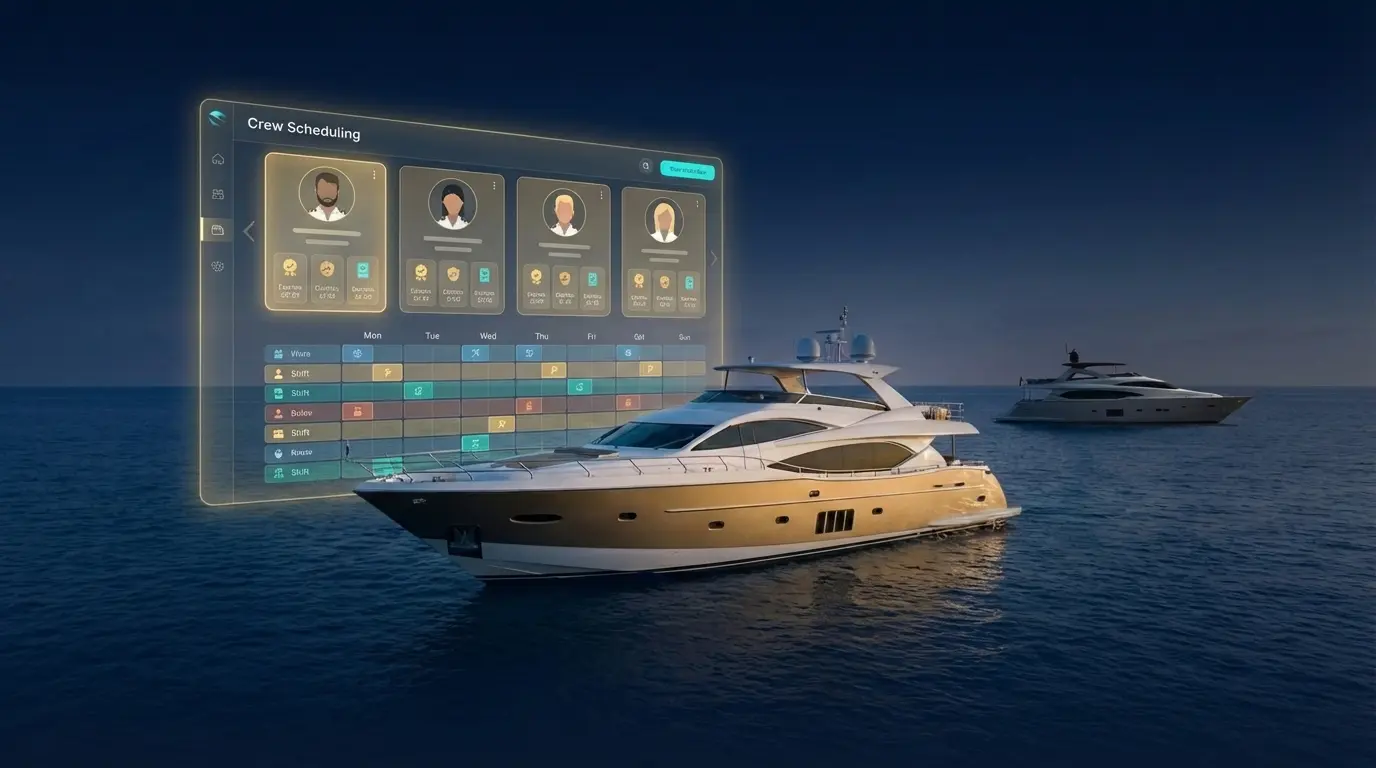
This is where charter fleet management software becomes essential for operations beyond 2-3 vessels. You need centralized visibility into crew rotation schedules, leave requests, training calendars, and vessel assignments — all in one place.
For smaller operations, even a well-organized Notion database can work if you're disciplined about updating it. The key is single source of truth. No more "Did you update the crew calendar?" conversations.
Layer 3: Communication Systems (Or: How to Stop Playing Telephone)
The communication nightmare on charter vessels is this: you have crew-to-crew communication (the captain talking to the engineer), vessel-to-shore communication (the captain talking to you), inter-vessel communication (captains coordinating rotations), and guest-facing communication (crew managing charter client expectations).
Each layer has different urgency levels, privacy requirements, and context needs. Mix them up, and you get chaos.
I learned this during a crisis when our engineer on Sunset Dream texted a maintenance issue to the group chat... the same group chat we used for charter coordination... where a charter guest's assistant was included. The guest saw "starboard engine overheating" and panicked, thinking their Caribbean vacation was in jeopardy.
It was a minor issue, fixed in 20 minutes. But the communication blunder created an hour of damage control.
Now we run parallel communication channels:
- Operational channel: Crew-only, for maintenance, scheduling, and internal issues
- Charter coordination channel: Shore team + captains, for booking logistics and guest management
- Emergency channel: Flagged contacts for urgent safety or compliance issues
- Guest-facing communication: Carefully curated, professional, reassuring
Best practices for yacht crew communication in 2026 emphasize transparent leadership while maintaining appropriate boundaries. Your crew should know they can reach you anytime for safety issues, but they also need clear protocols for non-urgent matters.
The breakthrough tool for us was moving to a platform that integrated crew scheduling, certification alerts, and team communication in one system. No more switching between apps, losing context, or wondering if someone saw the message.
The Role-Based Permission Structure That Changed Everything
Here's a mistake I made for years: I gave everyone access to everything "to be transparent."
Sounds democratic, right? In practice, it was a disaster.
Junior deckhands didn't need to see P&L statements for charter revenue. Charter guests' personal information shouldn't be accessible to the entire crew. Maintenance budgets and vendor negotiations weren't relevant to the chef.
But I also didn't want to be a bottleneck where every tiny decision ran through me.
The solution was role-based permissions aligned with actual job responsibilities.
For charter and fleet operations, this breaks down into clear tiers:
- Fleet Manager (me): Full access to financial data, crew records, vessel assignments, compliance tracking
- Captains: Full access to their vessel's operations, crew scheduling, maintenance logs, limited financial visibility
- Department Heads: Access to their domain (chef sees provisioning and galley inventory, engineer sees maintenance schedules and parts catalogs)
- Crew: Access to their own schedule, certifications, time-off requests, and vessel-specific operational info
- Shore Team: Administrative access for booking coordination, guest communications, compliance documentation
This structure solved the "Jake problem" I mentioned earlier. When crew members leave, their replacement steps into a defined role with appropriate access and documented responsibilities. No more institutional knowledge walking out the door.
It also dramatically reduced my workload. Captains could approve time-off requests, department heads could order supplies within budget parameters, and crew could manage their own certification renewals — all without me being in the loop for every decision.
The Real ROI: What Changed After Six Months
Numbers don't lie, and after six months of systematic crew management, here's what changed:
Compliance incidents: Down 100%. Not a single expired certification, missed medical check, or documentation issue. Zero.
Crew turnover: Down 43%. When people have clear expectations, fair scheduling, and feel like their time is respected, they stay. Our best crew members stopped job-hunting.
Time spent on crew coordination: Down 68%. I went from spending 15-20 hours per week juggling schedules and putting out fires to maybe 5 hours on strategic crew planning.
Charter cancellations due to crew issues: Zero. Not one. After that $47,000 nightmare, this was the metric I watched most carefully.
Guest satisfaction scores: Up 27%. Happy, well-coordinated crew create better guest experiences. It's that simple.
But the biggest change wasn't quantifiable. It was the shift from reactive firefighting to proactive management. Instead of waking up wondering what crisis would hit today, I was planning crew development, thinking about succession planning, and actually enjoying running my charter business again.
FAQ: Crew Management for Charter & Fleet Operations
How do I track crew certifications across multiple vessels without missing renewals?
Use a centralized system with automated alerts at 90, 60, and 30 days before expiration. The key is making renewal planning part of your scheduling workflow — if someone's STCW expires in 45 days, block out time for their refresher course now, not when it's urgent. Digital compliance tracking eliminates the spreadsheet guesswork and ensures you have scanned copies of every certificate accessible from anywhere.
What's the best way to handle crew scheduling when you need people across multiple vessels?
Shift from vessel-centric to fleet-wide thinking. Build a qualification matrix showing who can work on which vessels, create standardized role descriptions across your fleet, and maintain a single source of truth for all schedules. When someone requests time off or you need to fill a gap, you're looking at your entire crew pool, not just who's assigned to that vessel. This flexibility is what separates struggling fleet operators from successful ones.
How can I improve communication between shore team, crew, and charter guests without creating chaos?
Run parallel communication channels with clear purposes: operational (crew-only), charter coordination (shore + captains), emergency (flagged urgent contacts), and guest-facing (curated and professional). Never mix internal crew issues with client-facing communication. Set expectations for response times based on channel urgency, and use integrated platforms that keep communication in context with schedules and tasks.
What permissions should different crew roles have in a management system?
Align permissions with job responsibilities: fleet managers need full visibility, captains need complete access to their vessel's operations and crew, department heads need access to their specific domain (provisioning, maintenance, etc.), crew members need access to their own schedules and certifications, and shore team needs administrative access for bookings and compliance. The goal is empowering people to do their jobs without creating bottlenecks or exposing sensitive information inappropriately.
How do I prevent losing institutional knowledge when experienced crew members leave?
Document everything in systems, not in people's heads. This means standardized procedures for common tasks, centralized vendor contacts and provisioning lists, detailed maintenance logs with part numbers and procedures, and role-based onboarding checklists that transfer knowledge to new hires. When someone gives notice, have them do a knowledge transfer session where you capture their expertise into your documentation system. Make this part of your offboarding process.
Building Crew Management Systems That Scale
If you're reading this and thinking "I need to fix this now," start with the biggest pain point.
For most charter operators, that's certification compliance. Start there. Get every crew member's certificates scanned and stored digitally, set up expiration alerts, and create a renewal workflow. This alone will save you from catastrophic failures.
Next, tackle scheduling visibility. You need one system where you can see who's working where, who's on leave, who's in training, and who's available for emergency coverage. If you're still using group texts and paper calendars, upgrade immediately.
Then systematize communication. Define your channels, set clear expectations for response times, and separate internal operations from guest-facing communication.
The tools matter less than the system. I've seen operators succeed with everything from purpose-built yacht management platforms to carefully organized Notion workspaces. What matters is having a single source of truth, appropriate access controls, and proactive alerts instead of reactive scrambling.
For growing charter operations and fleet managers, the investment in proper crew management systems isn't optional anymore. The complexity of multi-vessel coordination, evolving compliance requirements, and the competitive pressure to deliver flawless guest experiences means you simply can't run a professional operation on spreadsheets and hope.
The moment you move from reactive crisis management to proactive crew coordination is the moment your charter business transforms from exhausting to sustainable.
And you'll never get another 2 AM phone call about an expired certification destroying your charter schedule.
Ready to transform your charter crew management? Learn how YachtWyse helps charter operators and fleet managers coordinate crew across multiple vessels with automated compliance tracking, intelligent scheduling, and integrated team communication. Start your free trial today.
Sources:
- Future of Yacht Crew 2026 | YATCO
- What the New STCW Updates Mean for Superyachts | People at Sea
- Maritime Compliance in 2026 | Orca Crew
- STCW Crew Work Rest Hours Compliance | ISF Watchkeeper
- AMOS Crew Management Software | Spectec
- Sealogical Yacht Management Software
- Crew Management Best Practices | LinkedIn
- Yacht Charter Management Software | ViewYacht
- Yacht Management Challenges in 2025 | Yachtway

Written by
YachtWyse Team
Maritime Technology Experts
The YachtWyse team brings decades of combined experience in maritime operations, marine engineering, and software development. We write from real-world experience managing vessels from 30ft cruisers to 100m+ superyachts.
Ready to Simplify Your Yacht Management?
YachtWyse helps owner-operators track maintenance, manage costs, and get AI-powered diagnostic assistance. Start your free trial today.
Request a DemoRelated Articles
Yacht Crew Management Software Guide (2026)
Compare the best yacht crew management software for superyachts in 2026. Certification tracking, MLC compliance, role-based permissions, and fleet oversight.
Charter Yacht Anchor Alarm: Tide-Aware Watch for Guests
Tide-aware anchor watch for charter operations — silent guest cabins, audit-grade logs, fleet-wide protocols, plus the GPS dependency captains must plan for.
Fleet-Wide Tide-Aware Anchor Watch for 2026
Fleet anchor watch finally goes shore-side. Tide-adjusted swing radius, fleet dashboards, captain-rotation handover, and audit-grade logs for multi-vessel ops.