Interactive Guest Portals for Crewed Charter
Quick Summary
- ✓Charter operator lost $48,000 rebooking because PDF itinerary couldn't compete with competitor's branded interactive portal.
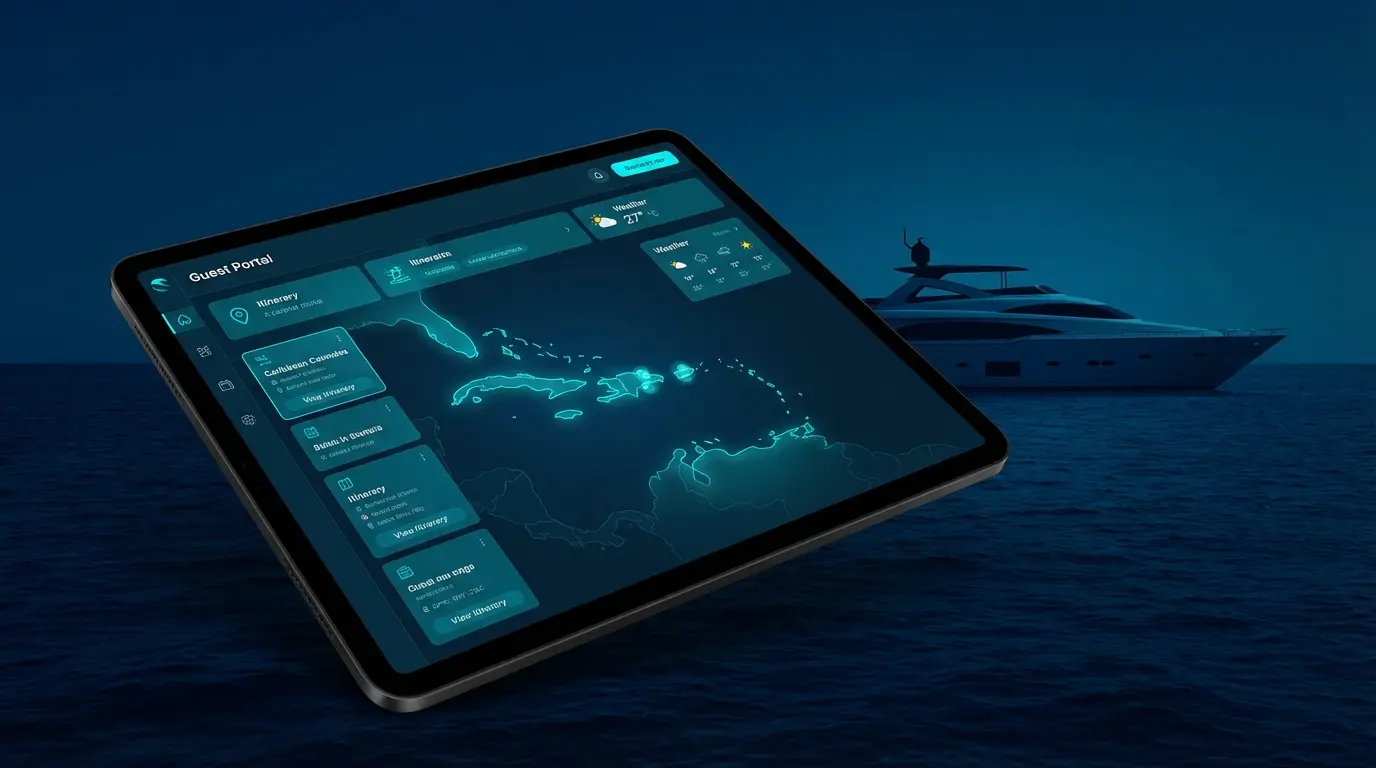
- ✓Interactive portals provide clickable maps with sea routing, day-by-day cards, per-stop weather forecasts, and AI destination guides.
- ✓Guests access portals 15-20 times before charter, creating repeated brand exposure and demonstrating professionalism.
- ✓PDF itineraries become outdated immediately, lack mobile optimization, don't capture preferences, and provide no engagement data.
- ✓Integrated platforms combine guest portals with booking management and provisioning for $200-300/month vs. $999+ standalone solutions.
The charter broker called me on a Tuesday afternoon, frustrated. She'd just lost a $48,000 repeat booking to a competitor—not because of the yacht, the crew, or the price. She lost it because of a PDF.
"The family loved their first charter with us," she told me. "But when they were deciding on their second trip, they were also talking to another operator. That operator sent them a link to an interactive portal where they could explore the entire itinerary on a map, see weather forecasts for each destination, read AI-generated descriptions of every island, and save their preferences."
She paused. "All we sent them was an 8-page PDF attachment."
The family went with the other operator. Not because the experience would be better—but because the booking experience already felt better. The portal made them feel like valued VIP guests before they ever stepped aboard.
That conversation happened three weeks ago. Since then, I've talked to a dozen charter operators who've encountered the same problem: in 2026, PDF itineraries aren't just old-fashioned—they're actively costing you bookings.
Here's what I've learned about why interactive guest portals have become the new standard in crewed charter, and how operators of all sizes are implementing them without enterprise budgets.
The PDF Problem: Why Static Documents No Longer Cut It
Let me be clear: PDFs aren't inherently terrible. They're portable, printable, and familiar. For a decade, they were the professional standard for sharing charter itineraries.
But something shifted in the past two years. Guest expectations changed.
What Guests Actually Expect in 2026
The luxury travel industry has undergone a fundamental transformation. According to recent industry research, ultra-high-net-worth travelers now expect seamless planning, transparency, and a single point of contact for complex trips. But more importantly, they expect digital-first experiences.
Think about how your charter guests book everything else in their lives:
- Hotels: Interactive property tours, virtual room previews, real-time availability calendars
- Restaurants: Dynamic menus with photos, dietary filters, reservation confirmations via app
- Travel: Live flight tracking, mobile boarding passes, itinerary apps with gate changes
- Entertainment: Personalized recommendations, preview trailers, one-click booking
Now think about what you're sending them: an 8-page PDF attached to an email.
The disconnect is jarring. You're offering a $30,000-$200,000 luxury experience, but the pre-charter communication feels like something from 2015.
The Hidden Costs of PDF Itineraries
Beyond just feeling outdated, PDF itineraries create real operational problems:
1. They're immediately out of date
Weather changes. Restaurants close unexpectedly. A destination you planned becomes unavailable. With a PDF, every change requires creating a new version, emailing it to the guests, and hoping they're looking at the latest copy.
I know one captain who had three different PDF versions floating around before a charter. The guests showed up expecting the activities from version 1, while the crew had prepared based on version 3. Chaos.
2. They don't capture guest preferences
Modern charter operations depend on understanding guest preferences before arrival. Dietary restrictions, activity preferences, cabin temperature preferences, favorite beverages, allergies, celebration dates—all of this information typically gets collected through back-and-forth emails.
Some operators use services like Sevenstar Yacht Management, which offers best-in-class digital preference forms. The cost? $999-$1,999 per year just for the preference form feature.
3. They don't showcase your professionalism
Your yacht is immaculate. Your crew is trained to five-star standards. Your provisioning is thoughtful and detailed. But your first impression is a generic PDF that looks identical to every other charter operator's itinerary.
That PDF doesn't convey the level of service you're about to deliver. It's a missed branding opportunity.
4. They're not mobile-friendly
Your guests are viewing your itinerary on their phones. PDFs on mobile devices require zooming, scrolling, and downloading. Interactive web portals? They just work—on any device, any screen size, any time.
5. They provide no engagement data
When you send a PDF, you have no idea if the guest opened it, read it, or shared it with their travel companions. With a portal, you can see when guests access the itinerary, which sections they spend time on, and whether they're engaging with the content.
One operator told me she discovered that guests were accessing the portal 15-20 times before their charter—far more engagement than she ever imagined. That insight shaped how she structures her pre-arrival communication.
What Makes an Interactive Guest Portal Effective
Not all guest portals are created equal. I've reviewed dozens of platforms—from standalone itinerary builders to full-featured charter management systems—and the truly effective ones share specific characteristics.
1. Interactive Maps with Real Sea Routing
The heart of any great guest portal is an interactive map. But not just any map—it needs to show the actual route the yacht will take, including sea routing between stops.
Guests want to visualize the journey. They want to click on each destination and see what's there. They want to understand the flow of the trip.
Platforms like Guest Trip pioneered this approach with Google Street View integration. ViewYacht offers AI-powered itinerary generation with drag-and-drop waypoints on a visual map.
But here's what separates good from great: bidirectional synchronization. When a guest hovers over a destination on the map, the corresponding day card should highlight. When they click a day card, the map should center on that location. This creates an intuitive, exploratory experience.
The map becomes more than a visual aid—it becomes an interactive planning tool that gets guests excited about the journey.
2. Day-by-Day Cards with Rich Content
While the map provides the overview, day cards deliver the details. Each day of the charter should have a dedicated card showing:
- Destination name and description
- Planned activities and experiences
- Dining recommendations
- Notable attractions
- Practical information (distance traveled, estimated arrival times)
The key is making this information scannable and visual. Guests shouldn't have to read paragraphs of text to understand what each day holds.
One captain I spoke with structures his day cards with three sections: Morning (what we'll see/do), Afternoon (activities and exploration), and Evening (dining and relaxation). This temporal structure helps guests mentally prepare for each day's rhythm.
3. Weather Forecasts Per Stop
This feature alone has become a competitive differentiator. According to charter industry trends, onboard systems and apps that provide personalization—including weather integration—are now expected as part of the luxury charter experience.
Guests want to know what weather to expect at each specific destination, not just a general forecast for the region. This helps them pack appropriately, set expectations, and get excited about activities.
The technical implementation matters here. The best portals pull weather data for each stop's specific coordinates and display it alongside the day card. Guests can see at a glance: "Day 3 in Virgin Gorda: 82°F, sunny, light winds 8-12 knots."
One operator told me this feature alone reduced pre-charter packing questions by 80%. Guests could see the week's weather and pack accordingly without needing to ask.
4. AI-Generated Destination Descriptions
Here's where technology creates real value. Manually writing detailed, engaging descriptions for every destination in every itinerary is time-consuming. Most operators either skip it entirely or copy generic content from tourism sites.
AI-powered platforms can generate rich, contextual descriptions for each stop—highlighting history, culture, activities, and unique features—all cached and ready to display.
According to industry analysis, platforms like Ankor and ViewYacht have integrated AI-powered content generation for creating stunning itineraries and proposals. But most of these tools are designed for brokers creating proposals, not for operators creating guest-facing portals.
The sweet spot is having AI-generated content that's:
- Cached for performance (instant loading)
- Editable (you can customize any description)
- Context-aware (references the specific charter, not generic tourism info)
- Brand-aligned (matches your tone and voice)
This gives you the efficiency of automation with the polish of custom content.
5. Full Brand Customization
This is non-negotiable. Your guest portal should feel like your portal, not a generic template with your logo slapped on top.
Effective brand customization includes:
- Custom domain or subdomain (portal.yourcompany.com)
- Your logo prominently displayed
- Your brand colors throughout the interface
- Your company name in all communications
- Your brand voice in copy and messaging
The goal is creating a seamless branded experience from the moment a guest receives the portal link through their entire charter journey.
I've seen operators use branded portals as a premium differentiator. They mention it in sales calls: "We provide every guest with a personalized, branded digital portal for their charter." That single line communicates professionalism and attention to detail.
6. Mobile-First Design
More than 70% of portal traffic comes from mobile devices. If your guest portal isn't designed mobile-first, you're delivering a poor experience to the majority of your guests.
Mobile-first means:
- Touch-optimized (tap targets sized for fingers, not mouse cursors)
- Responsive layout (adapts beautifully to any screen size)
- Fast loading (optimized images and minimal data transfer)
- Readable text (no zooming required)
- Intuitive navigation (thumb-friendly controls)
Guests should be able to explore their entire itinerary while sitting at a coffee shop, waiting at an airport, or relaxing at home—all from their phone, without frustration.
7. Shareable and Collaborative
Charter guests rarely travel alone. They're bringing family, friends, or business associates. Your portal should make it easy to share the itinerary with travel companions.
This serves two purposes:
- Practical: Everyone in the group can view and discuss the itinerary
- Marketing: When guests share the portal, they're showing your brand to potential future clients
Some portals include collaboration features—comments, notes, or preference submission from multiple users. This is particularly valuable for larger groups coordinating activities and preferences.
How Interactive Portals Increase Rebookings and Referrals
Let's talk about the ROI. Interactive guest portals aren't just a nice-to-have feature—they're a business driver.
The Data on Digital Guest Experiences
According to research on luxury charter trends, personalization and bespoke itineraries remain at the heart of demand, with guests expecting tailor-made experiences that feel curated specifically for them.
But here's the insight: the perception of personalization starts before the charter begins. The portal is the first tangible representation of the experience you're about to deliver.
When that portal is interactive, branded, and thoughtfully designed, it signals to guests: "We care about details. We use modern technology. We're going to deliver an exceptional experience."
Why Portals Drive Rebookings
Repeat business is the lifeblood of charter operations. Industry veterans know that acquiring a new customer costs 5-10 times more than retaining an existing one.
Interactive portals increase rebookings through several mechanisms:
1. They keep your brand top-of-mind
When guests access a portal 15-20 times before their charter, they're repeatedly seeing your branding, your attention to detail, and your professionalism. You're not just an email in their inbox—you're a destination they visit and explore.
2. They capture preferences for future trips
Modern portals include preference forms that capture everything from dietary restrictions to activity interests. This data makes the next booking seamless. Instead of starting from scratch, you can say: "Welcome back! We've saved your preferences from last time. Here's what we're planning based on what you loved before."
3. They demonstrate technological sophistication
Guests who've experienced an interactive portal don't want to go back to PDF itineraries with other operators. You've set a new standard. Switching to a competitor means accepting a downgrade in the booking experience.
4. They create shareable moments
Guests forward portal links to friends and family: "Look at this amazing trip we're taking!" Each share is a referral opportunity. The portal does your marketing for you.
One operator told me that 40% of her new bookings come from referrals, and she directly attributes this to her guest portal: "People share the link, their friends see how professional it looks, and they reach out to book their own charter."
The Conversion Impact
Here's a real scenario: A potential guest is comparing two charter operators. Both have similar yachts, comparable pricing, and excellent reviews.
Operator A sends a PDF itinerary via email attachment.
Operator B sends a link to a branded, interactive portal with a map, weather forecasts, AI destination guides, and day cards.
Which operator appears more professional? Which one feels more luxurious? Which experience would you rather book?
The portal isn't just a feature—it's a competitive differentiator that closes deals.
Implementation Guide: Setting Up Your Guest Portal
You're convinced. Interactive portals are no longer optional—they're essential. So how do you actually implement one without blowing your budget or spending months on setup?
Option 1: Standalone Guest Portal Solutions
Several companies specialize exclusively in guest-facing itinerary platforms:
Guest Trip Offers AI-powered itineraries with per-stop weather and Google Street View integration. It's a comprehensive solution but comes as a standalone product, meaning you'll need separate tools for vessel management, booking tracking, and financial management.
Charter Itinerary Provides collaborative review features and access to 250+ curated luxury experiences. Designed primarily for brokers creating proposals rather than operators managing ongoing guest communication.
YachtEye Multi-device infotainment system covering 1,600 destinations. Built for superyachts 50m+ and requires hardware installation, putting it out of reach for most charter operators.
Sevenstar Yacht Management Best-in-class preference forms designed by experienced stewardesses. But here's the catch: $999-$1,999 annually for just the preference form feature. No portal, no itinerary, no map.
The challenge with standalone solutions: you're adding another subscription, another login, another platform to manage. Your booking data lives in one place, your guest portal lives in another, and your vessel management lives in a third. Nothing talks to each other.
Option 2: Integrated Charter Management Platforms
The more strategic approach is choosing a platform that combines guest portals with the full charter lifecycle:
- Booking management and calendar
- Guest profiles and preference capture
- Revenue tracking and APA management
- Provisioning automation
- Crew coordination
- Guest portal with interactive itineraries
This integrated approach means:
- Guest data flows automatically from booking to portal
- Preference information feeds into provisioning
- One login, one platform, one subscription
- No data syncing between systems
YachtWyse takes this approach, including a fully-featured guest portal as part of its Charter plan. Instead of paying $499-$999 per vessel per month (typical for enterprise platforms), operators get booking management, financial tracking, and an interactive branded portal in one integrated system.
The portal includes:
- Interactive maps with sea routing between stops
- Day-by-day cards with activities and details
- Per-stop weather forecasts
- AI-generated destination descriptions
- Full brand customization (logo, colors, company name)
- Mobile-responsive design
- Shareable links for travel companions
You can see a live demo at app.yachtwyse.com/portal/caribbean-breeze/demo to experience exactly what your guests would see.
Setting Up Your First Portal: Step-by-Step
Regardless of which platform you choose, the setup process follows a similar pattern:
Step 1: Brand Configuration (30 minutes)
- Upload your logo
- Set brand colors
- Add company name and contact information
- Customize domain or subdomain if supported
Step 2: Itinerary Creation (1-2 hours per charter)
- Add destinations in sequence
- Upload or generate destination descriptions
- Specify activities and highlights for each day
- Set arrival/departure times
- Add any special notes or instructions
Step 3: Map Routing (15-30 minutes)
- Review auto-generated routes between stops
- Adjust waypoints if needed for accuracy
- Verify that routing reflects actual yacht paths (not straight lines)
Step 4: Content Enhancement (30-60 minutes)
- Review AI-generated descriptions for accuracy
- Add photos of destinations if available
- Include dining recommendations
- Note any special local events or attractions
Step 5: Guest Access (5 minutes)
- Generate shareable portal link
- Send link to guests via email
- Include instructions for accessing and sharing
Total time investment: 2-4 hours for your first portal. Subsequent charters? 1-2 hours as you build a library of destinations and refine your process.
Best Practices from Operators Who've Made the Switch
I've talked to charter operators who transitioned from PDFs to portals in the past year. Here's what they've learned:
Start with one charter as a pilot Don't try to convert your entire operation overnight. Pick an upcoming charter, build the portal, gather guest feedback, and refine your approach.
Use AI descriptions as a starting point, not the finish line AI-generated content is excellent for efficiency, but review it for accuracy and brand voice. Add personal touches, insider tips, and specific recommendations that reflect your local knowledge.
Send the portal link early Don't wait until a week before the charter. Send the link as soon as the booking is confirmed. This builds anticipation and gives guests time to explore, ask questions, and build excitement.
Track engagement If your platform provides analytics, monitor when guests access the portal and which sections they spend time on. This reveals what matters most to them.
Ask for feedback After the charter, ask guests about their experience with the portal. Was it helpful? What would they change? Use this input to improve future portals.
Promote it in sales conversations Mention your branded guest portal during initial sales calls. It's a differentiator that sets you apart from operators still using PDFs.
One operator shared this insight: "The portal changed how guests perceive us before they ever step aboard. It positions us as a premium, tech-forward operation—even though we're a small two-yacht charter company."
The Competitive Landscape: What Your Competitors Are Doing
Let's be direct: your competitors are already adopting interactive portals. The question isn't whether to implement one—it's how quickly you can catch up.
Enterprise Operators: Already There
Large charter fleets and superyacht operators have been using digital guest experiences for years. Platforms like Voly Group (winner of "Best Superyacht Software" three years running) and DeepBlue have made portals standard at the enterprise level.
These operations are paying $499-$999+ per vessel per month for integrated charter management. They understand that guest experience starts digitally, long before boarding.
Mid-Market Operators: Rapidly Adopting
Charter operators with 2-10 vessels are realizing they can't compete on guest experience using email and PDFs. They're adopting platforms that offer portal features at accessible price points.
According to industry forecasts, the global yacht management software market is projected to grow from $750M in 2022 to $1.9-$2.5B by 2031—a 14.6% compound annual growth rate. This growth is driven largely by cloud-based solutions, guest experience platforms, and AI integration.
Translation: the market is moving toward integrated digital experiences. Operators who don't adapt risk being left behind.
Bareboat and Smaller Operators: Mixed Adoption
This segment has been slower to adopt, often due to perceived cost or complexity. Many still rely on email chains and PDF attachments.
But here's the opportunity: implementing a portal as a smaller operator creates an even stronger competitive advantage. When guests compare a 3-yacht boutique operator with a slick digital portal against a 20-yacht fleet using PDFs, the boutique operator wins the perception battle.
You don't need to be big to deliver a premium digital experience. You just need the right tools.
Common Objections (and Why They Don't Hold Up)
Every time I discuss guest portals with operators, I hear the same concerns. Let's address them directly.
"My guests are older and prefer printed materials"
I hear this one constantly. And yes, some guests do prefer printed itineraries. But here's the thing: offering a digital portal doesn't prevent you from also providing a printed version.
Send the portal link and include a PDF or printed copy. Give guests options. But don't assume based on age—some of the most enthusiastic portal users are 60+ travelers who love the convenience of having everything on their phone.
One operator told me her oldest client (74 years old) accessed the portal 23 times before his charter. He forwarded the link to his entire extended family and used the interactive map to walk them through the planned route during a family dinner.
Age doesn't determine technology adoption—value does.
"We're too small to justify the cost"
If you're paying $999-$1,999 for just a preference form (like Sevenstar), or $499+ per vessel per month for enterprise platforms, yes—that's prohibitive for smaller operations.
But integrated platforms that include portals as part of a complete charter management system cost a fraction of that. When you factor in time saved on manual communication, reduced errors, and increased rebookings, the ROI is clear even for single-vessel operators.
One two-yacht operation calculated that reducing pre-charter email back-and-forth by 60% saved approximately 8 hours per charter. At 15 charters per year, that's 120 hours—three full weeks of work—saved annually.
"Our itineraries are too custom to use templates"
Good news: modern portals aren't template-based. They're fully customizable. You build each itinerary from scratch based on the specific charter, guest preferences, and planned route.
The efficiency comes from AI-generated destination content and saved stops you can reuse across charters—not from forcing guests into pre-built templates.
"We don't have photos or content for every destination"
You don't need your own photos. AI-generated descriptions provide rich, engaging content without requiring a photography library. Focus on the functionality (map, day cards, weather) and let AI handle the content heavy lifting.
As you build more itineraries, you can enhance destinations with your own photos and insider tips. But you don't need a content library to launch.
"What if guests don't use it?"
Track the analytics. The data consistently shows guests access portals 10-20+ times before their charter. They're using it—often more than you'd expect.
And even if a guest only accesses it once, that one view creates a better impression than a PDF attachment. You're not just providing information—you're demonstrating your brand values.
The Future: Where Guest Portals Are Headed
Interactive portals are just the beginning. Here's where the technology is evolving:
1. Real-Time Updates During Charter
Imagine guests checking the portal mid-charter to see updates: "We're adding an extra snorkeling stop at this location based on perfect conditions" or "Dinner tonight will now be at [restaurant] instead—here's the updated menu."
Real-time portal updates during the charter keep guests informed without requiring constant in-person communication.
2. Integrated Preference Capture
Instead of emailing preference forms separately, the portal becomes the intake mechanism. Guests fill out dietary restrictions, activity preferences, beverage choices, and special requests directly in the portal—all before arrival.
This data flows automatically into provisioning and crew briefings, eliminating manual data entry and reducing errors.
3. Post-Charter Engagement
The portal doesn't end when the charter ends. Operators are beginning to use portals for post-charter surveys, photo galleries, and rebooking offers.
Imagine guests returning to the portal after their trip to see a curated photo gallery from their charter, leave feedback via a built-in survey, and book their next trip with a single click.
4. Curated Experiences and Bookable Activities
Platforms like Charter Itinerary already offer 250+ curated luxury experiences. The next evolution: guests browsing and booking specific activities, restaurant reservations, and excursions directly through the portal.
This creates an additional revenue stream (concierge booking fees) while enhancing the guest experience.
5. AI-Powered Personalization
AI will move beyond generating destination descriptions to suggesting entire itineraries based on guest preferences, past behavior, and real-time conditions.
"Based on your interest in snorkeling and preference for quieter anchorages, we recommend these three alternative stops instead of the busier locations originally planned."
The portal evolves from a static display of information to an intelligent planning assistant.
Making the Transition: Your Next Steps
If you're still using PDF itineraries, here's how to make the switch:
Step 1: Audit your current process Document how much time you spend creating itineraries, answering guest questions, sending updates, and managing preferences. This is your baseline for measuring improvement.
Step 2: Test a demo portal Visit app.yachtwyse.com/portal/caribbean-breeze/demo or request demos from other platforms. Experience the guest perspective. What feels valuable? What seems gimmicky?
Step 3: Calculate your ROI Consider:
- Time saved on itinerary creation and updates
- Reduced pre-charter email volume
- Potential increase in rebookings (even a 10% lift is significant)
- Competitive advantage in sales conversations
- Reduced no-shows and miscommunications
Step 4: Choose a platform Decide between standalone portal solutions or integrated charter management platforms. Weigh cost, features, ease of use, and integration with your existing tools.
For most operators, integrated platforms offer better long-term value by consolidating booking management, financial tracking, and guest portals into one system.
Step 5: Pilot with one charter Don't convert everything at once. Select an upcoming charter, build the portal, send it to guests, and gather feedback. Use this pilot to refine your process before rolling it out more broadly.
Step 6: Train your team Make sure everyone involved in charter operations—captains, crew, booking managers—understands how the portal works and how it fits into the guest journey.
Step 7: Promote it Update your website, sales materials, and booking confirmation emails to highlight your branded guest portal. Make it a selling point.
Final Thoughts: The New Standard
Let me bring this back to where we started: the charter broker who lost a $48,000 repeat booking because of a PDF.
That loss wasn't about the yacht, the crew, the route, or the service. It was about perception. The competitor's interactive portal created a perception of professionalism, attention to detail, and modern sophistication. The PDF created a perception of "good enough."
In the luxury charter market, "good enough" doesn't cut it.
Interactive guest portals are no longer a premium feature offered by only enterprise operations. They're becoming table stakes—the minimum expected by guests who are accustomed to digital-first experiences in every other aspect of their lives.
The good news: implementing a portal is no longer prohibitively expensive or technically complex. Whether you operate a single yacht or a fleet of 10, accessible platforms now offer branded, interactive portals that rival what enterprise operators provide.
The question isn't whether interactive portals are worth it. The data is clear: they improve guest satisfaction, increase rebookings, create competitive differentiation, and save operational time.
The question is: how quickly can you implement one before your competitors do?
Because the broker who lost that $48,000 booking? She's implementing a portal now. She's not making the same mistake twice.
Don't wait until you lose your next rebooking to make the switch. The new standard in crewed charter is here. It's time to meet it.
Ready to see what an interactive guest portal looks like in action? Explore the live demo at app.yachtwyse.com/portal/caribbean-breeze/demo or learn more about YachtWyse's integrated charter management platform at yachtwyse.com/charter.
Sources:
- What's New in Yacht Travel: The Top Charter Trends for 2026
- The Biggest Yacht Charter Trends That Influenced 2025
- Superyacht Market 2026: Trends, Data & Industry Insights
- Charter Itinerary: Industry-Leading Yacht Charter Software
- View Yacht Charter Itineraries Generator
- Ankor Software: Charter Presentation Platform
Written by
YachtWyse Team
Maritime Technology Experts
The YachtWyse team brings decades of combined experience in maritime operations, marine engineering, and software development. We write from real-world experience managing vessels from 30ft cruisers to 100m+ superyachts.
Ready to Simplify Your Yacht Management?
YachtWyse helps owner-operators track maintenance, manage costs, and get AI-powered diagnostic assistance. Start your free trial today.
Request a DemoRelated Articles
The Complete Guide to Charter Guest Management in 2026
From preference sheets to post-charter follow-ups, learn how top charter operators deliver exceptional guest experiences that drive 90% rebooking rates and five-star reviews.
The AI Concierge Revolution: How Smart Guest Portals Are Changing Luxury Yacht Charters
Charter operators are watching hotel brands like Four Seasons and Ritz-Carlton deliver AI-powered guest experiences while yacht apps remain stuck on digital binders. Here's how AI concierge portals are closing that gap — and why the operators who adopt them first will own the rebooking advantage.
Charter Revenue Waterfall: True Profitability
I learned the hard way that a $25,000 charter week doesn't mean $25,000 profit. Here's how to calculate your real per-charter profitability using revenue waterfall analysis.