Med Season Prep: Chief Engineer's Checklist
Quick Summary
- ✓Begin systematic Mediterranean commissioning 6-8 weeks before your operational target date
- ✓Digital checklists provide real-time progress tracking, photo documentation, and automated reminders
- ✓Main engines, generators, and safety systems form the critical path that cannot flex
- ✓Yard delays cascade into compressed timelines; dependency tracking prevents bottlenecks
- ✓Reusable commissioning templates preserve institutional knowledge across crew rotations and seasons
The email arrived at 04:37 on a Tuesday morning in La Ciotat.
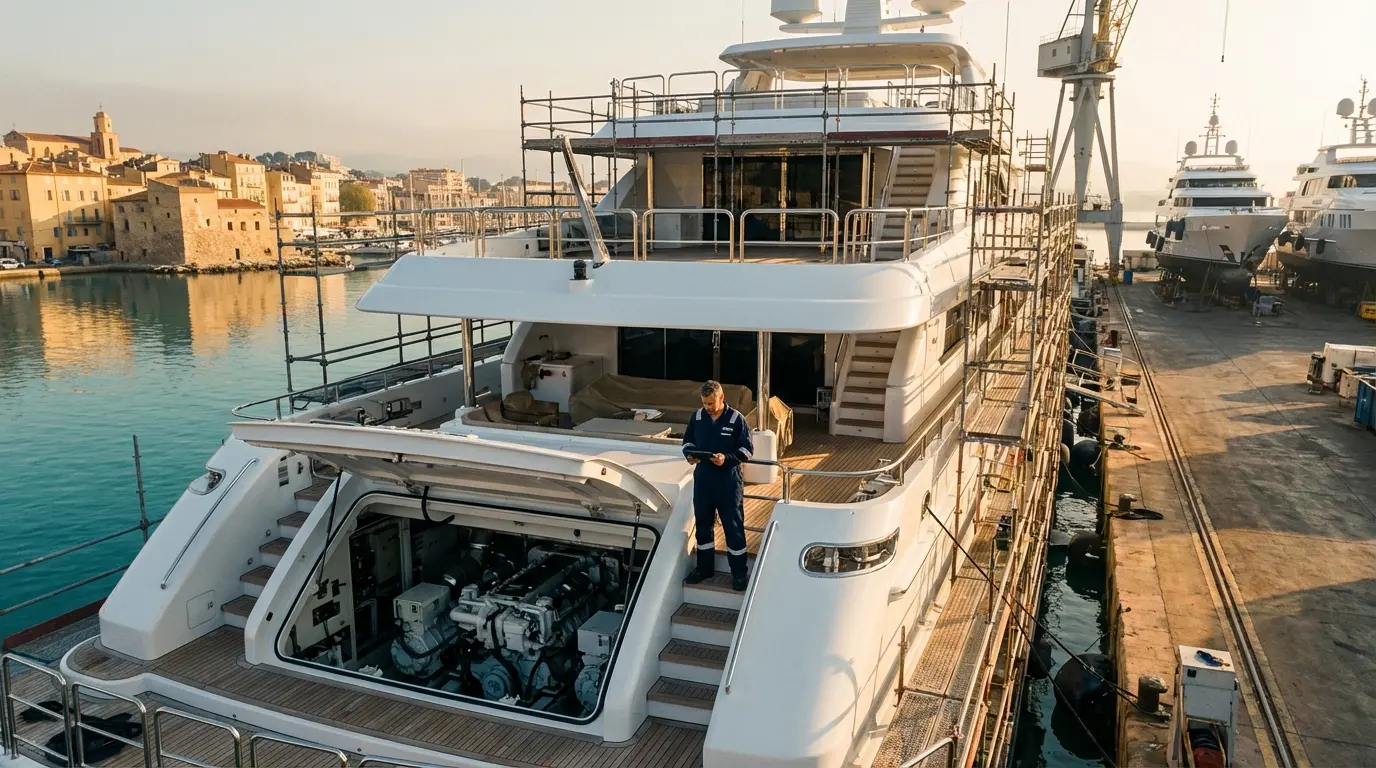
I was three weeks into a winter refit on a 52-meter motor yacht, sleeping in a portside cabin that smelled of epoxy and fresh teak dust. The management company had forwarded a message from the owner's charter broker. A client wanted to book the first two weeks of June. Could we confirm the yacht would be fully operational by May 15?
I stared at the screen in the dark. We had two generators partially dismantled. The HVAC system was waiting on a custom condenser unit shipping from Germany. The port stabilizer fin actuator was in a machine shop in Marseille. Three navigation displays were at the manufacturer for firmware upgrades. And our ISM annual audit was scheduled for April 28, which meant every piece of documentation, every drill record, every maintenance log needed to be current and auditable by then.
May 15. That was eleven weeks away.
I opened the spreadsheet I had been using to track commissioning tasks. It was 847 rows long. Some cells were color-coded. Some had notes. Some had question marks where I was waiting on subcontractor confirmations. The last time the second engineer had updated his section was nine days ago. The ETO's column had formatting that broke every time someone opened it on a different device.
I closed the laptop. Stared at the ceiling. And made a decision that fundamentally changed how I manage commissioning.
That refit season, I moved our entire commissioning workflow to a digital checklist platform. Not because the spreadsheet was wrong, exactly. Every item on it was legitimate. The problem was that a static document cannot tell you what is actually happening right now. It cannot remind the second engineer that the watermaker membrane replacement is three days overdue. It cannot show the captain a real-time completion percentage when the management company calls asking for a status update. And it absolutely cannot capture the photograph proving that the fire damper inspection was actually completed, not just checked off.
This guide is everything I have learned across seven Mediterranean seasons of commissioning superyachts in yards from Palma to Genoa. It is the checklist I wish someone had handed me that morning in La Ciotat.
The Mediterranean Season Cycle and Why Timing Is Everything
If you have spent any time in the superyacht industry, you know the rhythm. The Mediterranean season runs roughly May through October, with peak charter demand from late June through August. That means the entire fleet needs to transition from winter lay-up to full operational readiness in a compressed window between March and early May.
The cycle looks like this:
October through December: Decommissioning and yard entry. Yachts arrive at refit facilities in Palma, La Ciotat, Genoa, Barcelona, or Tuzla. Systems are winterized, antifouling is stripped, and refit scopes are finalized.
January through March: Active refit and maintenance. This is when the heavy work happens. Hull work, engine overhauls, interior refurbishments, system upgrades. Yards are at full capacity and competition for skilled subcontractors is fierce.
March through May: Commissioning. Every system must be brought back online, tested, documented, and certified. This is where the pressure builds, because yard delays during the refit phase compress the commissioning timeline. I have never worked a season where commissioning was not at least partially rushed.
May through October: Operations. Charter programs, owner cruising, boat shows in Monaco and Cannes. The yacht must perform flawlessly in Mediterranean summer heat with demanding schedules.
The critical insight that every chief engineer learns, usually the hard way, is that commissioning is not a checklist you work through once. It is a project management exercise with dependencies, parallel workstreams, and external constraints that shift daily. A delay on the generator overhaul pushes back the load bank test, which delays the HVAC commissioning, which means you cannot demonstrate climate control for the owner's sea trial.
This is exactly why paper and spreadsheet-based tracking falls apart. You need a system that shows you the critical path in real time.
Why Digital Checklists Changed My Commissioning Process
I am not a technology evangelist. I spent the first decade of my career with paper checklists and binders, and they worked well enough on smaller vessels. But once you are managing the commissioning of a 40-meter-plus yacht with an engineering team of three or four, plus twenty or thirty subcontractors, plus a management company and captain who all need visibility into progress, the limitations of static documents become operational risks.
Here is what I mean by that.
Accountability disappears in spreadsheets. When every department is updating the same Excel file, you lose track of who changed what and when. I once discovered that a critical safety system inspection had been marked complete by someone who thought they were updating a different row. The actual inspection had not been done. On a digital platform with task ownership and timestamps, that cannot happen.
Progress reporting becomes guesswork. The captain calls and asks how commissioning is going. With a spreadsheet, I would scroll through hundreds of rows trying to calculate a rough percentage. With a digital dashboard, I can give an instant answer broken down by department, by system, by priority level.
Photo documentation is either missing or scattered. When a flag state surveyor asks to see evidence that the emergency generator was load tested, you need more than a checkmark. You need the photograph of the load bank readings, the oil pressure gauge, the exhaust temperature. With a digital checklist, the photo is attached directly to the task. With paper, it is somewhere in a folder on someone's phone.
Yard WiFi is unreliable, but that is not an excuse anymore. Most modern planned maintenance systems offer offline functionality. You complete the checklist in the engine room where there is no signal, and it syncs when you walk back to the crew mess.
Automated reminders prevent items from falling through the cracks. During peak commissioning, I am managing dozens of parallel tasks. A system that sends a notification when a task is overdue or approaching its deadline is not a luxury. It is the difference between catching a missed item on Monday and discovering it on the sea trial.
The Commissioning Checklist: Organized by System
What follows is the comprehensive commissioning checklist I have built over seven seasons. I have organized it by system rather than by department because that is how the work actually flows. Your second engineer may own the watermakers while your ETO handles navigation systems, but the checklist itself should reflect the logical order of bringing a yacht back to life.
Main Engines and Propulsion
This is the critical path. Everything else can flex, but if the main engines are not commissioned, the yacht does not move.
- Inspect engine mounts and alignment after winter settlement
- Change all engine oils, filters, and fuel filters
- Inspect and replace raw water impellers
- Flush and pressure test cooling systems (fresh water and raw water circuits)
- Inspect turbochargers, intercoolers, and exhaust systems
- Check shaft seals, cutlass bearings, and propeller condition
- Verify gearbox oil levels and inspect for contamination
- Test engine control systems and alarm panels
- Conduct cold start and initial run-up per manufacturer protocol
- Perform sea trial with full load testing and RPM verification
- Document all readings and photograph gauge panels at operating temperature
Generators
Generators need to be online before you can commission any hotel system, so these come second.
- Complete oil and filter changes on all generator sets
- Inspect raw water cooling circuits and impellers
- Test automatic voltage regulators and frequency stability
- Conduct load bank testing at 25, 50, 75, and 100 percent rated load
- Verify automatic changeover and load sharing between generator sets
- Test emergency generator start sequence and blackout recovery
- Inspect exhaust systems for leaks and excessive back pressure
- Photograph load bank readings and electrical panel outputs
HVAC Systems
In the Mediterranean summer, HVAC is not a comfort system. It is the system that determines whether the owner or charter guest stays aboard or goes to a hotel. I have seen charter cancellation threats over cabin temperature issues.
- Inspect and clean all air handling units and fan coil units
- Check refrigerant levels and test for leaks across all circuits
- Flush and treat chilled water systems
- Clean or replace all air filters throughout the vessel
- Test thermostatic controls in every cabin and salon zone
- Verify seawater cooling pump operation and strainer condition
- Commission the system under simulated full occupancy load if possible
- Document temperature differential readings across all zones
Watermakers and Water Treatment
- Recommission reverse osmosis membranes per manufacturer protocol
- Flush preservation chemicals and test membrane rejection rates
- Calibrate salinity monitors and high-salinity shutoff alarms
- Test UV sterilization units and replace lamps if due
- Verify tank level sensors and automatic fill sequences
- Sample and test potable water quality (send for laboratory analysis if required)
- Check mineralization and pH dosing systems
- Document daily production rates during initial commissioning week
Navigation and Communication Systems
- Power up and test all radar systems, verifying bearing accuracy
- Test ECDIS with current chart updates installed
- Verify GPS receivers and cross-check position accuracy
- Test AIS transponder and verify MMSI data
- Commission autopilot and verify heading sensor calibration
- Test all VHF radios including DSC distress capability
- Verify satellite communication systems (VSAT, Fleet Broadband)
- Test GMDSS equipment per flag state requirements
- Check navigation light circuits and verify visibility arcs
- Update all electronic chart folios for planned operating areas
Stabilizers and Thrusters
- Inspect stabilizer fin actuators and hydraulic systems
- Verify fin angle sensors and zero-position calibration
- Test stabilizer system in automatic and manual modes at sea
- Commission bow and stern thrusters
- Verify thruster tunnel anodes and propeller condition
- Test thruster control stations (bridge, wing stations, and any remote panels)
- Document hydraulic pressure readings and fin response times
Tenders and Toys
Often left until the last minute, which is a mistake. A charter yacht without operational tenders is a yacht with unhappy guests.
- Commission tender engines and conduct sea trials
- Test tender davit or garage launch and recovery systems
- Inspect all lifting equipment, slings, and shackles (check certification dates)
- Commission jet skis, Seabobs, and water toys
- Verify all tender safety equipment (life jackets, flares, VHF)
- Test tender tracking and AIS systems if fitted
- Photograph all lifting equipment certification labels
Safety Systems
These items are non-negotiable and directly auditable. Do not leave them for the final week.
- Test fixed fire suppression systems in engine room and machinery spaces
- Verify all portable fire extinguisher inspection dates
- Test fire detection panels and verify zone mapping
- Inspect and service life rafts (confirm service certification dates)
- Test EPIRB battery expiry and registration data
- Verify SART operation
- Test emergency lighting and escape route markings
- Inspect all watertight doors and closures
- Conduct lifeboat and rescue boat launch if applicable
- Document all safety equipment expiry dates in a single register
AV, IT, and Entertainment Systems
- Power up all AV systems and verify source routing
- Test satellite TV reception and antenna tracking
- Verify guest WiFi performance and network security settings
- Test bridge CCTV and security camera systems
- Commission any cinema rooms, outdoor screens, or sound systems
- Verify crew communication systems (intercoms, portable radios)
- Test vessel monitoring and alarm systems from all display stations
Compliance and Documentation: The Paperwork That Cannot Wait
Commissioning the hardware is only half the job. The documentation and compliance requirements for a commercially operated superyacht in the Mediterranean are substantial, and missing a certificate expiry date can ground the yacht as effectively as a mechanical failure.
Flag State and Classification
- Verify all class society certificates are valid for the full operating season
- Confirm flag state annual survey is scheduled and any prerequisites are met
- Review class survey status and address any outstanding conditions of class
- Confirm trading certificates (Safe Manning, IOPP, Load Line) are current
- Verify vessel registration documents are aboard and current
ISM and Safety Management
If your yacht operates commercially, your ISM compliance documentation must be audit-ready at all times. The Mediterranean ports, particularly Palma, Antibes, and Athens, have seen increased port state control activity in recent years.
- Verify Document of Compliance and Safety Management Certificate validity
- Review and update the Safety Management System for any regulatory changes
- Ensure all crew are familiar with SMS procedures (especially new rotational crew)
- Confirm all required drills are logged and documented for the past 12 months
- Verify Designated Person Ashore contact details are current and tested
- Review and close any outstanding non-conformities or observations from previous audits
MLC Crew Documentation
The Maritime Labour Convention requirements are enforced with increasing rigor in Mediterranean ports. Automated MLC hours of rest tracking eliminates the documentation gaps that lead to detentions.
- Verify all Seafarer Employment Agreements are current and compliant
- Confirm STCW certificates and endorsements are valid for all crew
- Check medical certificate validity for every crew member
- Verify hours of rest recording system is operational and current
- Confirm crew accommodation and provisions meet MLC standards
- Review repatriation provisions and financial security documentation
MARPOL and Environmental Compliance
- Verify Oil Record Book is current and properly maintained
- Confirm oily water separator is operational and alarm tested
- Check sewage treatment plant operation and discharge compliance
- Review garbage management plan and record book
- Verify NOx Technical File is aboard for applicable engines
- Confirm fuel oil sulfur content documentation for Mediterranean ECA zones
- Check ballast water management plan and record book if applicable
Commercial Yacht Code (LY3/PYC)
For charter yachts, the Large Yacht Code or Passenger Yacht Code adds another layer of requirements beyond SOLAS.
- Verify Short Range Safety Certificate or equivalent is valid
- Confirm stability booklet and damage control plan are current
- Review passenger safety briefing procedures
- Verify crew qualification requirements for passenger operations
- Check medical stores and equipment against code requirements
Yard Coordination: Managing the Chaos
The most technically competent commissioning checklist in the world is useless if the subcontractors do not deliver. Yard coordination is where commissioning plans go to die, and it is the area where digital tools provide the most dramatic improvement over paper-based tracking.
Here is how I manage yard coordination during commissioning.
Maintain a single source of truth for all work orders. Every outstanding job, warranty claim, and punch list item should live in one system. Not in the yard's system, not in the project manager's email, not on a whiteboard in the captain's office. One system, visible to everyone who needs to see it.
Track dependencies explicitly. The HVAC commissioning cannot happen until the generators are load tested. The navigation system calibration requires the vessel to be afloat and mobile. Map these dependencies so that when a subcontractor slips by three days, you immediately see what downstream tasks are affected.
Document everything with photographs. When a yard claims that a job has been completed to specification, a photograph is worth more than a signature. I have resolved warranty disputes worth tens of thousands of euros using timestamped photographs attached to digital checklist items showing that the work was not completed as described.
Hold daily stand-up meetings during peak commissioning. Fifteen minutes, every morning, with the engineering team and key subcontractors. Review what was completed yesterday, what is planned today, and what is blocked. Update the digital checklist in real time during the meeting so everyone leaves with the same information.
Crew Onboarding for the Season
Mediterranean season brings crew rotation. New faces arrive in the yard, jet-lagged and unfamiliar with the vessel. The commissioning period is actually the best time for crew familiarization because systems are being tested individually, which creates natural teaching moments.
Pair new crew with system commissioning tasks. If a new second engineer is joining for the season, assign them the watermaker recommissioning. They will learn the system more deeply in three days of hands-on commissioning than in three weeks of normal operation.
Use the checklist as a familiarization tool. A well-structured commissioning checklist is effectively a systems inventory. Walking through it with new crew gives them a comprehensive overview of every system aboard.
Document vessel-specific procedures. Every yacht has quirks. The starboard generator that needs the fuel primed manually. The stabilizer system that requires a specific startup sequence. Capture these in the checklist notes so they are preserved when crew rotate again next season.
How YachtWyse Brings It All Together
I have used spreadsheets, paper checklists, generic project management tools, and several maritime-specific platforms over the years. The reason I now recommend YachtWyse for commissioning workflows is that it was built by people who understand how superyacht engineering departments actually work.
Smart checklists with department assignments. Each commissioning task can be assigned to a specific crew member or department. The chief engineer sees the full picture. The ETO sees only their navigation and AV tasks. The bosun sees deck equipment and tender commissioning. Nobody is overwhelmed with irrelevant items.
Photo capture built into every task. Tap a checklist item, take a photograph, add a note. The evidence is attached to the task permanently. When the surveyor asks for proof six months later, it is there.
Real-time progress dashboards. The captain can see commissioning progress without calling the engine room. The management company can see it without calling the captain. The owner can see it without calling anyone. This alone eliminates hours of status reporting every week.
Offline access for yard environments. Refit yards are not known for reliable WiFi. YachtWyse works offline and syncs when connectivity returns. You complete checklists in the engine room bilge where there is no signal, and everything updates automatically when you surface.
Template reuse across seasons. Your commissioning checklist becomes a living template. Clone it for next season, adjust for new equipment or regulatory changes, and you start each spring with institutional knowledge intact, even if half the crew has rotated.
If you are managing a fleet, the fleet management tools give your technical superintendents visibility across every vessel's commissioning status simultaneously. For individual yachts operating on charter programs, the charter management features integrate guest scheduling with operational readiness tracking so you never promise availability before the yacht is actually ready.
Practical Tips From Seven Seasons in the Yards
I will close with the field-tested advice that does not fit neatly into a checklist but has saved me more than once.
Start safety system commissioning first, not last. Everyone wants to hear the main engines run. But if your ISM audit is in April and your fire suppression system has not been tested, you have a problem that no amount of engine room enthusiasm can solve.
Order long-lead spare parts in December. Mediterranean refit yards empty their parts shelves between January and April. If you need a specific impeller, a set of injectors, or an HVAC compressor, order it before Christmas. Waiting until March means waiting until June.
Build two weeks of float into your commissioning timeline. Whatever the management company tells the charter broker, add fourteen days to your internal target date. When the generator control module takes an extra week to arrive from the manufacturer, you will be grateful for the buffer.
Keep a commissioning lessons-learned log. After every season, spend thirty minutes documenting what went wrong, what took longer than expected, and what you would do differently. Add those insights to next year's checklist template. After three seasons, your commissioning process will be remarkably efficient.
Walk the vessel stem to stern on the final day. Not as an engineer. As a guest. Open every door, turn on every light, flush every head, run every tap. The items you catch during this walkthrough are always the ones that would have caused the most embarrassment.
Frequently Asked Questions
When should superyacht Mediterranean season commissioning start?
Most chief engineers begin systematic commissioning six to eight weeks before the target operational date. For a typical early May departure, that means structured work should be underway by mid-March, with critical path items like main engine recommissioning and safety system certification starting first.
What is the biggest risk during spring commissioning?
Yard delays cascading into compressed timelines. When a subcontractor misses a deadline on one system, it creates a bottleneck that delays dependent systems. A digital checklist with dependency tracking and real-time progress visibility helps identify these cascades before they become critical.
How does a digital checklist improve commissioning compared to spreadsheets?
Digital checklists provide real-time completion tracking visible to all stakeholders, photo documentation of completed work, automated reminders for outstanding items, department-level task assignments, and offline access for yard environments with poor connectivity. Spreadsheets require manual updating, have no notification capability, and cannot capture photographic evidence.
What compliance checks must be completed before Mediterranean charter operations?
Charter yachts must verify flag state annual survey status, class society certificate validity, ISM Safety Management System audit readiness, MLC crew documentation and hours of rest records, MARPOL compliance including ECA requirements, and Commercial Yacht Code (LY3 or PYC) compliance. All certificates must be valid for the entire operating season.
Can commissioning checklists be reused across seasons?
Yes. A well-structured digital checklist becomes a template that improves each season. Items can be added or adjusted based on lessons learned, yard-specific requirements, and regulatory changes. YachtWyse allows you to clone previous commissioning checklists and adapt them for the current season, preserving institutional knowledge even when crew rotates.
Start This Season With a System, Not a Spreadsheet
The Mediterranean season waits for no one. Charter brokers are already booking June and July. Owners expect their yachts pristine and operational by the time the water warms in May. The yards in Palma and La Ciotat and Genoa are running at capacity.
The question is not whether your yacht will be ready. It is whether your commissioning process will give you confidence that nothing has been missed.
If you are still managing commissioning on spreadsheets, paper checklists, or a combination of emails and good intentions, this is the season to make the switch. YachtWyse gives your engineering department the digital infrastructure to manage every commissioning task, every compliance requirement, every subcontractor deliverable, and every piece of photographic evidence in one platform that works online and off.
Your first charter guests deserve a yacht where every system has been commissioned, tested, documented, and verified. Your flag state surveyor deserves audit-ready records. And you deserve a commissioning season where you sleep through the night instead of staring at an 847-row spreadsheet at four in the morning.
Related Articles
- Flag State Survey Prep: How Digital PMS Reduces Deficiencies - Get survey-ready with digital records
- ISM Compliance Software for Superyachts - Digital tools for ISM Code compliance
- Best Superyacht PMS Software in 2026 - Comparing the top maintenance platforms
- YachtWyse for Fleet Management - Multi-vessel oversight and standardized operations
Sources
Research for this article included:

Written by
YachtWyse Team
Maritime Technology Experts
The YachtWyse team brings decades of combined experience in maritime operations, marine engineering, and software development. We write from real-world experience managing vessels from 30ft cruisers to 100m+ superyachts.
Ready to Simplify Your Yacht Management?
YachtWyse helps owner-operators track maintenance, manage costs, and get AI-powered diagnostic assistance. Start your free trial today.
Request a DemoRelated Articles
Marine Equipment Tracking Software (2026)
How marine equipment tracking software helps superyacht engineers manage inventories, meet class society requirements, and prevent costly failures in 2026.
Best Superyacht PMS Software in 2026
A chief engineer's honest comparison of the best planned maintenance systems for superyachts in 2026, from Seahub to YachtWyse and beyond.
Paper Logbooks to AI: Modernize Yacht Records
How superyacht captains and engineers are replacing paper logbooks and spreadsheets with AI-powered digital maintenance records that prevent failures.