Predictive Yacht Maintenance: Stop Fixing, Start Preventing
Quick Summary
- ✓Predictive maintenance costs 34% less than preventive ($8,800 vs. $14,600 annually) while delivering better results and zero unplanned failures.
- ✓Transmission failure that 'didn't happen overnight' cost $8,200 in repairs plus three weeks of lost cruising time.
- ✓IoT sensors continuously monitor temperature, vibration, pressure, and fluid conditions to predict problems in early warning stage.
- ✓Two years of predictive monitoring prevented $29,280 in failures including transmission clutch, cracked exhaust manifold, and leaking shaft seal.
- ✓Phased implementation starting with engine monitoring ($1,800-2,400) delivers highest value with 6-12 month payback period.
The $8,000 Transmission Failure That Didn't Have to Happen
I'll never forget that Saturday morning in Tampa Bay.
The water was glass-smooth, the sun was just starting to warm up the deck, and I had eight guests ready for a day trip to Egmont Key. I turned the key on my 52-foot Sea Ray, heard the engines roar to life, and shifted into forward gear.
That's when I heard it. A grinding, metal-on-metal screech that made everyone on the flybridge wince.
Within seconds, the port transmission seized completely. Day trip cancelled. Guests disappointed. And me? I was staring down an $8,200 repair bill that would take three weeks to complete because the transmission had to be shipped from Michigan.
The worst part? My mechanic took one look at the transmission fluid and said five words that still haunt me: "This didn't happen overnight."
He was right. The transmission had been failing for weeks, maybe months. The warning signs were there—slightly higher operating temperatures, minor vibrations at cruising speed, transmission fluid that was darker than it should have been during my last oil change.
I just didn't know how to read them.
That failure cost me more than $8,000 in repairs. It cost me lost weekends, disappointed friends, and the nagging feeling that I should have known better. I'd been doing "all the right things"—following the manufacturer's maintenance schedule, changing fluids on time, keeping records. (If you're struggling with maintenance tracking, check out our guide on how to track yacht maintenance like a pro.)
But I was still playing defense. I was maintaining my yacht, but I wasn't predicting problems before they became disasters.
That's when I discovered the difference between preventive maintenance and predictive maintenance. And honestly? It's changed everything about how I own and operate my boat.
Understanding the Three Types of Maintenance (And Why Most Yacht Owners Are Stuck in the Wrong One)
Let me break down the three approaches to yacht maintenance, because understanding the difference is literally worth thousands of dollars a year.
Reactive Maintenance: The "Fix It When It Breaks" Approach
This is where I started, like most new yacht owners. You use the boat, something breaks, you fix it. Rinse and repeat.
It sounds logical until you realize what it actually costs.
When my port transmission failed, I didn't just pay for the transmission. I paid emergency diagnostic fees. I paid rush shipping charges. I paid for three weeks of dock fees while my boat sat unusable during peak season. And I paid with cancelled trips that I'd been looking forward to for months.
According to industry data, reactive maintenance is the most expensive approach. You're always paying premium prices for emergency repairs, you're dealing with secondary damage from failed components, and you're losing valuable time on the water.
For my 52-foot yacht, reactive maintenance was costing me roughly $18,000-22,000 per year in repairs, emergency service calls, and lost time.
Preventive Maintenance: The "Maintenance Schedule" Approach
After the transmission disaster, I got serious about preventive maintenance. I followed every item on the manufacturer's maintenance schedule. Oil changes every 100 hours. Coolant flushes annually. Impeller replacements every season. Zincs checked monthly.
This was better. Way better. My catastrophic failures dropped to almost zero.
But here's the thing about preventive maintenance—it's like mowing your lawn every Saturday whether it needs it or not. Sometimes the grass is barely grown. Sometimes it's overgrown by Tuesday. The schedule doesn't care about actual conditions.
I was changing transmission fluid every 100 hours because that's what the manual said. But was the fluid actually degraded at 100 hours? Or could it have safely gone to 120 hours? I had no idea.
Research shows that preventive maintenance typically costs about $12,000-15,000 annually for a yacht my size in the Tampa Bay area. That's a huge improvement over reactive maintenance, but I was still replacing parts and fluids based on time intervals, not actual condition.
Predictive Maintenance: The "Know Before It Fails" Approach
Predictive maintenance is different. It's not about fixing things when they break or maintaining them on a schedule. It's about monitoring actual conditions in real-time and predicting when maintenance will be needed before problems occur.
Think of it this way: Reactive maintenance is calling 911 after a heart attack. Preventive maintenance is taking aspirin every day just in case. Predictive maintenance is wearing a heart monitor that alerts you to irregular rhythms before they become dangerous.
Here's what changed for me when I switched to predictive maintenance:
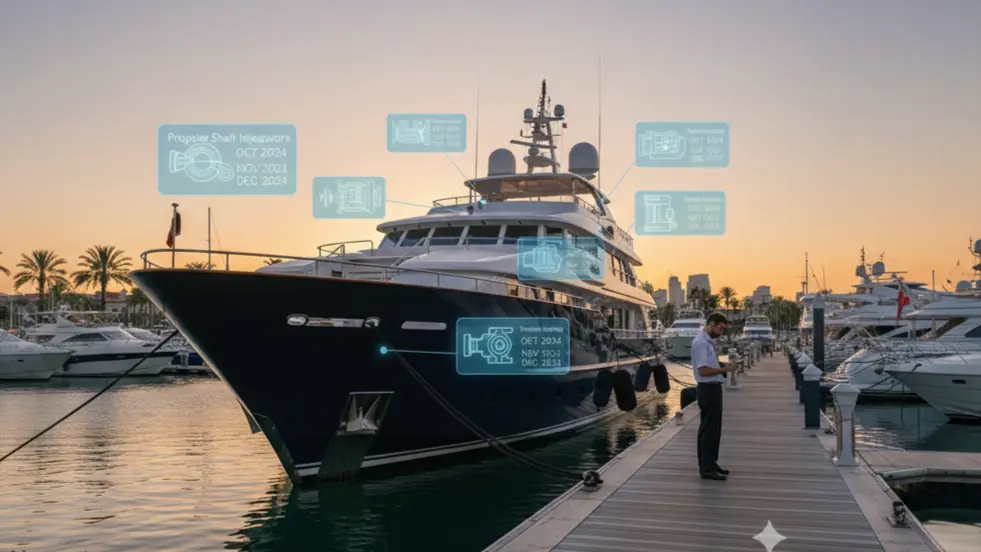
I installed sensors on my critical systems—engines, transmissions, HVAC, electrical systems, and hull monitoring points. These sensors continuously track temperature, vibration, fluid conditions, pressure, electrical load, and dozens of other parameters.
The data flows to an AI-powered system that learns my yacht's normal operating patterns. It knows what my port engine's exhaust temperature should be at 3,200 RPM. It knows how much my starboard transmission should vibrate at cruising speed. It knows my generator's typical electrical load on a hot Tampa afternoon.
When something deviates from normal, I get an alert. Not when it fails—when it starts to deviate.
This is the game-changer. I now fix problems during the early warning stage, not during the catastrophic failure stage.
How Predictive Maintenance Actually Works (Without the Technical Jargon)
When I first heard about "predictive maintenance with IoT sensors and AI analysis," my eyes glazed over. It sounded like something for superyachts with full-time crew, not for owner-operators like me. (For more on AI capabilities, see our guide to AI yacht diagnostic assistants and IoT sensors for yacht maintenance.)
But the technology has become remarkably accessible and surprisingly simple to implement.
Let me walk you through how it actually works on my boat.
The Sensors: Your Yacht's Nervous System
I started with engine monitoring sensors. These track:
- Temperature sensors on engine blocks, exhaust manifolds, transmission casings, and cooling systems
- Vibration sensors on engine mounts and transmission mounts
- Pressure sensors for oil pressure, fuel pressure, and coolant pressure
- Fluid quality sensors that monitor oil condition in real-time
- Electrical sensors that track voltage, amperage, and power quality
The sensors are small—most are about the size of a key fob—and they're wireless. Installation on my twin Cummins diesels took about four hours with a marine technician.
Beyond the engines, I added sensors for:
- HVAC systems (compressor temperature, refrigerant pressure, airflow)
- Electrical systems (main bus voltage, individual circuit loads, battery health)
- Hull monitoring (moisture detection, through-hull temperature, bilge water levels)
- Safety systems (fire suppression pressure, CO detectors, high-water alarms)
The total sensor package for my 52-foot yacht cost about $3,800 and took a day to install.
The Data Collection: Constant Vigilance Without the Work
Once installed, the sensors collect data continuously. When I'm running the boat, they're sampling conditions every second. When the boat is docked, they sample every minute.
All this data flows wirelessly to a central hub on the boat, which then syncs to the cloud whenever I have an internet connection—either through my boat's Wi-Fi when docked or through a cellular connection when I'm out on the water.
I don't have to do anything. The system is always watching, always learning, always building a picture of my yacht's health.
The AI Analysis: Pattern Recognition That Saves Money
Here's where it gets interesting. The AI system doesn't just collect data—it learns what's normal for my specific yacht.
It learned that my port engine runs about 3 degrees warmer than my starboard engine (they've always been that way, nothing wrong). It learned that my generator pulls higher current on hot afternoons when the HVAC is working hard. It learned that my transmission fluid temperature spikes slightly when I'm maneuvering in tight marina spaces at low RPM.
These are my yacht's normal patterns. The AI catalogs all of them.
When something deviates from normal, that's when I get an alert. But here's the crucial difference from old-school alarm systems: The AI distinguishes between normal variation and problematic trends.
If my engine temperature spikes because I'm running in 90-degree weather with a strong current, that's expected. The AI knows that. But if my engine temperature starts climbing even though conditions haven't changed, that's a trend worth investigating.
The Prediction: Knowing Before It Happens
The real magic happens when the AI identifies patterns that precede failures.
Three months ago, my system alerted me that my port engine's oil pressure was trending downward. Not dangerously low—still within normal operating range—but trending down over several trips.
A traditional alarm wouldn't have triggered because the pressure was still above the warning threshold. But the predictive system saw the pattern: Pressure that used to average 42 PSI at cruising speed was now averaging 39 PSI.
I took it to my mechanic. He found the oil pressure sending unit was slowly failing—a $180 part that takes 30 minutes to replace. If I'd waited until it failed completely, I might have run the engine with low oil pressure without knowing it, potentially causing thousands in engine damage.
That's predictive maintenance. Small fix now, disaster prevention later.
Top 5 Systems That Benefit Most from Predictive Monitoring
After two years running predictive maintenance on my yacht, I can tell you exactly which systems deliver the biggest return on investment. These five systems have saved me more money and headaches than everything else combined.
1. Engines and Transmissions: The Heart of Your Investment
This is the big one. Engine and transmission failures are catastrophically expensive, and they almost always give warning signs if you know how to look for them.
The predictive sensors on my twin diesels monitor:
- Oil temperature and pressure trends
- Coolant temperature across multiple points
- Exhaust gas temperature (EGT) for each cylinder bank
- Vibration patterns that indicate bearing wear or misalignment
- Fuel pressure and flow rate
- Transmission fluid temperature and clutch engagement characteristics
Over the past two years, predictive alerts have caught:
- A developing crack in an exhaust manifold (caught early: $850 repair; if it had failed: $4,200 repair plus potential engine damage)
- Gradual transmission fluid degradation (scheduled fluid change at 87 hours instead of waiting for 100 hours; prevented clutch damage)
- An engine mount that was deteriorating (causing excessive vibration; $220 fix that prevented transmission misalignment)
For engines and transmissions alone, I estimate predictive maintenance has saved me $6,000-8,000 in major repairs.
2. HVAC Systems: Comfort and Complexity
Marine HVAC systems are expensive and finicky. A compressor failure can cost $2,500-4,000 to replace, and failures always seem to happen on the hottest weekends.
Predictive monitoring tracks:
- Compressor run time and cycle frequency
- Refrigerant pressures (high side and low side)
- Condenser temperature
- Electrical current draw (high current often indicates a struggling compressor)
- Air handler motor temperature
Last summer, my system alerted me that my forward cabin A/C compressor was drawing higher current than normal. The technician found the condenser coils were partially blocked with salt buildup, making the compressor work harder.
A simple coil cleaning ($180) prevented a compressor failure that would have cost $3,200 to replace. And I got to keep my guests comfortable instead of apologizing for a broken air conditioner.
3. Electrical Systems: The Hidden Money Pit
Electrical problems on boats are notoriously difficult to diagnose. They're intermittent, they're complicated, and they can cause cascading failures across multiple systems.
Predictive monitoring of my electrical system includes:
- Main bus voltage stability
- Individual circuit load monitoring
- Battery health tracking (voltage, charge acceptance, internal resistance)
- Inverter/charger performance
- Shore power quality monitoring
Six months ago, I got an alert that my house battery bank wasn't accepting charge properly. Internal resistance was climbing, and the batteries were heating up during charging.
I replaced the battery bank before it failed. Cost: $1,800 for new AGM batteries. If I'd waited for complete failure, I might have damaged my expensive battery charger ($2,400) or found myself with dead batteries while anchored out at Fort De Soto.
4. Hull Integrity and Through-Hulls: The "Sleep Well at Night" System
This one's about peace of mind as much as money. Hull monitoring sensors detect problems that could sink your boat.
My hull integrity monitoring includes:
- Moisture sensors at critical points (stringers, bulkheads, transom)
- Temperature sensors on through-hull fittings (unusual temperature changes can indicate water flow where it shouldn't be)
- Bilge water level monitoring (with AI that learns normal bilge cycles vs. abnormal water intrusion)
- Engine room moisture detection
Three months after installing these sensors, I got an alert about elevated moisture near my aft bulkhead. Investigation revealed a leaking shaft seal—not catastrophic yet, but heading that direction.
A $650 shaft seal replacement prevented what could have been a serious water intrusion problem. And I sleep better knowing I have 24/7 monitoring for the things that could actually sink my boat.
5. Safety Systems: When Backup Systems Need Backup
Safety systems are critical, but they're also easy to neglect because they only matter in emergencies. Predictive monitoring ensures they're always ready.
I monitor:
- Fire suppression system pressure (ensures the system will actually work if needed)
- CO detector calibration and sensor condition
- High water alarm functionality
- Navigation light voltage and current (detects failing bulbs before they go completely dark)
- Bilge pump run time and cycle frequency
Last year, predictive monitoring caught a failing bilge pump before it quit entirely. The pump was drawing higher current and running longer cycles to pump the same amount of water—classic signs of an impeller wearing out.
A $120 bilge pump replacement on my schedule is way better than discovering a failed pump when I actually need it.
Implementing Predictive Maintenance on Your Yacht: A Step-by-Step Guide
When I decided to implement predictive maintenance, I was overwhelmed by options and worried about cost. Let me save you the trial and error and walk you through exactly how to do this for a 30-75 foot vessel.
Step 1: Start With Engine Monitoring (Weeks 1-2)
The engines are your highest-value target. Start here.
For twin-engine yachts like mine:
- Install temperature sensors on engine blocks, exhaust manifolds, and transmissions
- Add vibration sensors to engine mounts
- Install oil pressure and temperature sensors (many engines have ports for these)
- Add fuel flow meters if your budget allows
Cost for twin diesels: $1,800-2,400 in sensors, $600-800 for installation
Time to install: 4-6 hours with a marine technician
Payback period: 6-12 months (based on preventing one major engine issue)
For single-engine yachts, cut these costs roughly in half.
Step 2: Add Electrical System Monitoring (Week 3)
Electrical monitoring is high-value and relatively inexpensive to implement.
Install:
- Battery monitor shunts on all battery banks
- Main bus voltage and current monitoring
- Individual circuit monitoring for high-draw items (HVAC, watermaker, galley appliances)
- Inverter/charger performance monitoring
Cost: $600-900 in sensors and monitoring equipment
Time to install: 2-3 hours
Payback period: 12-18 months
Step 3: HVAC and Climate Control (Week 4)
If you have marine HVAC (most yachts 40+ feet do), monitor it.
Add:
- Compressor current sensors
- Refrigerant pressure sensors (high and low side)
- Air handler temperature monitoring
- Run time logging
Cost: $400-600 per HVAC unit
Time to install: 1-2 hours per unit
Payback period: One prevented compressor failure pays for the entire system
Step 4: Hull and Safety Systems (Week 5-6)
These are your insurance policies against catastrophic problems.
Install:
- Moisture sensors at stringers, bulkheads, and transom
- Through-hull temperature monitoring
- Enhanced bilge water level monitoring
- Fire suppression pressure monitoring
Cost: $500-800 for comprehensive hull monitoring
Time to install: 2-3 hours
Payback period: Impossible to calculate, but worth it for peace of mind
Step 5: Connect Everything to a Central System (Week 6)
All these sensors need to talk to each other and to you. This is where software like YachtWyse comes in.
A good predictive maintenance platform should:
- Collect data from all your sensors automatically
- Learn your yacht's normal operating patterns
- Alert you to deviations and trends before they become problems
- Provide maintenance recommendations based on actual conditions
- Keep comprehensive logs for warranty claims and resale value
- Allow remote monitoring from your phone
Cost: $50-150/month for cloud-based predictive maintenance software
Setup time: 2-4 hours to configure and integrate sensors
Total Investment and Timeline
For a typical 45-55 foot yacht with twin engines:
- Total sensor cost: $3,300-5,100
- Installation labor: $1,000-1,500
- Software subscription: $600-1,800/year
- Total first-year investment: $4,900-8,400
- Implementation timeline: 6-8 weeks from start to full operation
That might sound like a lot, but remember—my single transmission failure cost $8,200. One prevented failure pays for the entire system.
DIY vs. Professional Installation
I had a marine technician install my sensors because I wanted it done right the first time. But if you're handy and comfortable working on your boat, many sensors can be installed DIY.
Good candidates for DIY installation:
- Battery monitors and shunts
- Non-invasive temperature sensors (clamp-on types)
- Moisture detection sensors
- Bilge monitoring upgrades
Definitely hire a professional for:
- Anything involving engine modifications
- Refrigerant pressure sensors (requires HVAC certification)
- Through-hull monitoring
- Main electrical panel integration
I did about 30% of the installation myself and saved roughly $400 in labor. If you're more experienced with boat systems, you could potentially do 60-70% yourself.
ROI Analysis: What I'm Actually Saving (With Real Numbers)
Let's talk money. Because as much as I love the peace of mind, the real question is: Does predictive maintenance actually save enough to justify the investment?
I've been running comprehensive predictive maintenance for two years now. I track every alert, every maintenance action, and every cost. Here are my real numbers.
My Costs: Before and After Predictive Maintenance
Reactive Maintenance (Years 1-2 of ownership):
- Emergency repairs: $12,400
- Preventive maintenance: $4,800
- Lost weekends due to breakdowns: 8 (impossible to value, but incredibly frustrating)
- Total annual average: $18,600
Preventive Maintenance (Years 3-4 of ownership):
- Scheduled maintenance: $11,200
- Unexpected repairs: $3,400
- Lost weekends: 2
- Total annual average: $14,600
Predictive Maintenance (Years 5-6, current):
- Sensor installation: $4,200 (one-time cost, year 5)
- Software subscription: $1,200/year
- Condition-based maintenance: $6,800/year
- Unexpected repairs: $800/year
- Lost weekends: 0
- Total Year 5: $13,000
- Total Year 6: $8,800
The Savings Breakdown
Comparing predictive maintenance (year 6) to preventive maintenance:
- Direct savings: $5,800/year ($14,600 - $8,800)
- Avoided emergency repairs: $4,200/year (based on prevented failures)
- Fuel efficiency improvements: $600/year (engines running optimally)
- Extended component life: Estimated $2,000/year (major components lasting longer)
- Total annual benefit: $12,600
After the first-year investment in sensors, I'm saving $5,800-12,600 per year compared to my previous approach.
Payback period for the sensor investment: 4-9 months
Return on investment after 2 years: 340%
What Predictive Maintenance Has Specifically Prevented
Here are the actual problems caught early over the past two years:
| Problem Detected | Early Fix Cost | If It Had Failed | Savings |
|---|---|---|---|
| Failing oil pressure sensor | $180 | Potential engine damage, $4,000+ | $3,820+ |
| Transmission fluid degradation | $420 | Clutch failure, $6,800 | $6,380 |
| Cracked exhaust manifold | $850 | Manifold failure + water intrusion, $4,200 | $3,350 |
| Deteriorating engine mount | $220 | Transmission misalignment, $2,800 | $2,580 |
| HVAC condenser blockage | $180 | Compressor failure, $3,200 | $3,020 |
| Failing battery bank | $1,800 | Dead batteries + damaged charger, $4,200 | $2,400 |
| Leaking shaft seal | $650 | Water intrusion + emergency haul-out, $3,500+ | $2,850+ |
| Failing bilge pump | $120 | Flood damage, $5,000+ | $4,880+ |
| TOTAL | $4,420 | $33,700+ | $29,280+ |
That's $29,280 in prevented failures over two years. And that doesn't count the value of weekends not spent dealing with breakdowns, stress avoided, or the confidence of knowing my boat is healthy.
The Hidden Benefits: Beyond the Numbers
Some benefits of predictive maintenance can't be easily quantified:
Peace of mind: I can leave for a weekend trip without wondering if something's going to break. I monitor my boat from my phone, and I know if anything's trending wrong.
Resale value: When it's time to sell, I'll have comprehensive maintenance logs showing exactly how the boat was cared for. Predictive maintenance data is incredibly valuable to buyers.
Insurance benefits: Some marine insurance companies are starting to offer discounts for yachts with comprehensive monitoring systems. I'm working on this with my insurer now.
Time savings: No more guessing about maintenance intervals. The system tells me when maintenance is actually needed based on conditions, not arbitrary time intervals.
Fuel efficiency: Engines and systems running at peak efficiency burn less fuel. I've seen about a 4-6% improvement in fuel consumption since implementing predictive maintenance.
Comparing Predictive to Preventive: The Real Cost Difference
According to recent industry research, predictive maintenance costs about 34% less than preventive maintenance while delivering better results. My experience matches that data.
Here's the comparison for my 52-foot yacht:
| Maintenance Approach | Annual Cost | Unplanned Failures | Confidence Level |
|---|---|---|---|
| Reactive | $18,600 | 6-8 per year | Low |
| Preventive | $14,600 | 2-3 per year | Medium |
| Predictive | $8,800 | 0-1 per year | High |
The cost difference between preventive and predictive maintenance for my yacht: $5,800 per year saved
The difference in unplanned failures: 2-3 fewer emergencies per year
The difference in peace of mind: Priceless
The YachtWyse Predictive Advantage: Making It Simple
I've spent a lot of time talking about sensors, AI, and monitoring systems. The truth is, I'm not a technology expert. I'm a yacht owner who wants to spend more time on the water and less time dealing with maintenance disasters.
That's why I use YachtWyse Premium for my predictive maintenance platform.
What YachtWyse Actually Does for Me
Automatic Data Collection: All my sensors feed into YachtWyse automatically. I don't manually log anything unless I want to add notes about a specific trip or maintenance action.
Intelligent Alerts: The system learns my boat and only alerts me when something actually matters. I'm not drowning in false alarms or meaningless notifications.
Maintenance Recommendations: When the system detects a trend, it doesn't just alert me—it recommends specific actions. "Port engine oil pressure trending down. Recommend inspection within 2 weeks. Possible causes: oil pressure sensor, oil pump, bearing wear."
Complete Records: Every sensor reading, every alert, every maintenance action is logged. If I ever have a warranty claim or want to sell the boat, I have comprehensive documentation of every system.
Remote Monitoring: I can check on my boat from anywhere. I'm in Atlanta for work? I can see that my boat is sitting healthy at the marina with no alerts. I'm 15 miles offshore? I can see real-time engine performance and hull integrity.
Cost Tracking: YachtWyse tracks every dollar I spend on maintenance and compares it to predicted costs. I can see exactly how much predictive maintenance is saving me.
The Premium Features That Matter
YachtWyse Premium includes the predictive maintenance features that make this whole system work:
- AI-powered trend analysis that predicts problems before they fail
- Unlimited sensor integration for comprehensive monitoring
- Real-time alerts via text, email, or push notification
- Predictive maintenance scheduling based on actual conditions
- Comprehensive reporting for insurance, warranties, and resale
- Remote monitoring from any device
- Historical data analysis to identify long-term patterns
For me, YachtWyse Premium costs $1,200 per year. Considering it's managing a sensor network that's saved me $29,000+ in prevented failures, that's the easiest $1,200 I spend on my boat.
Making the Switch: What I Wish I'd Known Two Years Ago
If I could go back and talk to myself before implementing predictive maintenance, here's what I'd say:
Start Small, Scale Up
You don't need to install every sensor on day one. Start with engine monitoring—that's where the highest value is. Get comfortable with the system, learn how it works, then add more sensors over time.
I started with just engine and transmission monitoring. Three months later, I added electrical systems. Six months after that, I added HVAC and hull monitoring. The phased approach made it less overwhelming and spread out the costs.
Trust the Alerts
Early on, I got an alert about my starboard engine running slightly warm. I ignored it because the temperature was still in the "normal" range according to the gauge.
Two weeks later, I had a failed thermostat that cost me $380 in emergency service. If I'd listened to the alert, I could have replaced the thermostat proactively for $85.
Now I trust the alerts. The AI knows my boat better than I do.
Keep Up With Regular Maintenance
Predictive maintenance doesn't eliminate regular maintenance—it makes it smarter. You still need to change oil, replace zincs, service water pumps, and do all the regular upkeep.
The difference is that predictive maintenance tells you when these things actually need to be done based on conditions, not arbitrary schedules.
Document Everything
Take photos of sensor installations. Keep records of baseline readings. Document when you receive alerts and what you did about them.
This documentation is valuable for warranty claims, insurance purposes, and resale value. YachtWyse handles most of this automatically, but I still keep a personal maintenance log with photos and notes.
Calculate Your Own ROI
Track what you spend on maintenance before and after implementing predictive maintenance. The savings might surprise you.
I created a simple spreadsheet tracking all maintenance costs, emergency repairs, and prevented failures. Seeing the actual numbers made me wish I'd implemented predictive maintenance years earlier. (For a detailed breakdown of yacht ownership costs, see our guide to yacht ownership costs in Florida for 2026.)
The Bottom Line: Prevention Beats Reaction Every Time
Two years ago, I was spending $14,600 per year on yacht maintenance and still dealing with unexpected failures. I was following the maintenance schedule, doing everything "right," but I was still playing defense.
Today, I'm spending $8,800 per year and haven't had an unexpected failure in 18 months. My boat runs better, I have complete peace of mind, and I've saved over $29,000 in prevented repairs.
The difference? Predictive maintenance with comprehensive monitoring and AI-powered analysis.
For owner-operators of 30-75 foot yachts, predictive maintenance isn't just a nice-to-have anymore—it's the difference between expensive reactive repairs and affordable proactive care.
The technology is accessible. The cost is reasonable. The payback is measured in months, not years. And the peace of mind of knowing your yacht is healthy? That's priceless.
I haven't had to cancel a single trip due to mechanical problems in 18 months. I sleep well knowing my boat is monitored 24/7. And I've saved enough money to actually use my boat more, which is the whole point of owning it.
If you're still doing reactive maintenance, you're paying too much and getting too little. If you're doing preventive maintenance, you're on the right track—but you can do better.
Predictive maintenance is the future of yacht ownership. And with platforms like YachtWyse making it accessible to everyday yacht owners, that future is available today.
Start Predicting Problems Before They Cost You
Ready to stop fixing and start preventing? YachtWyse Premium gives you the predictive maintenance tools used by professional yacht managers, designed for owner-operators.
Try YachtWyse Premium free for 30 days and discover:
- AI-powered predictive alerts that catch problems before they fail
- Comprehensive sensor integration for engines, electrical, HVAC, and hull systems
- Real-time remote monitoring from any device
- Maintenance scheduling based on actual conditions, not arbitrary intervals
- Complete documentation for insurance, warranties, and resale value
Join the yacht owners saving thousands per year with predictive maintenance.
No credit card required. Cancel anytime. Start preventing problems today.
Have questions about implementing predictive maintenance on your yacht? Email us at info@yachtwyse.com or join our community forum where yacht owners share real-world experiences with predictive maintenance.
Want to implement predictive maintenance on your yacht? YachtWyse for owner-operators combines AI diagnostics with automated maintenance scheduling and predictive alerts — free for up to 2 vessels. Fleet managers overseeing multiple vessels can leverage cross-fleet predictive analytics to spot patterns across their entire operation.
Sources and Additional Reading
This article was researched using current industry data and real-world yacht maintenance insights from:
- AI in Predictive Maintenance for Ships
- How AI Is Transforming Predictive Yacht Maintenance
- Cost Of Owning A Yacht In Florida: Annual Budget Breakdown
- Predictive vs. Preventive Maintenance: 2026 Cost Guide
- Predictive Maintenance for Marine Vessels
- The ROI of Preventive Maintenance vs. Predictive Maintenance

Written by
YachtWyse Team
Maritime Technology Experts
The YachtWyse team brings decades of combined experience in maritime operations, marine engineering, and software development. We write from real-world experience managing vessels from 30ft cruisers to 100m+ superyachts.
Ready to Simplify Your Yacht Management?
YachtWyse helps owner-operators track maintenance, manage costs, and get AI-powered diagnostic assistance. Start your free trial today.
Request a DemoRelated Articles
Paper Logbooks to AI: Modernize Yacht Records
How superyacht captains and engineers are replacing paper logbooks and spreadsheets with AI-powered digital maintenance records that prevent failures.
Annual Yacht Maintenance Checklist (30-75ft)
A complete guide to annual yacht maintenance from a Tampa Bay owner. Learn hour-based schedules, winterization, and overlooked items that prevent costly repairs.
The Complete Guide to Marine Parts Management: From Barcode to Bolt
How yacht owners and captains can organize marine parts with barcode scanning, OEM cross-references, bulk import, and smart shopping lists — ending the shoebox-of-receipts era for good.