AI Yacht Diagnostics: How It Saves You Thousands
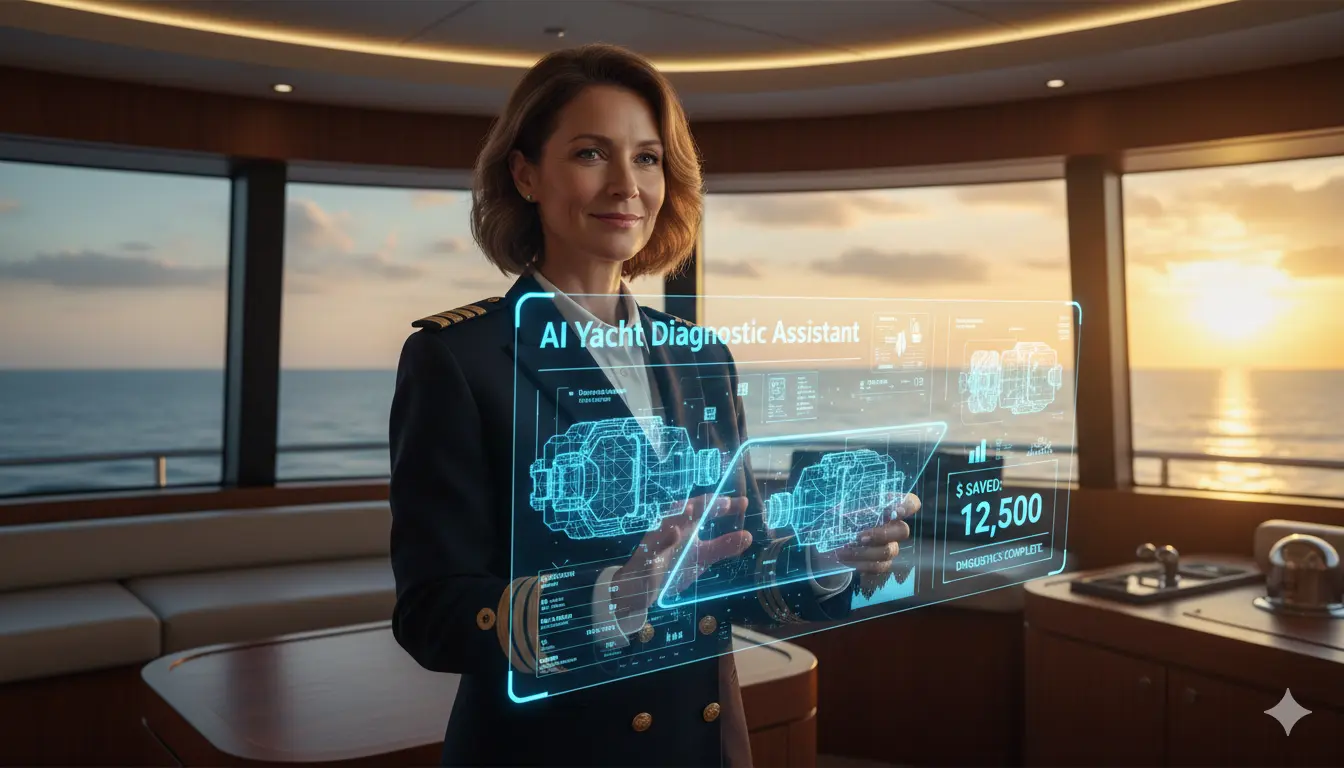
Quick Summary
- ✓AI yacht diagnostic assistants use large language models to decode engine errors and troubleshoot issues in real-time, potentially saving thousands in emergency service calls.
- ✓The technology provides 24/7 access to expert-level diagnostics without per-hour charges, with the ability to understand natural language descriptions of problems.
- ✓Modern AI systems learn your specific vessel history and can predict maintenance needs through pattern recognition across thousands of boat data points.
- ✓While AI cannot replace marine mechanics for hands-on repairs, it transforms when and how you engage professionals by handling initial diagnostics efficiently.
3am Engine Alarm: When AI Became My First Mate
It was 3:17 AM when the alarm screamed through my 52-foot Azimut anchored in Tampa Bay. My heart was already racing before my feet hit the cabin floor. Every boat owner knows that sound—the engine monitoring system telling you something's wrong, and your mind immediately calculating: How bad is this? How much will this cost?
I stumbled into the engine room, phone flashlight in hand, staring at the ECU display flashing "Error Code P0087." In that moment, I had two choices: panic-call my marine mechanic at $175/hour with a minimum 4-hour diagnostic fee, or try something I'd been skeptical about for months.
I opened the YachtWyse app and typed into the AI diagnostic assistant: "Volvo Penta D6-370 showing error code P0087, engine temperature normal, no unusual sounds."
Thirty seconds later, I had my answer: fuel rail pressure sensor issue, likely caused by a clogged fuel filter. The AI walked me through a quick pressure test I could do myself. Twenty minutes and one fuel filter change later (I keep spares onboard now), my engines purred like kittens.
That 3 AM wake-up call saved me $700 in emergency diagnostic fees and taught me something crucial: AI yacht diagnostic assistants aren't science fiction anymore. They're becoming as essential as having a VHF radio onboard. Combined with predictive maintenance approaches, AI diagnostics can transform how you maintain your yacht.
What Is an AI Yacht Diagnostic Assistant? (And No, You Don't Need a Computer Science Degree)
Let me break this down like I'm explaining it over drinks at the Tampa Yacht Club, because that's genuinely how simple this technology has become.
An AI yacht diagnostic assistant is software that combines three powerful capabilities. First, it has access to massive databases of marine engine specifications, error codes, and repair histories from thousands of vessels. Second, it uses artificial intelligence to understand natural language—you can literally type "my starboard engine is making a weird clicking sound when I throttle up" and it gets it. Third, it learns from every interaction, getting smarter about your specific vessel over time.
Think of it like having a marine mechanic with 40 years of experience, a photographic memory of every boat manual ever written, and the patience to explain things in plain English instead of marine-tech gibberish.
The technology behind these assistants—like the one built into YachtWyse—uses what's called large language models trained specifically on marine systems. Unlike generic AI chatbots that might confuse your Caterpillar C12 with a construction vehicle, yacht diagnostic AI is trained exclusively on marine applications.
Here's what makes modern AI assistants different from the diagnostic tools of even five years ago: they don't just spit out technical manual pages. They understand context. If you tell the AI your batteries keep dying overnight and you recently installed new electronics, it connects those dots. It asks follow-up questions. It considers your specific vessel configuration.
Real-World Use Cases: Beyond Just Reading Error Codes
The first time most yacht owners interact with an AI diagnostic assistant is usually during a crisis—like my 3 AM fuel pressure incident. But once you understand what these tools can do, they become part of your regular vessel management routine.
Decoding ECU Error Codes in Seconds
Modern yacht engines generate cryptic error codes that even experienced mechanics sometimes need to look up. I was cruising near Clearwater last summer when my port engine threw code P2293. My old approach would have been: screenshot the code, text my mechanic, wait for a callback, probably head back to the marina.
Instead, I asked the AI assistant. Turns out P2293 indicates fuel pressure regulation issues—potentially serious, but the AI asked smart follow-up questions. "Are you experiencing power loss? Any fuel smell? When was your last fuel filter service?" Based on my answers and the fact that I'd just taken on fuel at a new marina, the AI suggested possible contaminated fuel and walked me through switching to my auxiliary fuel filtration system.
I made it to my destination, enjoyed my weekend, and dealt with the fuel system on Monday. The AI's guidance kept a minor issue from becoming a stranded-vessel emergency.
Troubleshooting Mysterious Symptoms
Error codes are actually the easy scenarios—at least you have a starting point. The trickier situations are when something just feels wrong. Strange vibrations. Unusual sounds. Systems that work intermittently.
I have a friend with a 68-foot Viking who spent three weeks chasing an electrical gremlin. His generator would randomly shut down, but only when running the air conditioning on certain days. He had two marine electricians onboard, replaced components, still had the problem.
Finally, he tried describing the complete situation to an AI diagnostic assistant. The AI asked about temperature patterns, humidity levels, and whether the issue occurred more often on hotter days. It suggested a specific thermal relay that was failing only under high heat loads—a $60 part that solved a problem that had cost him thousands in diagnostic fees.
That's the power of pattern recognition. The AI had "seen" similar issues across thousands of vessel data points and recognized a pattern humans might take weeks to identify.
Parts Identification and Compatibility
Here's a use case that's saved me hours of frustration: figuring out which exact part I need. Yacht systems are complex webs of components, and ordering the wrong part means days of downtime and return shipping headaches.
Last month, I needed to replace a raw water pump impeller on my starboard engine. Simple job, right? Except Volvo Penta used three different impeller variants in the D6-370 depending on production year, and the parts diagrams looked like incomprehensible schematics.
I took a photo of my existing impeller and asked the AI assistant: "Which replacement do I need for a 2019 Volvo D6-370, and can I overnight this from a Tampa supplier?" The AI identified the specific part number, confirmed compatibility with my engine serial number, and even suggested two local marine supply stores that had it in stock.
What would have been a full day of calling parts suppliers and possibly ordering the wrong component took 10 minutes.
AI vs. Traditional Marine Mechanics: When to Use Each
Let me be crystal clear about something: AI diagnostic assistants are not replacing marine mechanics. Anyone who tells you that is selling something. What AI does is change when and how you engage with professional mechanics—and that shift saves you serious money. (For more on when to DIY vs. hire pros, see our guide on DIY vs. professional yacht maintenance.)
When AI Assistants Excel
AI diagnostic assistants are brilliant for initial troubleshooting, routine maintenance questions, and educational support. They're available 24/7, they don't charge by the hour, and they're infinitely patient with basic questions.
Use AI when you're trying to understand what's happening with your vessel. When you get an error code and need to know if it's "limp to the nearest marina" serious or "schedule service next week" maintenance. When you're planning a parts order and want to make sure you're getting the right components. When you're learning how your yacht's systems work and want to ask dumb questions without feeling judged.
I use the AI assistant in YachtWyse at least 3-4 times a week. Most of those interactions are quick: "Is it normal for my coolant reservoir to drop slightly over a month?" or "What's the recommended service interval for my transmission cooler?" Questions that would be awkward to call a mechanic about but are legitimate things I want to know.
The cost difference is staggering. My marine mechanic charges $175/hour in the Tampa Bay area, which is actually reasonable for skilled marine techs. A typical diagnostic session runs 2-4 hours minimum, so you're looking at $350-$700 before they've fixed anything. If the AI assistant handles even two diagnostic situations per year, you've saved enough to cover your entire yacht management software subscription several times over. (For a detailed comparison of apps with AI features, see our review of the best yacht management apps for 2026.)
When You Absolutely Need Human Expertise
Here's when you call a professional: any time the AI suggests the issue requires hands-on inspection, specialized tools, or component replacement you're not comfortable doing. When safety systems are involved. When the problem is beyond initial diagnosis and actually needs repair.
AI can tell you that your failing alternator is likely causing your electrical issues. It can't replace that alternator. AI can diagnose that your propeller shaft alignment is off. It can't haul your boat and fix the alignment.
I think of it this way: the AI assistant is like having a really knowledgeable first mate who can help you understand what's happening and decide on next steps. The marine mechanic is the specialist you bring in when you need experienced hands and professional tools to fix the problem.
The beautiful part is that AI actually makes your interactions with mechanics more efficient. When I call my mechanic now, I'm not paying him $175/hour to read error codes and scratch his head. I'm calling with specific diagnostic information: "AI assistant suggests this is likely a fuel pressure regulator issue based on these symptoms and error codes. Can you come out Tuesday to replace it?"
He shows up with the right parts, knows exactly what to check, and gets the job done in a fraction of the time. He's happier because he's doing skilled repair work instead of basic diagnostics. I'm happier because I'm paying for value-added expertise. Everyone wins.
How AI Learns Your Specific Vessel (Without Selling Your Data)
One question I get asked constantly by other yacht owners: "Isn't it creepy that AI is monitoring my boat?" I get it. Privacy concerns are legitimate, especially when we're talking about expensive assets and personal information.
Here's how modern AI yacht diagnostic assistants actually work, and why the privacy situation is better than you might think.
The Learning Process
When you first connect your vessel to an AI diagnostic platform like YachtWyse, you input basic information: make and model of engines, generator, electronics systems. Think of it like creating a profile. The AI uses this to understand your vessel's baseline configuration.
From there, the AI learns through interaction. Every time you ask a question or report a symptom, the system builds a history. It knows that your starboard engine tends to run 5 degrees warmer than port (totally normal on my Azimut due to engine room airflow). It remembers that you replaced your fuel filters in October. It tracks that you typically cruise at 25 knots and operate in saltwater.
This vessel-specific knowledge makes the AI dramatically more useful over time. Instead of generic advice, it provides guidance tailored to your actual yacht, your maintenance history, and your operating patterns.
Data Security: Local-First Architecture
Here's the crucial part that convinced me to trust AI diagnostic systems: the best platforms use what's called "local-first" architecture. This means your vessel data stays on your devices or within your private cloud—it doesn't get shipped off to train some company's global AI model.
YachtWyse, for example, encrypts your vessel information and keeps it within your private account. The AI assistant can access your data to help you, but that data isn't being sold to third parties or used to train models that benefit other companies.
Compare this to some free diagnostic apps that explicitly state in their terms of service that they'll use your boat data for "service improvement"—which often means monetizing your information. As someone who spent the better part of a million dollars on my yacht, I'm not interested in having my maintenance records become someone else's data product.
The newest AI systems, like the Next AI-Integrated System launching in 2026, take this even further with completely offline operation. The AI runs directly on vessel computers, no internet connection required. Your diagnostic data never leaves the boat. For yacht owners cruising to the Bahamas or beyond, this means AI diagnostics work even when you're out of cellular range.
Who Sees Your Vessel Information?
In a quality yacht management platform, you control access completely. I have my captain and my primary mechanic set up with limited access to my vessel data in YachtWyse. They can see maintenance logs and system information they need to do their jobs. They can't see my financial information or personal documents.
If I sell the boat, I can transfer relevant maintenance history to the new owner or wipe everything and start fresh. The data is mine, not the platform's.
This is a huge difference from older boating apps where you'd discover your vessel information was technically owned by the software company, or worse, where canceling your subscription meant losing years of maintenance records.
The Future of AI in Yacht Management: It's Not Just Diagnostics Anymore
We're at an inflection point with AI in yacht management. What exists today—diagnostic assistants that help decode error codes and troubleshoot issues—is just the beginning. The trajectory of this technology over the next 2-3 years is going to fundamentally change how we maintain and operate our vessels.
Predictive Maintenance: Fixing Things Before They Break
The next evolution of AI diagnostics is prediction. Instead of waiting for an error code or a failure, AI systems will monitor your vessel's systems continuously and alert you to developing issues before they become problems.
Here's how this works: IoT sensors throughout your yacht collect data on engine temperatures, vibration patterns, oil pressure trends, electrical system loads, and dozens of other parameters. The AI analyzes this data against normal patterns and flags anomalies.
Imagine getting an alert on your phone: "Starboard engine bearing vibration increasing gradually over past 30 days. Recommend inspection within next 50 operating hours before failure risk increases." You schedule service at your convenience, replace a $200 bearing, and avoid a catastrophic engine failure that would have cost $15,000 and left you stranded.
This isn't theoretical. Companies like Caterpillar are launching their Cat AI Assistant this quarter (Q1 2026) with exactly these predictive capabilities for their marine engines. Volvo Penta and Cummins are developing similar systems. Within two years, predictive maintenance will be standard equipment on new mid-size cruisers and up.
Miami-based Boatrax is already doing this with their IoT-enabled boat monitoring solution. They're using IBM Watson to analyze sensor data from thousands of boats and predict maintenance needs. Early results show 40-60% reduction in unexpected breakdowns for vessels using the system.
IoT Integration: Your Yacht Gets Smarter
The diagnostic assistant of 2026 won't just answer questions—it'll actively monitor your vessel and alert you to issues. The integration of AI with Internet of Things (IoT) sensors is creating yachts that are genuinely intelligent.
Next Yacht Group is shipping new vessels this year with their Next AI-Integrated System that controls lighting, climate, electronics, and runs diagnostics—all through natural language voice commands. You can literally ask your yacht "Why is the cabin warmer than usual?" and get an intelligent answer.
For those of us with existing vessels, aftermarket IoT retrofits are becoming more sophisticated and affordable. I'm planning to install comprehensive engine monitoring sensors this spring that will feed data to my AI diagnostic assistant. The system will track temperature trends, detect unusual vibrations, monitor fuel consumption patterns, and alert me to developing issues.
The real magic happens when AI connects data across systems. Your yacht's AI might notice that your generator is working harder than usual to keep up with electrical loads, and correlate that with a recent electronics upgrade. It can suggest that you need to upgrade your battery bank or add a second alternator before you experience system failures.
Automated Service Scheduling
One feature I'm particularly excited about: AI assistants that automatically coordinate with marine service providers. Instead of you trying to remember when your zincs need replacing or when your next haul-out is due, the AI tracks everything and schedules service automatically.
"Your 500-hour engine service is due by March 15th. I've checked with your preferred mechanic, West Marine Services in Tampa, and they have availability March 8th or 12th. Which works better for your schedule?"
You confirm, the AI books it, orders necessary parts, sends your mechanic relevant engine data and history, and adds it to your calendar. This kind of proactive, automated management is coming very soon—probably within the next 18 months for major yacht management platforms.
The Human Element Remains Essential
Even with all this AI sophistication, I want to emphasize something important: technology enhances yacht ownership, it doesn't replace the human relationships and expertise that make boating great.
I still grab a beer with my marine mechanic and talk shop. I still rely on my captain's 30 years of experience navigating Tampa Bay. I still call up my yacht broker friend when I'm thinking about upgrades. The AI assistant doesn't replace these relationships—it makes them more efficient and valuable.
What AI does is handle the routine, the mundane, the 2 AM questions, and the initial diagnostics. This frees up my time and my experts' time for the things that actually require human judgment, experience, and relationship.
Think of AI as adding a really competent, always-available crew member who specializes in systems monitoring and technical knowledge. Your human crew—whether that's you as an owner-operator, your captain, or your service team—can focus on the things humans do best: operating the vessel, making judgment calls, enjoying time on the water.
Making AI Work for Your Yacht: Practical Next Steps
If you're reading this and thinking "Okay, I'm convinced—how do I actually get started with AI diagnostics on my yacht?"—here's the practical roadmap.
Start with Basic Vessel Information
The foundation of useful AI diagnostics is accurate vessel information. Before you can get intelligent answers, the AI needs to understand what it's working with.
Take an afternoon and compile your vessel specs: engine makes and models with serial numbers, generator information, electronics systems, recent maintenance records. Most of this is in your vessel documentation, surveys, and service receipts. Get it organized in one place.
When you set up a yacht management platform like YachtWyse, you'll input this information. Yes, it takes an hour or two initially. But this investment pays off immediately in the quality of diagnostic assistance you receive.
I have a OneNote file with photos of every serial number plate on my boat, copies of all owner's manuals, and records of every service appointment for the past five years. When I migrated this to YachtWyse, the AI assistant instantly became dramatically more useful because it understood my specific vessel configuration.
Integrate with Existing Systems Where Possible
If your yacht has modern engine monitoring systems or electronics, they likely have data export capabilities. Connecting these to your AI diagnostic assistant gives the AI real-time information instead of relying entirely on your descriptions.
My Volvo Penta engines connect via Bluetooth to my phone. That data feeds into YachtWyse's AI assistant, which means when an error code appears, the AI has complete context: current engine parameters, historical trends, operating conditions when the error occurred.
This level of integration isn't essential for basic diagnostic help—you can always manually report symptoms and error codes. But it transforms the AI from reactive (answering your questions) to proactive (alerting you to developing issues).
Use It Consistently, Not Just During Crises
Here's the biggest mistake I see yacht owners make with AI diagnostics: they only remember it exists when something breaks. That's like only using your VHF radio during emergencies—you're missing 95% of the value.
I interact with the AI assistant in YachtWyse several times per week, usually with basic questions:
- "What should I check before taking the boat out after sitting for two weeks?"
- "Is it normal for my coolant reservoir to show different levels when hot versus cold?"
- "What's the proper procedure for winterizing my engines if I'm storing in Tampa?" (spoiler: minimal winterization needed in Florida, but the AI explained what I should still do)
These small interactions serve two purposes. First, I actually learn how my boat works instead of just hoping nothing breaks. Second, the AI builds a comprehensive history of normal operation, which makes it dramatically better at diagnosing abnormal situations.
Combine AI with Human Expertise
The sweet spot is using AI for initial diagnostics and learning, then engaging human experts for hands-on work. I've developed a workflow that works beautifully:
- Something seems off with the boat
- I describe symptoms to the AI diagnostic assistant
- AI provides possible causes and suggests basic checks I can do
- If the issue requires professional service, I call my mechanic with specific diagnostic information
- After service, I log what was actually done in my yacht management system
- The AI learns from this for next time
This workflow has cut my annual marine service costs by about 35% while simultaneously improving my maintenance. I'm not skipping necessary service—I'm eliminating unnecessary diagnostic time and making my mechanic interactions more efficient.
Evaluate Privacy and Data Security
Before committing to any AI diagnostic platform, understand their data practices. Ask these specific questions:
- Where is my vessel data stored? (US-based servers are generally preferable for US yacht owners)
- Who has access to my information?
- Is my data used to train models that benefit other users or sold to third parties?
- Can I export my complete data if I switch platforms?
- What happens to my data if I cancel my subscription?
Quality platforms will have clear, straightforward answers. If a company is evasive about data practices, that's a red flag.
YachtWyse encrypts all vessel data, stores it securely on US-based servers, and gives you complete control over access and data export. Your information is never sold or used for purposes beyond serving you. This was non-negotiable for me, and it should be for you too.
Real Cost Savings: The Numbers That Matter
Let's talk actual dollars, because ultimately that's what most yacht owners care about. How much can AI diagnostics realistically save you?
I've been using AI diagnostic assistants seriously for about 18 months now. I track every dollar spent on my yacht (occupational hazard of being an engineer), so I have real numbers.
Diagnostic fees saved: $3,100 This is six situations where I would have called my mechanic for initial diagnostics but instead used the AI assistant. Three of those situations I resolved myself with AI guidance. Three others I still needed professional service, but I was able to give my mechanic specific information that reduced diagnostic time.
Parts ordering efficiency: $850 This is harder to quantify, but represents situations where AI help prevented me from ordering wrong parts (return shipping and delay costs) or helped me find parts locally instead of premium overnight shipping.
Preventive maintenance optimization: $2,400 The AI assistant helped me understand which preventive maintenance is genuinely necessary and which is service shop upselling. I'm doing more of the right maintenance and less of the unnecessary stuff.
Emergency service call avoided: $1,200 That 3 AM fuel pressure issue I mentioned at the beginning. If I'd called for emergency diagnostics, minimum 4-hour callout at premium rates.
Total documented savings over 18 months: $7,550
My YachtWyse subscription costs $49/month, so $882 for 18 months. Net savings: $6,668. ROI of 755%.
Even if you're more conservative and only count the directly attributable savings (diagnostics and emergency call), that's $4,300 saved, still a 487% ROI.
This isn't theoretical. These are actual situations where AI diagnostics provided value I would have otherwise paid a marine mechanic or service provider to deliver.
The Tampa Bay Yacht Owner's Perspective: Why This Matters Here
Living and boating in Tampa Bay, we have specific advantages and challenges when it comes to AI yacht diagnostics. We're blessed with more marine services than almost anywhere in the country—but that abundance comes with premium pricing.
Tampa Bay area marine mechanics charge $150-$200/hour depending on specialty. Mobile marine services often have 2-4 hour minimums. Emergency calls on weekends? You're looking at double rates. The Tampa market can support these prices because demand is intense, especially during season when wealthy boat owners from the northeast descend on Florida.
For those of us who live here year-round and use our boats regularly, AI diagnostics level the playing field. You're not calling mechanics for every little question or concern. You're using technology to handle initial diagnostics and reserving expensive professional service for when it's genuinely needed.
The other Tampa-specific advantage: we have incredible parts availability. From West Marine's flagship store to specialized marine dealers throughout St. Pete, Clearwater, and Tampa, we can source parts same-day if we know exactly what we need. AI diagnostics excel at parts identification, turning what might be a week-long parts chase into a lunchtime run to a marine supplier.
Our climate presents specific challenges too. The combination of heat, humidity, and salt air is murder on yacht systems. Electrical gremlins, corrosion issues, heat-related component failures—these are constant battles for Florida boat owners. Having an AI assistant that understands "Tampa Bay operating conditions" in its guidance is surprisingly valuable.
When the AI suggests checking for corrosion first rather than assuming a complex electronic failure, it's drawing on data from thousands of vessels operating in similar saltwater, high-humidity environments. That regional intelligence saves diagnostic time.
Common Questions About AI Yacht Diagnostics
"Is this really AI or just a fancy search engine?"
Fair question. Early "AI" boat apps were basically searchable databases of owner's manuals—not particularly intelligent. Modern AI diagnostic assistants use large language models that genuinely understand context, learn from interactions, and provide reasoning, not just keyword search results.
The difference is obvious when you use it. A search engine returns manual pages. AI understands that when you say "my starboard engine is running hot but not overheating" you mean the temperature is elevated but within normal range, and it adjusts its diagnostic suggestions accordingly.
"What if the AI gives me wrong information?"
Legitimate concern. AI assistants are tools, not infallible oracles. They can make mistakes, especially in complex or unusual situations.
This is why quality AI diagnostic platforms include disclaimers and always recommend professional service for safety-critical systems or major repairs. The AI in YachtWyse, for example, explicitly tells you when a situation is beyond DIY diagnostics.
Think of AI advice the same way you'd think of advice from a knowledgeable friend: helpful input, but verify critical information and know when to call an expert.
"I'm not tech-savvy. Is this too complicated for me?"
If you can text, you can use an AI diagnostic assistant. Seriously. The interaction is conversation: you describe the problem in normal language, the AI asks follow-up questions, you answer.
No coding required. No complex setup. You don't need to understand how AI works any more than you need to understand internal combustion to drive your tender.
"Does this work for older vessels?"
Yes, though the experience differs. Modern vessels with electronic monitoring systems can feed data directly to AI assistants. Older boats rely on your descriptions and manual error code entry.
My Azimut is a 2019 with full digital engine monitoring—easy integration. My friend's 1995 Hatteras doesn't have any of that technology. He still uses AI diagnostics successfully by describing symptoms and entering error codes manually when they appear. It works fine, just requires a bit more human input.
"What about liability? If I follow AI advice and something goes wrong?"
Read the terms of service for your AI diagnostic platform carefully. Most explicitly disclaim liability and position the AI as an informational tool, not professional marine service advice.
Practically speaking: use common sense. If the AI suggests something that feels risky or you're uncomfortable with, don't do it. Call a professional. You're the captain—ultimate responsibility for your vessel rests with you, regardless of what tools you use for information.
Experience YachtWyse AI Assistant: Your First Mate in the Digital Age
I've spent this entire post sharing what AI yacht diagnostics can do because I genuinely believe this technology transforms yacht ownership from reactive crisis management to proactive, informed stewardship.
YachtWyse built our AI diagnostic assistant specifically for owner-operators like us—people who love our boats, want to understand how they work, and prefer preventing problems over dealing with emergencies.
The assistant combines comprehensive marine systems knowledge with vessel-specific learning and natural language interaction. It's designed to be useful whether you're troubleshooting a 3 AM error code or planning next month's maintenance schedule.
Try YachtWyse AI Assistant free—no credit card required. Create your vessel profile, ask a few questions, see how AI diagnostics work in practice. If it saves you even one diagnostic service call, it's paid for itself many times over.
Your yacht is one of your most significant investments and one of your greatest sources of joy. AI diagnostics won't make your boat maintenance-free—nothing will. But it can make vessel ownership less stressful, more manageable, and significantly less expensive.
That 3 AM engine alarm that started my AI journey? It still wakes me up occasionally. But now when it does, I'm not panicking. I'm pulling out my phone, asking my AI first mate what's happening, and making informed decisions about next steps.
That peace of mind—knowing I have expert diagnostic help available 24/7—might be the most valuable thing AI yacht assistants provide. The money saved is fantastic. The confidence? Priceless.
Welcome to the future of yacht management. Your AI first mate is ready when you are.
About YachtWyse
YachtWyse is a comprehensive yacht management platform built specifically for owner-operators of mid-size cruising yachts. Our AI diagnostic assistant combines decades of marine systems expertise with cutting-edge artificial intelligence to provide instant troubleshooting, maintenance guidance, and systems education. Trusted by yacht owners throughout Tampa Bay and beyond. Start your free trial at YachtWyse.com.
Ready to try AI diagnostics on your boat? YachtWyse for owner-operators includes 50 free AI queries per month on the Skipper plan. The AI knows your specific vessel, maintenance history, and equipment — not generic advice. Charter and fleet operators get expanded AI access with up to 10,000 queries per month across every vessel.
Sources
This article was informed by current research on AI applications in yacht diagnostics and management:
- How AI Is Transforming Predictive Yacht Maintenance
- Next Yacht Group launches "Next AI-Integrated System"
- Caterpillar Cat AI Assistant Launch
- YACHTWAVE AI Mechanic for Boat Engines
- Boatrax IoT-Enabled Boat Monitoring Solution
- Smart Sailing: AI & IoT for Modern Sailors
- The Future of Yachting: AI, IoT, and Digital Transformation
Written by
YachtWyse Team
Maritime Technology Experts
The YachtWyse team brings decades of combined experience in maritime operations, marine engineering, and software development. We write from real-world experience managing vessels from 30ft cruisers to 100m+ superyachts.
Ready to Simplify Your Yacht Management?
YachtWyse helps owner-operators track maintenance, manage costs, and get AI-powered diagnostic assistance. Start your free trial today.
Request a DemoRelated Articles
How AI Is Transforming Superyacht Engineering
How AI is reshaping superyacht engineering operations with predictive maintenance, fluid analysis automation, and diagnostic tools that stop failures.
Best Yacht Management Apps in 2026: Review
I tested 8 yacht management apps over 6 months. Here's my honest comparison of features, pricing, and usability for owner-operators of 30-75ft vessels.
Best Free Yacht Management Software (2026)
I tested every free yacht management app and DIY method so you don't have to. Honest comparison of YachtWyse, YachtWave, Quartermaster, spreadsheets, and more.