How AI Is Transforming Superyacht Engineering
Quick Summary
- ✓AI predictive maintenance analyzes patterns to warn about failures weeks before traditional thresholds trigger alarms
- ✓Fluid analysis automation correlates oil data with operating hours and historical trends, detecting bearing wear before critical thresholds
- ✓AI diagnostic assistants provide context-aware troubleshooting 24/7, compressing hours of manual research into minutes
- ✓A single prevented emergency generator failure saves $50,000-$150,000; avoided charter cancellation protects $150,000-$350,000 revenue
- ✓Maritime operators report 20% reductions in engine downtime after implementing AI-driven monitoring systems
I was standing in the engine room of a 55-meter Amels in Antibes when the starboard main engine's turbocharger failed without warning.
No gradual performance loss. No advance indication in the daily logs. Just a sudden catastrophic failure at 1,400 RPM during a Mediterranean crossing with the owner aboard. The turbo housing cracked, sent metal fragments into the exhaust manifold, and took the starboard engine offline in under thirty seconds.
What followed was the kind of cascading disaster that every chief engineer has either lived through or lies awake dreading. An emergency limp into Nice on the port engine alone. A frantic search for a replacement turbocharger that would need to be air-freighted from the Netherlands. A week of the owner's summer program cancelled while the yacht sat alongside with scaffolding in the engine room. The total bill, including parts, emergency labor, port fees, and the cancelled leg of a charter handover, exceeded $180,000.
The turbocharger had been serviced according to the manufacturer's schedule. The oil analysis from six weeks prior had shown slightly elevated iron particles, but the readings fell within the lab's acceptable range. The exhaust gas temperatures had been creeping upward by two degrees per week for the previous month, but that kind of gradual drift is almost invisible when you are reading gauges and logging numbers manually.
That experience crystallized something I had been thinking about for years. The way we maintain superyachts, even the best-run programs with experienced engineers and comprehensive planned maintenance systems, is fundamentally limited by what humans can observe, remember, and correlate across thousands of data points.
Artificial intelligence changes that equation entirely. And after spending the last several years working at the intersection of AI and marine engineering operations, I am convinced we are at the beginning of the most significant shift in superyacht technical management since the adoption of planned maintenance systems.
The Current State of Superyacht Engineering: Brilliant People, Blunt Tools
Let me be direct about where the industry stands today, because understanding the baseline is essential before discussing where AI takes us.
The superyacht sector employs some of the most skilled marine engineers in the world. Chief engineers on large yachts manage machinery plants that rival small commercial vessels, maintain systems ranging from diesel-electric propulsion to cryogenic air conditioning, and do it all while meeting ISM compliance standards and keeping everything running silently enough that guests never hear a pump cycle.
But even the best chief engineers are working with fundamentally blunt tools.
The standard approach to superyacht maintenance falls into two categories. Calendar-based preventive maintenance says you change the oil every 500 hours, inspect the watermaker membranes every six months, overhaul the generators at 10,000 hours. It works. It prevents the worst outcomes. But it is inherently wasteful because it treats every engine and every component as identical, regardless of actual operating conditions.
Then there is reactive maintenance. Something breaks, you fix it. Despite every chief engineer's best efforts, reactive maintenance still accounts for a significant portion of technical work aboard superyachts. Unexpected failures happen because the signals were there but buried in data that no human could reasonably monitor continuously across hundreds of systems.
The costs are staggering. A major engine overhaul runs upward of $200,000. Emergency generator repairs can easily exceed $50,000 when you factor in expedited parts shipping, specialist labor at premium rates, and the operational disruption. For charter yachts, the calculus is even more brutal. A 50-meter yacht chartering at $200,000 per week that loses a week to unplanned maintenance has not just incurred repair costs. It has lost charter revenue, damaged its reputation with the charter broker network, and potentially triggered a cascade of scheduling problems that ripple through the entire season.
The industry knows this. Every management company, every chief engineer, every owner's representative understands that reactive maintenance is the most expensive way to operate. The question has always been: what is the alternative when you are dealing with the sheer complexity of a modern superyacht's machinery plant?
That is exactly where AI enters the picture.
How Predictive Maintenance Actually Works on a Superyacht
I want to move past the buzzwords because this industry has been promised technological revolutions before, and chief engineers are rightly skeptical. So let me explain what AI-powered predictive maintenance actually does in practical, operational terms.
At its core, predictive maintenance uses machine learning algorithms to analyze equipment data and identify patterns that precede failures. But that sentence, while accurate, does not capture how this works in the engine room of a 60-meter yacht.
Here is what actually happens.
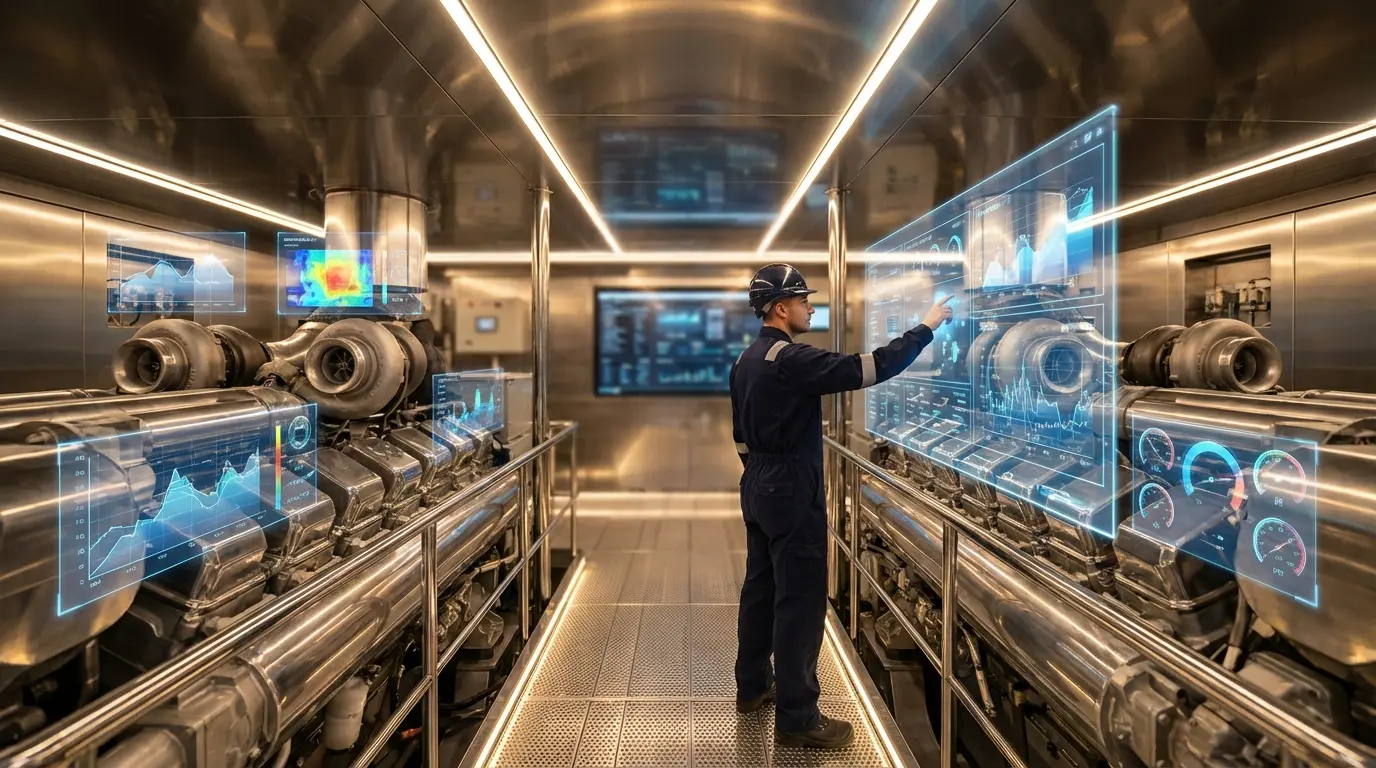
The system ingests data from multiple sources. Service history records, including every maintenance task, parts replacement, and repair logged over the life of the equipment. Operating hour meters. Fluid analysis results. Environmental data such as sea water temperature, operating profiles, and seasonal patterns. On vessels with integrated monitoring, it also pulls real-time sensor data for temperatures, pressures, vibration, and flow rates.
The AI builds a baseline model of normal behavior for each piece of equipment. Not normal according to the manufacturer's generic specifications, but normal for that specific engine, on that specific vessel, operating in those specific conditions. A CAT C32 running Mediterranean summers at sustained 85 percent load develops a different baseline than the same engine doing North Sea transits at variable speeds.
Once the baseline is established, the system continuously compares current data against the model. When readings begin to deviate from the established pattern, even by amounts too small for a human to notice in daily log entries, the AI flags the trend and projects where it is heading.
This is the critical difference. A traditional alarm triggers when a reading crosses a fixed threshold. By that point, something has already gone wrong. AI-powered prediction catches the drift weeks or months before it reaches that threshold, while the problem is still inexpensive and convenient to address.
Going back to that turbocharger failure in Antibes. An AI system analyzing the exhaust gas temperature trend alongside the oil analysis data would have connected those two signals and flagged the turbo as deteriorating well before it failed. Not because either signal alone was alarming, but because the combination, when compared against thousands of similar failure patterns, pointed clearly toward a developing problem.
Fluid Analysis Automation: Reading Between the Lines
Of all the applications of AI in superyacht engineering, fluid analysis automation may be the one that delivers the most immediate, tangible value.
Every well-managed yacht sends oil samples, coolant samples, and hydraulic fluid samples to a laboratory on a regular schedule. The lab returns a report with dozens of measured values: wear metals like iron, copper, and lead; contaminant levels; viscosity measurements; additive depletion indicators; and particle counts.
Here is the problem. Most chief engineers receive these reports as PDF documents or spreadsheets. They review them against the lab's flagged abnormal readings, note anything that seems concerning, and file the report. If nothing is flagged as critical, the report goes into the records and life continues.
But the real intelligence in fluid analysis is not in any single reading. It is in the trends across multiple samples over time, correlated with operating hours, duty cycles, environmental conditions, and the specific characteristics of each piece of equipment.
AI transforms this process. Instead of looking at a single snapshot, the system builds a continuous model of fluid health for every monitored system. It correlates iron particle counts with operating hours since the last overhaul, compares copper trends against similar engines in the same operating environment, and identifies when additive depletion is accelerating faster than the oil change interval can accommodate.
A practical example. A 65-meter yacht's port main engine oil analysis shows iron levels at 28 ppm. The lab's threshold is 40 ppm, so it is not flagged. But AI analysis reveals that iron levels have increased from 12 ppm to 28 ppm over the last three sampling intervals, which is 500 hours. At that rate of increase, the engine will exceed the critical threshold before the next scheduled overhaul. Combined with a slight uptick in lead particles, the pattern is consistent with main bearing wear at an earlier stage than the maintenance schedule anticipates.
The chief engineer receives an alert not saying "your iron is high" but rather explaining that bearing wear is progressing faster than expected and recommending an inspection window in the next 200 hours, before the yacht enters the charter season when downtime would be catastrophic.
That is the difference between data and intelligence. The data was always there. AI provides the intelligence to act on it.
AI Diagnostics: A Chief Engineer's Conversation Partner
When something goes wrong aboard a superyacht, the chief engineer's first resource has traditionally been experience, manufacturer manuals, and phone calls to technical support lines that operate on shore-side business hours. At two in the morning crossing the Bay of Biscay, those phone lines are closed.
AI diagnostic assistants fundamentally change this dynamic. Instead of scrolling through a 400-page service manual searching for fault code descriptions, the engineer describes the problem in plain language and receives contextual, reasoned diagnostic guidance in seconds.
This is not a search engine returning manual excerpts. A well-designed AI diagnostic assistant understands context. When a chief engineer types "starboard generator showing high exhaust temp on cylinder four, load is normal, ambient temp 32C, last injector service was 2,200 hours ago," the AI processes that entire context. It considers the specific generator model, the operating hours since last service, the ambient conditions, and the combination of symptoms to provide a prioritized differential diagnosis.
Is it the injector itself? Possibly, given the hours. Could it be a valve clearance issue? The AI checks whether the last valve adjustment aligns with the symptom pattern. Is there a turbocharger-related airflow restriction that would affect individual cylinder temperatures? The system works through the logic systematically, asking follow-up questions when needed, and providing its reasoning so the engineer can evaluate whether the diagnostic path makes sense.
For chief engineers, this is not about being told what to do. It is about having a knowledgeable conversation partner available around the clock who can process information faster than any human and who never forgets a technical bulletin or a service history detail. The engineer retains full authority and judgment. The AI handles the data processing and pattern matching.
The practical impact on daily workflow is significant. Troubleshooting that might take hours of manual research and phone calls can be compressed into minutes. Junior engineers can access senior-level diagnostic reasoning to support their development. And problems that might have been misdiagnosed, leading to unnecessary parts replacements and continued underlying issues, are correctly identified the first time.
Smart Checklists That Adapt to Reality
One of the quieter but potentially most impactful applications of AI in superyacht engineering is the concept of adaptive checklists.
Every superyacht runs on checklists. Pre-departure checks, daily rounds, weekly maintenance routines, ISM compliance inspections. These checklists are typically static documents. The same items appear regardless of season, operating conditions, recent maintenance history, or current equipment status.
AI makes checklists intelligent. Consider a pre-departure checklist for a yacht about to cross from the Balearics to Sardinia. A standard checklist would include the same items whether the yacht had been sitting idle for two weeks or had just completed a charter. An AI-enhanced system factors in the specific context.
The vessel has been stationary for fourteen days. The system adds checks for stagnant cooling water systems and watermaker membrane preservation. The weather forecast shows following seas and 25 knots of wind. The checklist emphasizes stabilizer system checks and loose gear securing. The starboard generator's oil analysis from last week showed a slight upward trend in silicon, suggesting a possible air filter issue. The checklist adds an air filter inspection specific to that generator.
The checklist adapts to what the vessel actually needs right now, not what a generic template assumes it might need.
For crew workload management, this is transformative. Instead of running through fifty identical items every departure, the engineering team focuses attention where it is genuinely needed. Nothing falls through the cracks because conditions have changed since the checklist was last updated. And every check has a clear rationale tied to actual vessel data, which means crew take the process seriously rather than treating it as a box-ticking exercise.
The Shift: From "Fix When Broken" to "Fix Before It Breaks"
The transition from reactive to predictive maintenance is not just a technical upgrade. It fundamentally changes the chief engineer's role, the crew's daily experience, and the financial dynamics of yacht ownership.
When a yacht operates reactively, the engineering team spends a disproportionate amount of time firefighting. Unplanned failures dictate the schedule. Parts ordering is rushed. Repairs are done under pressure with whatever resources are immediately available. The chief engineer's expertise is consumed by crisis management rather than strategic technical planning.
Predictive maintenance reverses this dynamic. When the AI identifies a developing issue weeks before it becomes a failure, the chief engineer has time. Time to research the optimal repair approach. Time to source the correct parts without paying emergency shipping premiums. Time to schedule the work during a convenient maintenance window rather than during the owner's birthday cruise.
The impact on crew workload and morale is substantial. Engineers who spend their days executing planned, purposeful maintenance rather than responding to emergencies develop deeper expertise and higher job satisfaction. Junior engineers learn from structured maintenance processes rather than chaotic emergency repairs. The entire technical operation becomes more professional, more systematic, and more effective.
For owners and management companies, the financial case is compelling. The maritime industry broadly reports that operators implementing AI-driven monitoring systems see meaningful reductions in engine-related downtime. On superyachts, where the cost of downtime includes not just repairs but lost charter revenue, disrupted owner programs, and reputational damage, the return on investment is even more pronounced.
One way to think about it: the cost of preventing a failure is almost always a fraction of the cost of recovering from one. A bearing inspection prompted by AI analysis might cost $5,000 in labor and a day alongside. The catastrophic failure that inspection prevents could cost twenty to thirty times that amount.
Where the Industry Is Heading
I want to be honest about where we are on the adoption curve, because credibility matters more than hype in a conversation with working engineers.
The superyacht industry is early in AI adoption. Most vessels still operate on calendar-based maintenance schedules supplemented by the chief engineer's experience and intuition. The majority of fluid analysis interpretation is manual. Diagnostic troubleshooting relies on human expertise and manufacturer support.
But the trajectory is unmistakable. Industry surveys suggest that 65 percent of maintenance teams plan to incorporate AI tools by the end of 2026. The digital twin market in the marine sector is projected to grow from $590 million in 2025 to $2.4 billion by 2032. The technology is moving from experimental to operational.
Several developments will accelerate this transition.
Sensor integration is becoming standard on new builds. Modern superyachts are being delivered with comprehensive monitoring systems that provide the data foundation AI needs to function effectively. As retrofit sensor packages become more affordable and less invasive, older vessels will gain access to the same capabilities.
Digital twins, virtual replicas of a vessel's entire machinery plant, will allow engineers to simulate maintenance scenarios, test configuration changes, and predict the long-term impact of operating decisions before committing to them in the real world. Imagine being able to ask "what happens to my generator overhaul interval if I increase the average load from 60 percent to 75 percent?" and receiving a data-driven answer specific to your vessel.
Autonomous monitoring will extend the chief engineer's reach. AI systems that continuously monitor all machinery spaces, detect anomalies, and provide contextual alerts will mean that critical changes never go unnoticed, regardless of crew rotation, watch schedules, or the inevitable human tendency to overlook gradual drift.
Cross-fleet learning will make every vessel smarter. When AI identifies a failure pattern on one yacht, that knowledge can be anonymized and shared across the fleet, so every vessel benefits from every other vessel's experience. A bearing failure pattern identified on a 45-meter yacht in the Caribbean improves predictions for a sister vessel operating in Southeast Asia.
The chief engineers who engage with these tools early will shape how they develop. The platforms that work closely with working engineers, listening to what actually matters in the engine room rather than what sounds impressive in a sales presentation, will be the ones that deliver real value.
What This Means for You
If you are a chief engineer, technical director, or fleet manager reading this, the question is not whether AI will transform superyacht engineering. It is whether you want to be ahead of the curve or playing catch-up.
The tools available today, including predictive maintenance algorithms, AI diagnostic assistants, and adaptive checklist systems, are already delivering measurable results on operating vessels. They are not replacing engineering expertise. They are amplifying it, giving skilled professionals the data-driven insights to make better decisions faster.
At YachtWyse, we have built these capabilities specifically for the superyacht sector. Our Wyse-I diagnostic assistant was designed in collaboration with working chief engineers. Our predictive maintenance algorithms understand marine operating environments, not just generic industrial patterns. Our integrated cost tracking shows the direct ROI of preventive versus reactive maintenance in real financial terms.
This is not about technology for its own sake. It is about running better vessels, protecting owner investments, keeping crew safer, and ensuring that the next turbocharger failure never makes it from "developing problem" to "cancelled charter."
The engineering teams that adopt these tools now will set the standard for what professional superyacht technical management looks like in the years ahead.
Frequently Asked Questions
How does AI predictive maintenance work on superyachts?
AI predictive maintenance analyzes equipment data including service histories, operating hours, fluid analysis results, and environmental conditions to identify patterns that precede failures. Instead of replacing parts on a fixed calendar schedule, the system learns what normal looks like for each piece of equipment and alerts engineers when readings deviate from baseline, often weeks before a failure would occur.
Can AI replace a chief engineer on a superyacht?
No. AI is a force multiplier, not a replacement. It handles data processing, pattern recognition, and routine diagnostics so the chief engineer can focus on complex problem-solving, safety decisions, and technical leadership. The engineer's experience and judgment remain essential for interpreting AI recommendations in the context of real-world operating conditions.
What is fluid analysis automation and why does it matter?
Fluid analysis automation uses AI to interpret oil analysis, coolant reports, and hydraulic fluid data. Instead of waiting for a lab to flag an abnormal result, AI correlates fluid data with equipment hours, operating conditions, and historical trends across similar engines. It can detect degradation patterns weeks earlier than traditional threshold-based alerts.
Is AI superyacht maintenance only for new builds?
Not at all. AI-powered maintenance platforms work with any vessel that has documented maintenance history. Newer vessels with integrated monitoring systems provide richer data, but AI can deliver meaningful predictions from service logs, fluid analysis reports, and manual equipment readings on older yachts as well.
What ROI can I expect from AI-powered yacht maintenance?
The ROI varies by vessel size and operational profile, but the math is straightforward. A single prevented emergency generator failure can save $50,000 to $150,000 in parts, labor, and downtime. For charter yachts, avoiding one cancelled charter week on a 50-meter vessel protects $150,000 to $350,000 in revenue. Most operators see measurable returns within the first season.
Related Articles
- Best Superyacht PMS Software in 2026 - Comparing the top planned maintenance systems
- ISM Compliance Software for Superyachts: A Captain's Guide - Digital tools for ISM Code compliance
- MLC Hours of Rest: Automated Yacht Crew Tracking - Automated crew rest hour compliance
- YachtWyse for Superyachts - Purpose-built management for vessels 30m+
- YachtWyse for Fleet Management - Multi-vessel oversight and enterprise features
Sources
Research for this article included:
Written by
YachtWyse Team
Maritime Technology Experts
The YachtWyse team brings decades of combined experience in maritime operations, marine engineering, and software development. We write from real-world experience managing vessels from 30ft cruisers to 100m+ superyachts.
Ready to Simplify Your Yacht Management?
YachtWyse helps owner-operators track maintenance, manage costs, and get AI-powered diagnostic assistance. Start your free trial today.
Request a DemoRelated Articles
AI Yacht Diagnostics: How It Saves You Thousands
Discover how AI yacht diagnostic assistants decode engine errors, predict maintenance needs, and save thousands in repair costs for yacht owners.
IoT Sensors & Predictive Yacht Maintenance
How smart yacht sensors and IoT technology prevent costly failures and transform maintenance from reactive to predictive—real ROI data included.
Best Yacht Management Apps in 2026: Review
I tested 8 yacht management apps over 6 months. Here's my honest comparison of features, pricing, and usability for owner-operators of 30-75ft vessels.