The AI Concierge Revolution: How Smart Guest Portals Are Changing Luxury Yacht Charters
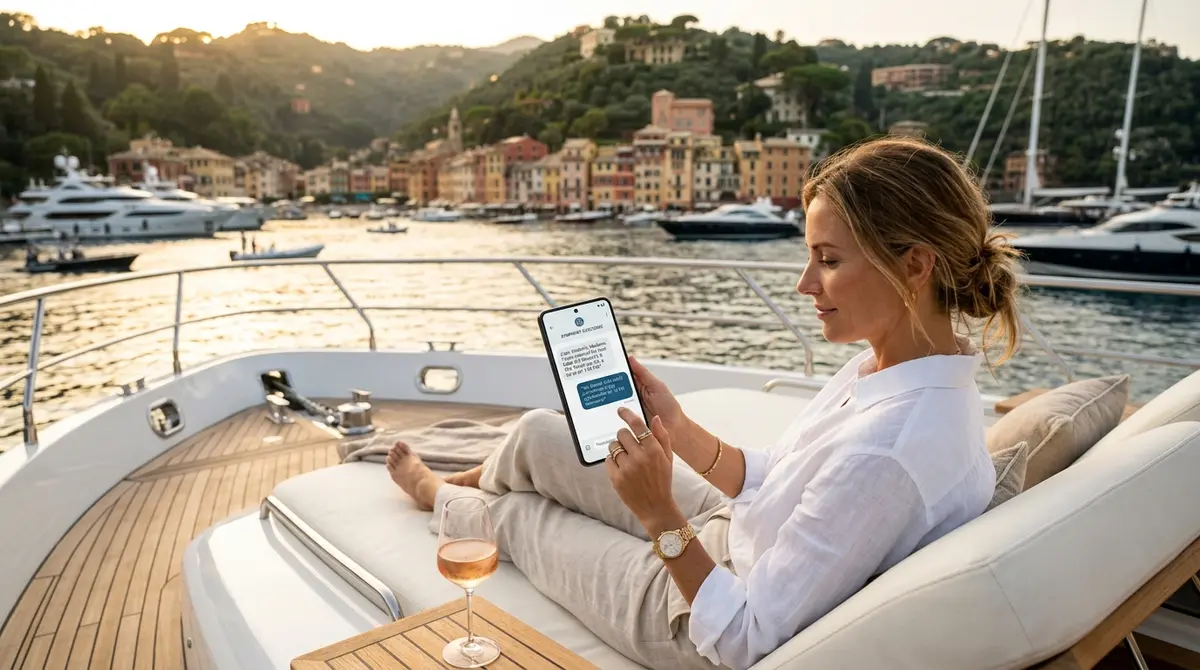
Quick Summary
- ✓Luxury hotels have deployed AI concierge systems that anticipate guest needs, handle requests in real time, and remember preferences across stays — yacht charter has had nothing comparable until now.
- ✓Every major yacht guest app (Charter Guest, YachtEye, Guest Trip) is an information delivery tool — none offer interactive concierge, request handling, or preference persistence across charters.
- ✓AI concierge portals connect the full charter lifecycle: inquiry to preference sheet to onboard experience to post-charter follow-up — ending the fragmentation that costs operators rebookings.
- ✓Guest profiles that persist across charters create a compounding advantage: returning guests feel known before they step aboard, even if the crew has changed.
- ✓Next Yacht Group launched local-first onboard AI in 2026, but guest-facing concierge that bridges pre-charter through post-charter remains an open category.
Last month, a charter broker told me about a guest — a repeat client, third charter in two years — who arrived in Sardinia to find the crew had no idea she was lactose intolerant.
Her preference sheet said it clearly. But it was buried in a PDF email chain from the first booking, attached to a thread that the new captain had never seen. The chef served a cream-based pasta on night one. The guest was polite about it. She also hasn't rebooked.
That preference sheet existed. The information was captured. But it lived in an email attachment on someone else's laptop, and nobody thought to forward it when the crew changed.
This is not a technology problem. It is a continuity problem. And it is the exact problem that AI concierge portals are built to solve.
The Gap Between What Guests Expect and What Yachting Delivers
Your charter guests live in a world where every other luxury service they touch has figured out digital hospitality.
When they check into a Four Seasons, the app already knows their room preference, their pillow type, their preferred morning newspaper. They can message the concierge through Four Seasons Chat — request a dinner reservation, ask about the spa schedule, arrange airport transport — and a real person responds within minutes, backed by AI that routes and prioritizes requests.
The Ritz-Carlton goes further. Their ChatGenie system uses predictive algorithms that analyze guest behavior, weather data, and local events to proactively suggest services before guests ask. A returning guest doesn't need to restate their preferences. The system remembers — and the staff acts on that memory naturally.
These are the brands your charter guests compare you to. Not consciously, maybe. But when they open a 12-page PDF preference sheet that looks like a tax form, when they can't figure out what time the tender is available without finding the bosun, when they have to explain their nut allergy for the third charter in a row — they notice the difference.
And the data backs this up. Hotels deploying AI concierge systems report guest satisfaction increases of up to 25% and front desk inquiry volume drops of nearly 40%. The hospitality industry calls 2025-2026 the "operationalization year" — the moment AI concierge moved from pilot programs to standard infrastructure.
Yachting, meanwhile, is still passing around PDFs.
What Yacht Guest Apps Actually Do Today
If you've looked at the yacht guest app market, you've probably come across the three main players: Charter Guest by SOS, YachtEye, and Guest Trip.
All three are solid products. And all three do essentially the same thing: they digitize the welcome binder.
Charter Guest offers zoomable deck plans, AI-generated destination guides, crew bios, and a safety sign-off feature developed after the Bayesian tragedy — a feature captains requested more than any other. It's well-designed, crew-friendly, and built by people who actually work on yachts.
YachtEye digitizes the guest-facing information layer — crew profiles, menus, wine lists, tender and toy catalogs, daily schedules. It's clean, eco-friendly (no more printing binders), and keeps information current because crew can update it in real time.
Guest Trip focuses on itinerary visualization — shareable, visual trip plans that look good on any device.
Here is what none of them do:
| Capability | Charter Guest | YachtEye | Guest Trip |
|---|---|---|---|
| Guest request submission | No | No | No |
| Preference collection | No | No | No |
| Cross-charter guest profiles | No | No | No |
| AI-powered personalization | No | No | No |
| Real-time crew chat | No | No | No |
The gap is not subtle. Every yacht guest app on the market is a one-way information channel: crew publishes, guest reads. None of them let a guest ask a question, submit a request, or have their preferences remembered for next time.
The concierge layer — the thing that makes Four Seasons Chat feel like talking to a knowledgeable friend instead of reading a manual — does not exist in any yacht-specific product.
What an AI Concierge Actually Changes
An AI concierge is not a chatbot bolted onto a guest app. It is a system that knows context — the vessel, the itinerary, the weather, the destination, and the guest's own preferences — and uses that context to answer questions and fulfill requests intelligently.
Here is the difference in practice.
Without AI concierge: Guest wants to know about snorkeling near the current anchorage. They find a crew member, ask. The crew member checks their phone, maybe consults a guidebook, gives an answer. If it's 2am and the guest is curious, they wait until morning.
With AI concierge: Guest opens the portal on their phone, types: "What's the best snorkeling near our anchorage?" The AI knows the vessel's current position, the local dive sites, today's water conditions, visibility forecasts, and the guest's stated interest in marine life from their preference sheet. It responds with three options, ranked by proximity and conditions, with a note that Site 2 has the turtle nesting the guest mentioned wanting to see.
That is not science fiction. That is what Ritz-Carlton's predictive service algorithms already do for hotel guests — analyzing multiple data sources to surface relevant recommendations at the right moment. The technology exists. It just hasn't been applied to yachting.
Request Handling That Actually Works
The second transformation is request management. Today, guest requests on a charter happen verbally — at dinner, on the sundeck, passing in the corridor. Crew members hold these requests in their heads, sometimes writing them in a notebook, sometimes forgetting.
An AI concierge portal changes the flow:
- Guest submits request — "Can we arrange a beachside dinner tomorrow evening?"
- Crew receives notification — the stew sees it on her device immediately, with the guest name and cabin
- Crew acknowledges — the guest sees "The crew is arranging this for you" in their portal
- Crew delivers — the request is tracked from submission to fulfillment
No request falls through the cracks. No guest has to wonder whether anyone heard them. And at the end of the charter, the operator has a complete record of every request made and fulfilled — data that feeds back into provisioning, crew training, and the guest's persistent profile.
Language That Disappears
Here is a detail that matters more than most operators realize: 72% of luxury guests become dissatisfied with digital systems that feel impersonal or culturally inappropriate.
Your charter guests are international. A family from Munich. A couple from Tokyo. A group from Sao Paulo. They all arrive on the same yacht, and they all need to understand the safety briefing, the daily schedule, and the toy catalog.
Modern AI concierge systems auto-detect language. The German guest sees the portal in German. The Japanese guest sees it in Japanese. The Brazilian guest sees it in Portuguese. No crew member needs to speak all three languages. The system handles it — not with clunky machine translation, but with AI that understands context and delivers fluent, natural-sounding responses.
For charter operators serving international HNWI clientele — and 60% of UHNWIs are now under 50, digitally fluent, and accustomed to apps that speak their language — this is not a luxury feature. It is a baseline expectation.
The Lifecycle Problem Nobody Talks About
The biggest issue in charter guest management is not any single touchpoint. It is the fragmentation between touchpoints.
Think about how the typical charter guest journey works today:
- Inquiry happens in email or through a broker
- Preference sheet is a separate PDF or Google Form, maybe linked from a different email
- Confirmation documents live in yet another email thread
- Onboard information is on a separate app (if digital) or a binder (if paper)
- During-charter requests happen verbally
- Post-charter feedback is a separate survey link, if it happens at all
- Rebooking outreach is a separate CRM workflow
Seven touchpoints. Seven disconnected systems. Zero continuity between them.
The guest's preference sheet exists, but it is not connected to the onboard system. The onboard system knows the vessel, but it does not know the guest's history. The CRM knows the guest booked before, but it does not know what they ate, what they loved, or that their anniversary is next month.
An AI concierge portal connects the full lifecycle:
Inquiry → Preference sheet (smart, pre-filled for returning guests) → Pre-charter portal (destination preview, crew introduction, itinerary exploration) → Onboard concierge (requests, recommendations, real-time updates) → Post-charter (feedback, gratuity, preference update) → Rebooking (profiles persist, preferences remembered)
One system. One guest profile. One continuous thread of context.
This is the model that luxury hotels perfected. The Sage Hospitality approach — systematically gathering and analyzing guest preferences to craft experiences that encourage return visits — does not treat data as marketing material. It treats data as service delivery infrastructure. The Ritz-Carlton's Memory Makers program trains staff to log personal details shared in conversation. A guest who mentions their daughter's graduation during one stay receives a congratulations note on the next.
The yacht equivalent: a guest who mentioned loving Barolo on their last charter finds a bottle waiting in their cabin on the next one, with a note from the chef about the evening's pairing. Not because the crew remembered — because the system remembered, and the crew acted on it.
The AI Concierge Is Not Replacing Your Crew
This is the concern I hear most from captains: "Are you trying to put a robot between me and my guests?"
No. And the luxury hotel industry has already answered this question definitively.
Four Seasons does not position their Chat feature as a chatbot. They position it as technology that connects real people in real time. AI handles routing. AI handles the 2am question about what time breakfast starts. AI handles the translation. But when a guest needs something personal, emotional, or complex — a surprise anniversary dinner, a medical situation, a complaint — a human responds.
The Peninsula Hotels call this "augmented concierge." AI handles the routine. Humans handle the nuanced.
On a yacht, this means:
- AI handles: "What time does the tender go to shore?" / "Is the Wi-Fi password the same as yesterday?" / "What restaurants are within walking distance of the marina?"
- Crew handles: "We'd love a surprise birthday cake for my wife tomorrow" / "The children are nervous about snorkeling — can someone go with them?" / "We want to change the itinerary entirely because my mother isn't feeling well"
The AI makes the crew look exceptional. It handles the logistical noise so the crew can focus on the moments that actually create memories — and rebookings.
The Competitive Window Is Open — But Not For Long
The yacht industry is waking up to this. Next Yacht Group launched its AI-Integrated System at the Fort Lauderdale Boat Show — a local-first AI assistant that runs entirely offline, managing onboard systems from lighting to fuel monitoring. It is a significant step, but it is focused on vessel operations, not guest experience.
The guest-facing AI concierge — the system that bridges pre-charter inquiry through post-charter follow-up — remains wide open. No yacht-specific product has built it. The Hoteza platform serves as the infrastructure layer for hotel concierge experiences — there is no equivalent for yachts.
This is the window. The charter operators who adopt AI concierge portals now will build guest profiles, accumulate preference data, and create a rebooking advantage that compounds with every charter. The operators who wait will spend the next two years watching their competitors deliver experiences they cannot match.
What This Looks Like in Practice
YachtWyse built Wyse-I as an AI concierge embedded directly in the guest portal. It is not a standalone chatbot. It is woven into the charter workflow — from the moment a guest receives their portal invitation to the follow-up after disembarkation.
Before the charter, guests open a branded portal personalized to their vessel, their dates, and their destination. Returning guests see their previous preferences pre-loaded — dietary requirements, beverage choices, activity interests — with the option to update. The AI generates destination previews tailored to their stated interests: if you said you love snorkeling, you see the best dive sites at each anchorage, not a generic Wikipedia summary of the Amalfi Coast.
During the charter, guests interact with Wyse-I naturally. "Can we arrange sunset cocktails on the beach tonight?" The request goes to the crew. The crew acknowledges, arranges, and delivers. The guest sees the status update in their portal. No verbal relay chain. No forgotten request.
"What's the weather looking like for tomorrow's sail to Bonifacio?" Wyse-I knows the itinerary and pulls current forecasts — not a weather app screenshot, but a contextual answer: "The mistral has calmed overnight. The captain has confirmed conditions are good for the crossing. Expect light winds and calm seas, arriving around 3pm."
After the charter, every preference, every request, every piece of feedback feeds into the guest profile. When that guest books again — same operator, different vessel, different crew — the system knows them. The chef knows the Barolo preference. The stew knows the preferred pillow configuration. The captain knows the guest likes early departures and quiet anchorages.
The guest doesn't have to fill out another preference sheet from scratch. They just confirm what's already there.
The Rebooking Advantage
Charter operators spend heavily on acquisition — broker commissions, boat show presence, digital marketing, social media. A single charter lead can cost thousands of dollars to generate.
A returning guest costs almost nothing. They already know you. They already trust you. They've already told their friends.
The operators with 90% rebooking rates are not spending more on marketing. They are spending more on memory. They remember what their guests love. They remember what went wrong. They remember the anniversary, the wine, the daughter's name.
An AI concierge makes that memory systematic instead of accidental. It does not depend on the same crew returning next season. It does not depend on a captain who keeps excellent notes. It works because the system holds the knowledge, and whoever is on the crew next season can deliver against it.
According to CharterWorld's analysis of UHNWI travel trends, 97% of ultra-luxury travelers plan trips specifically to reduce stress. Over 80% plan to maintain or increase travel spending. The demand is there. The question is whether your operation can deliver the personalized, frictionless experience these guests expect from every other luxury brand they touch.
What to Look For in an AI Concierge Platform
If you are evaluating AI concierge solutions for your charter operation, here are the questions that matter:
Does it connect the full lifecycle? A concierge that only works during the charter misses the pre-charter preference capture and the post-charter follow-up that drives rebookings. Look for end-to-end integration.
Does the guest profile persist? If preferences reset with every booking, you are running a form, not a concierge. Returning guests should feel recognized, not interrogated.
Does it work in multiple languages? If you serve international clientele — and most charter operators do — language detection should be automatic, not a manual setting.
Does it integrate with your charter workflow? A standalone concierge app creates another silo. The concierge should connect to your booking system, your provisioning workflow, and your crew operations — so the preference for "no shellfish" flows from the form to the chef without manual forwarding.
Does it augment the crew or replace them? The right answer is augment. The AI should handle information and logistics. The crew should handle relationships and moments. If the platform is designed to minimize crew interaction, it is solving the wrong problem.
Can your crew actually use it? The most sophisticated AI in the world is worthless if your chief stew can't figure out how to respond to a guest request. The crew interface matters as much as the guest interface.
The Bottom Line
The yacht charter industry is two years behind luxury hospitality in guest experience technology. That is not a criticism — it is an opportunity.
The tools exist. The guest expectations exist. The AI infrastructure is proven across thousands of hotel properties worldwide. What has been missing is a platform built specifically for the charter workflow — one that understands the difference between a hotel stay and a charter, between a front desk and a bridge, between a housekeeping request and a provisioning requirement.
The operators who close that gap now will own the guest relationship in a way their competitors cannot match. Not because of the technology itself, but because of what the technology enables: a guest who feels known, remembered, and cared for — every time they step aboard.
That is what rebooking rates are built on. Not yacht specifications. Not pricing. Memory.
YachtWyse's Wyse-I AI concierge is available in the Charter plan. It connects the full guest journey — from inquiry and preference capture through onboard concierge to post-charter follow-up — in a single platform. See how it works →

Written by
YachtWyse Team
Maritime Technology Experts
The YachtWyse team brings decades of combined experience in maritime operations, marine engineering, and software development. We write from real-world experience managing vessels from 30ft cruisers to 100m+ superyachts.
Ready to Simplify Your Yacht Management?
YachtWyse helps owner-operators track maintenance, manage costs, and get AI-powered diagnostic assistance. Start your free trial today.
Request a DemoRelated Articles
Interactive Guest Portals for Crewed Charter
I watched a charter operator lose a $48,000 rebooking because their PDF itinerary couldn't compete with a competitor's branded digital portal. Here's why interactive guest experiences are now table stakes in 2026.
The Complete Guide to Charter Guest Management in 2026
From preference sheets to post-charter follow-ups, learn how top charter operators deliver exceptional guest experiences that drive 90% rebooking rates and five-star reviews.
Charter Revenue Waterfall: True Profitability
I learned the hard way that a $25,000 charter week doesn't mean $25,000 profit. Here's how to calculate your real per-charter profitability using revenue waterfall analysis.