Marine Equipment Tracking Software (2026)
Quick Summary
- ✓Untracked equipment is the leading cause of avoidable survey deficiencies and mid-charter breakdowns on superyachts
- ✓New SOLAS lifting appliance regulations effective January 2026 require documented registers and five-year load testing cycles
- ✓AI-powered tracking correlates equipment age, operating hours, and failure history to predict replacements before breakdowns occur
- ✓Spare parts visibility across multiple storage locations eliminates redundant purchasing and emergency freight costs
- ✓The ROI case is straightforward: one prevented emergency refit event covers a decade of software subscriptions
In the sprawling refit yards of Tuzla, where cranes swing above partially stripped hulls and the air carries the sharp scent of marine epoxy, a chief engineer aboard a 55-meter Benetti recently recounted a scenario that has become uncomfortably familiar in the superyacht sector. During a routine class renewal survey, the attending Lloyd's surveyor requested documentation for a hydraulic power pack installed during a previous refit cycle in Genoa three years earlier. The engineer knew the unit existed. He could walk the surveyor to its location in the lazarette. What he could not produce was a complete record of its manufacturer specifications, installation date, warranty status, or the service history that had accumulated since installation.
The resulting deficiency finding delayed the vessel's return to operational status by eleven days. The owner absorbed EUR 84,000 in additional yard costs, crew expenses, and a missed charter departure from Bodrum. The hydraulic unit itself was functioning perfectly.
This is the central paradox of marine equipment management aboard large yachts in 2026: the machinery works, but the documentation surrounding it does not. And as regulatory frameworks tighten, class societies sharpen their scrutiny, and vessel complexity continues to escalate, the gap between what is installed aboard and what is properly tracked has become one of the most expensive blind spots in superyacht operations.
The Equipment Visibility Problem on Modern Superyachts
A 60-meter motor yacht built in the last decade carries between 800 and 1,200 discrete pieces of trackable equipment. This figure encompasses main propulsion components, generator sets, HVAC compressors, watermakers, stabilizer systems, navigation electronics, communication arrays, deck machinery, tender garage hydraulics, safety equipment, galley appliances, and hundreds of ancillary items ranging from sewage treatment plants to wine cellar climate units.
Each of these assets has a manufacturer, a model number, a serial number, installation date, warranty terms, recommended service intervals, and a growing history of maintenance events. Many have associated spare parts that may be stored in the engine room, the bosun's locker, a shore-based warehouse in Palma de Mallorca, or a management company's logistics center in Fort Lauderdale.
Captain Sarah Lindgren, who manages technical operations for a fleet of three vessels ranging from 42 to 68 meters, describes the challenge in operational terms. When an ETO reports a fault on a Kohler generator control board, the first question is whether there is a spare aboard. The second question is where it is stored. The third question is whether the spare is compatible with the specific firmware revision of the installed unit. Without a centralized equipment register, answering these questions requires phone calls, emails, photographs of nameplates, and often a physical search through multiple storage compartments.
This equipment visibility gap compounds with every crew rotation. Knowledge of what is aboard, where spares are stored, and which units have been serviced recently resides in the memory of individual crew members rather than in a system that persists across rotational changes. When a chief engineer departs after a two-year rotation, a significant portion of the vessel's institutional knowledge departs with them.
Regulatory Pressure Is Accelerating
The regulatory landscape around marine equipment documentation has tightened considerably heading into 2026. The most significant development is SOLAS Regulation II-1/3-13, which establishes mandatory safety requirements for onboard lifting appliances and their associated loose gear. Effective January 1, 2026, this regulation requires annual thorough examination and load testing on a five-year cycle for all lifting equipment aboard.
For superyachts, the implications extend beyond the crane on the foredeck. Passerelles with integrated hoists, tender davits, and even certain swimming platform mechanisms fall within the scope of these requirements. Each piece of equipment must be permanently marked with its Safe Working Load and recorded in the Register of Ship's Lifting Appliances and Cargo Handling Gear. Existing equipment installed before the effective date must be tested and documented by the first renewal survey on or after January 2026, as outlined in IMO supporting guidelines MSC.1/Circ.1663.
Classification societies have responded accordingly. Bureau Veritas, DNV, and Lloyd's Register have all updated their survey protocols to include more granular equipment documentation requirements. Surveyors now expect not only that equipment is maintained but that vessels can demonstrate a complete chain of custody from installation through every subsequent service event.
For captains and fleet managers relying on spreadsheets, email threads, or the institutional memory of their engineering department, these requirements represent a significant compliance risk. A vessel cannot produce documentation it never created, and retroactive record-building rarely withstands survey scrutiny.
The ISM Code further reinforces this requirement. Element 10 of the ISM Code mandates that maintenance of the ship and equipment shall be carried out in accordance with relevant regulations and with any additional requirements established by the company. Digital equipment registers that feed directly into ISM-compliant safety management systems are becoming less of a convenience and more of an operational necessity.
What Marine Equipment Tracking Software Actually Does
Marine equipment tracking software, at its core, maintains a centralized digital register of every asset aboard a vessel. But the distinction between a basic asset list and a genuine equipment management platform lies in the depth of integration and the intelligence layered on top of the raw data.
The Equipment Register
The foundation is a hierarchical equipment database organized by system, location, and criticality. Each entry captures manufacturer details, model and serial numbers, installation date, warranty expiration, and links to associated documentation such as operation manuals, technical bulletins, and certification records. The register serves as a single source of truth that persists across crew rotations, management company transitions, and ownership changes.
Manufacturer Maintenance Schedules
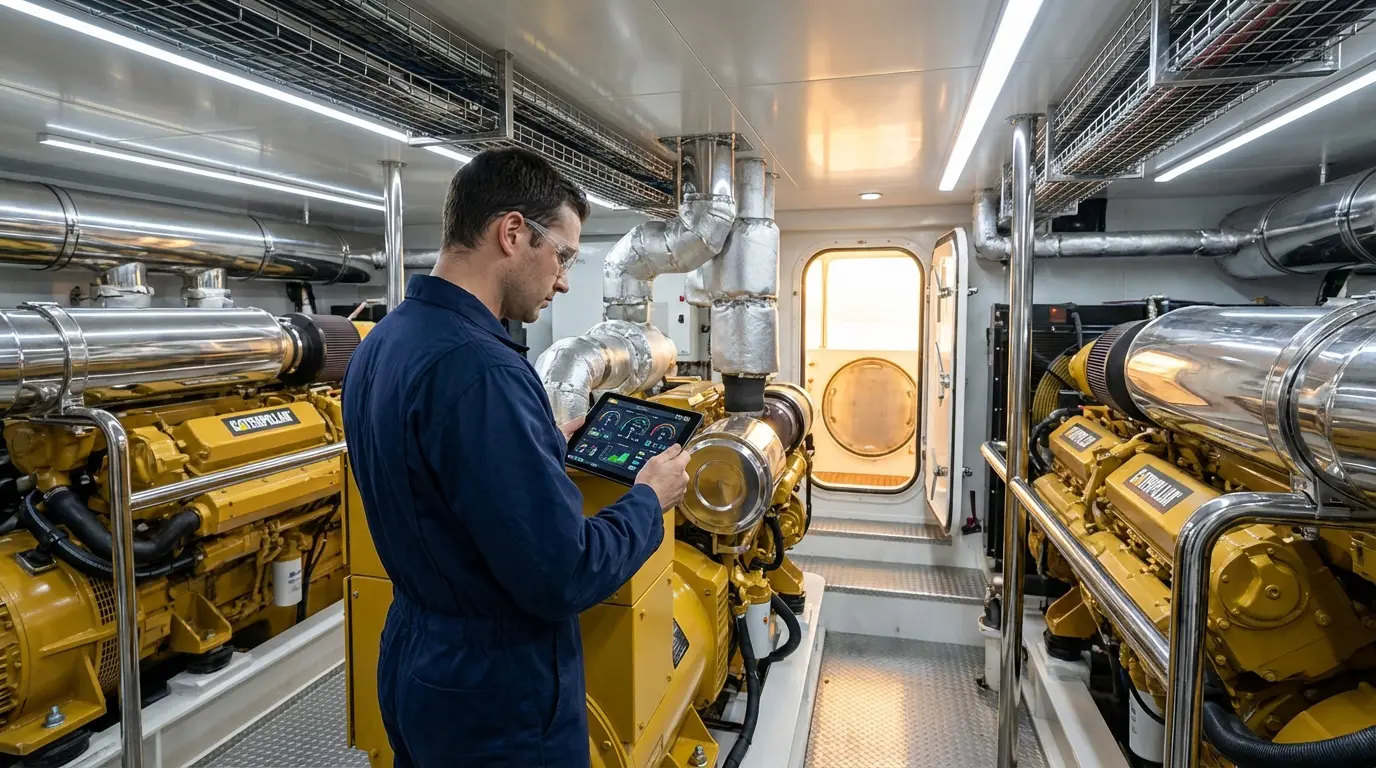
Effective platforms import or reference manufacturer-recommended service intervals and integrate them with the vessel's planned maintenance system. When a Caterpillar C32 reaches its 4,000-hour service interval, the system generates the corresponding work order with the correct parts list, fluid specifications, and procedural references. This eliminates the common failure mode where generic maintenance schedules diverge from manufacturer requirements over time.
Spare Parts Inventory
Equipment tracking becomes substantially more valuable when connected to spare parts management. A properly configured system knows not only what equipment is installed but what spares are available, where they are stored, and what minimum stock levels should be maintained. When inventory drops below the reorder threshold, the system alerts the responsible crew member or purchasing department. For fleet operations managing multiple vessels, spare parts visibility across the fleet can eliminate redundant purchasing entirely.
Certificate and Warranty Management
Every piece of safety equipment, from EPIRB batteries to life raft certification, operates on an expiry cycle. Equipment tracking platforms with automated alert systems prevent the silent lapse of certifications that trigger survey deficiencies. Warranty tracking ensures that equipment failures within coverage periods are directed to the manufacturer rather than absorbed as operational costs.
AI-Powered Diagnostics and Predictions
The most significant advancement in marine equipment tracking is the application of artificial intelligence to equipment lifecycle data. Platforms like YachtWyse analyze patterns across equipment age, operating hours, service history, environmental conditions, and component relationships to predict when equipment is likely to require intervention.
Rather than replacing a watermaker membrane on a fixed 18-month cycle regardless of actual condition, an AI-driven system correlates feed water quality, production output trends, differential pressure readings, and historical failure data to recommend replacement when the data indicates genuine degradation. This approach reduces unnecessary replacements while preventing the unplanned failures that disrupt charter schedules and generate emergency procurement costs.
Evaluating Equipment Tracking Platforms in 2026
The superyacht management software market offers several platforms with equipment tracking capabilities, each with distinct strengths and architectural approaches.
Established Platforms
Seahub, trusted across both the superyacht and commercial marine sectors, offers a modular equipment management system with lifecycle tracking, warranty management, and integration with its maintenance and inventory modules. The platform's strength lies in its breadth of deployment across vessel types and its established relationships with fleet management companies.
Sealogical, approaching its 23rd year in the market, provides equipment management within its broader ISM compliance and crew management framework. Its heritage in regulatory compliance makes it particularly strong for vessels requiring integrated safety management and equipment documentation.
IDEA Yacht, celebrating its 25th anniversary in 2026, delivers inventory and stock control capabilities alongside equipment registers, with particular strength in purchasing workflow integration. Its longevity in the market means many yards and management companies are familiar with its data structures and reporting formats.
YMS 360 differentiates with department-specific inventory forms and a scanning and labelling system that addresses the physical logistics of spare parts management across multiple storage locations aboard large vessels.
The AI-Native Approach
YachtWyse represents a newer architectural philosophy that treats equipment tracking not as a static register but as a living dataset that becomes more valuable over time. By applying AI analysis to equipment histories, operating patterns, and cross-fleet data, the platform generates predictive insights that move equipment management from reactive documentation to proactive lifecycle optimization.
The platform's AI diagnostic assistant allows engineering crew to describe equipment symptoms in plain language and receive context-aware troubleshooting guidance drawn from the vessel's specific equipment configuration and maintenance history. For a chief engineer troubleshooting a stabilizer fault at 0200 during an Atlantic crossing, the difference between searching through paper manuals and querying an AI system that knows the vessel's exact equipment configuration is measured in hours of downtime avoided.
The Financial Case for Equipment Tracking
The economics of marine equipment tracking software are driven by the cost of the problems it prevents rather than the efficiency gains it delivers, though both contribute to the return on investment.
Emergency Procurement
When a critical component fails without a spare aboard, the resulting emergency procurement chain involves identification, sourcing, expedited shipping, customs clearance (often across jurisdictions), and potentially diverting the vessel to a port where the part can be delivered. Captain Marcus Hartwell, who oversees operations for a 72-meter Lurssen, estimates that emergency part procurement runs three to five times the cost of planned purchasing when factoring in express freight, customs brokerage, and the operational disruption of schedule changes.
A digital spare parts system with reorder alerts and cross-location visibility addresses this failure mode directly. If the part exists in the fleet's shore inventory in Barcelona, it can be dispatched by scheduled courier rather than emergency freight. If it needs to be ordered, lead time awareness allows for standard shipping rather than air freight.
Survey Delays
As illustrated in the opening scenario, the cost of survey delays caused by inadequate equipment documentation extends well beyond the survey fee itself. Yard day rates for vessels in the 50-80 meter range commonly exceed EUR 5,000 per day in major refit hubs. Crew costs continue regardless. Charter commitments may be jeopardized. And the reputational impact on management companies can affect client retention.
A vessel that presents a surveyor with a complete digital equipment register, linked maintenance histories, and current certification status eliminates the documentation-related portion of survey risk entirely.
Refit Cost Control
The yacht maintenance and refit market continues its expansion, with projections indicating growth from USD 2.9 billion in 2026 toward USD 4.6 billion by 2030. Within this market, a significant cost driver is the discovery of equipment issues during refit that could have been addressed during normal operational maintenance windows. Vessels entering major refits with complete equipment histories and accurately tracked service intervals avoid the scope creep that inflates refit budgets by 30 to 50 percent above initial estimates.
The Annual Calculation
For a 50-meter vessel, comprehensive equipment tracking software typically costs between EUR 2,000 and EUR 6,000 annually depending on the platform and modules selected. A single avoided emergency procurement event, survey deficiency, or unplanned refit extension recovers multiple years of subscription cost. When amortized across the operational savings in purchasing efficiency, reduced inventory duplication, and crew time recovered from manual record-keeping, the net cost of operating without equipment tracking software substantially exceeds the cost of implementing it.
Implementation: From Spreadsheet to System
The transition from informal equipment tracking to a structured digital platform follows a predictable pattern across most superyacht operations.
Phase One: Equipment Audit (Weeks One Through Three)
The engineering department conducts a systematic walk-through of every space aboard, documenting equipment with photographs, nameplate data, and location references. This process is most efficiently conducted during a yard period or winter layup when access to all spaces is unrestricted. The resulting inventory becomes the foundation of the digital register.
Modern platforms like YachtWyse allow crew to build this inventory incrementally using mobile devices, capturing equipment data and photographs directly in the engine room, lazarette, or bridge rather than transcribing from clipboards after the fact.
Phase Two: Spare Parts Reconciliation (Weeks Two Through Four)
Concurrent with the equipment audit, the deck and engineering departments inventory all spare parts across every storage location. Each spare is linked to its parent equipment, creating the relationship between the asset register and the inventory system. This phase often reveals both gaps (critical spares that are not aboard) and surplus (duplicate parts ordered by successive crew rotations who could not verify existing stock).
Phase Three: Schedule Integration (Weeks Three Through Five)
Manufacturer maintenance schedules are loaded or configured for each piece of tracked equipment. Running hour meters are recorded as baseline values. Certificate expiry dates are entered with appropriate lead-time alerts. The planned maintenance system begins generating work orders based on actual equipment data rather than generic templates.
Phase Four: Operational Adoption (Ongoing)
The system enters daily use as crew log maintenance completions, update spare parts consumption, and record equipment readings against the digital register. Over time, the accumulated data enables increasingly accurate predictions, more efficient purchasing, and a continuously improving documentation posture for surveys and audits.
Crew Adoption and the Mobile-First Imperative
The most sophisticated equipment tracking platform delivers no value if the engineering team does not use it consistently. This reality has driven a fundamental shift in how marine software is designed.
Platforms that require desktop access through a ship's office workstation face an inherent adoption barrier. Equipment maintenance happens in the engine room, on deck, and in the lazarette. A system that requires the engineer to complete work physically, then return to a computer to log it, introduces a friction point where data quality degrades.
Mobile-first platforms that function on phones and tablets in the spaces where work actually occurs remove this barrier. Offline capability is essential for vessels operating beyond reliable connectivity. The ability to photograph a nameplate, scan a barcode, or log a maintenance completion on a tablet while standing in front of the equipment produces fundamentally better data than any retrospective documentation process.
For fleet operators and enterprise management companies overseeing multiple vessels, crew adoption rates directly determine the quality of cross-fleet analytics. When equipment data is consistently captured across all vessels in a fleet, patterns emerge that are invisible at the individual vessel level: failure rates by manufacturer, component lifespans by operating profile, and spare parts consumption trends that inform fleet-wide purchasing strategy.
What to Look for in 2026
The marine equipment tracking landscape is maturing rapidly. When evaluating platforms for superyacht operations, the following capabilities distinguish comprehensive solutions from basic asset lists.
Hierarchical equipment structures that reflect the actual system architecture of the vessel, with parent-child relationships between systems, sub-systems, and components.
Integrated spare parts management with multi-location inventory tracking, reorder alerts, and purchasing workflow support.
Manufacturer schedule integration that maintains alignment between service intervals and actual equipment configurations rather than relying on generic templates.
Certificate and warranty lifecycle management with automated alerts calibrated to provide sufficient lead time for renewal or replacement.
AI-powered analytics that convert equipment history into predictive insights, identifying components trending toward failure before they generate unplanned downtime.
Mobile-first architecture with offline capability, ensuring that data capture happens where equipment exists rather than where computers are located.
Survey-ready reporting that produces the documentation packages class surveyors and flag state inspectors require, formatted to their expectations and complete with audit trails.
Fleet-level visibility for management companies and multi-vessel owners, enabling cross-fleet equipment analysis and centralized procurement.
The Direction of Travel
The superyacht industry is moving, albeit gradually, from a culture of documentation as obligation toward documentation as operational intelligence. Equipment tracking software sits at the center of this transition. When every asset aboard is digitally registered, linked to its maintenance history, connected to its spare parts inventory, and monitored by AI systems that learn from accumulated operational data, the result is not merely better paperwork. It is a fundamentally different operational posture: one that anticipates failures, optimizes purchasing, streamlines surveys, and preserves institutional knowledge independent of any individual crew member.
For captains, chief engineers, and fleet managers navigating the increasingly complex intersection of vessel operations, regulatory compliance, and financial accountability, marine equipment tracking software has moved beyond the category of operational convenience. In 2026, it is infrastructure.
Ready to see how AI-powered equipment tracking transforms your vessel operations? Explore YachtWyse for enterprise fleets or request a demo to see the platform in action.
Related Articles
- Best Superyacht PMS Software in 2026
- ISM Compliance Software for Superyachts
- Flag State Survey Prep: Digital PMS Cuts Deficiencies
- Paper Logbooks to AI: Modernize Yacht Records
- How AI Is Transforming Superyacht Engineering
Sources
- Seahub Equipment Management Module
- Sealogical Yacht Management Software
- IDEA Yacht Management Software
- YMS 360 Yacht Management Software
- Bureau Veritas - New SOLAS Requirements for Lifting Appliances January 2026
- DNV - New Safety Requirements for Onboard Lifting Appliances from January 2026
- IMO 2025-2026 Regulatory Updates - RMS Ship Repair
- Yacht Maintenance and Refit Market Analysis - Future Market Insights
- Marine Cloud Planned Maintenance
- Vessel Vanguard Maintenance Tracking

Written by
YachtWyse Team
Maritime Technology Experts
The YachtWyse team brings decades of combined experience in maritime operations, marine engineering, and software development. We write from real-world experience managing vessels from 30ft cruisers to 100m+ superyachts.
Ready to Simplify Your Yacht Management?
YachtWyse helps owner-operators track maintenance, manage costs, and get AI-powered diagnostic assistance. Start your free trial today.
Request a DemoRelated Articles
Best Superyacht PMS Software in 2026
A chief engineer's honest comparison of the best planned maintenance systems for superyachts in 2026, from Seahub to YachtWyse and beyond.
Paper Logbooks to AI: Modernize Yacht Records
How superyacht captains and engineers are replacing paper logbooks and spreadsheets with AI-powered digital maintenance records that prevent failures.
The Complete Guide to Marine Parts Management: From Barcode to Bolt
How yacht owners and captains can organize marine parts with barcode scanning, OEM cross-references, bulk import, and smart shopping lists — ending the shoebox-of-receipts era for good.